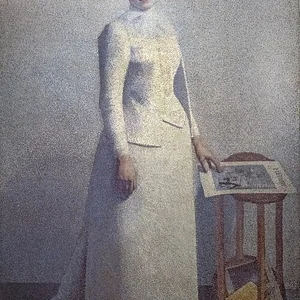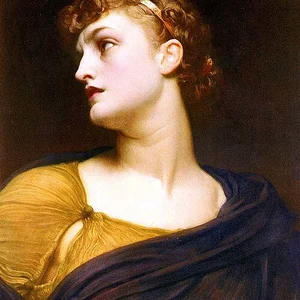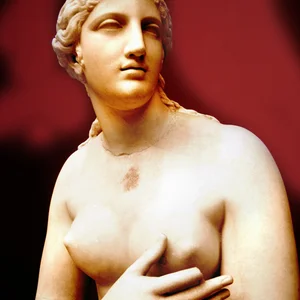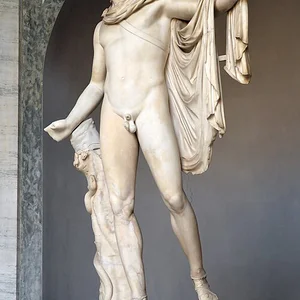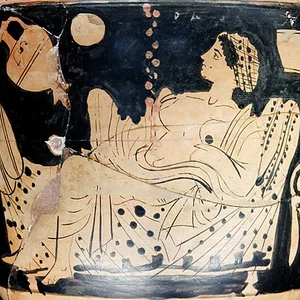

Danaë is a princess of Argos, daughter of King Acrisius. Imprisoned by her father in a bronze chamber to prevent a prophecy, she is seduced by Zeus transformed into a shower of gold and gives birth to Perseus, the hero who will kill Medusa.
Danaë
Danaë
9 min read
Frequently asked questions
Key Facts
- Only daughter of Acrisius, king of Argos, and Eurydice
- Imprisoned in an underground bronze chamber to thwart the oracle foretelling that she would bear the murderer of her father
- Seduced by Zeus metamorphosed into a shower of gold, she conceives Perseus
- Cast adrift at sea with her son in a chest, she washes ashore on the island of Seriphos
- Perseus fulfills the prophecy by accidentally killing Acrisius during games
Works & Achievements
One of the most beautiful fragments of ancient Greek lyric poetry: Danaë, in the chest at sea, sings a lullaby to the infant Perseus. This poem is considered a masterpiece of archaic Greek lyric.
Sophocles wrote a tragedy about Danaë, of which only fragments remain. It attests to the dramatic importance of the character in classical Athenian theater.
Titian painted at least six versions of the subject for the greatest courts of Europe (Farnese, Philip II of Spain). These paintings, showing Danaë reclining under the golden rain, are among the most famous works of the Italian Renaissance.
Rembrandt paints Danaë in a luminous moment of expectation, welcoming the divine light with an open-armed gesture. This painting, housed in the Hermitage Museum in Saint Petersburg, was vandalized in 1985 and meticulously restored.
A symbolist and sensual version of the myth by Klimt, depicting Danaë asleep in a golden circular composition characteristic of his Art Nouveau style. The work perfectly illustrates the late 19th-century fascination with myths of divine fecundity.
The most complete mythographic text on Danaë and Perseus, compiling all versions of the Argive heroic myth. A reference source for historians and educators since the Renaissance.
Anecdotes
The oracle at Delphi predicted to King Acrisius of Argos that his own grandson would kill him. Terrified by this prophecy, he built an underground chamber lined with bronze and imprisoned his daughter Danaë there so she could never have a child. This decision perfectly illustrates the Greek belief that no one can escape their fate.
Zeus, struck by the beauty of the imprisoned Danaë, transformed himself into a shower of gold to seep through the roof of the tower and join the young woman. This divine metamorphosis gave birth to Perseus, one of the greatest Greek heroes — proving that no human wall can withstand the will of the gods.
When Acrisius discovered that Danaë had given birth to a son, he refused to believe that the father was Zeus. Rather than killing them directly — for fear of divine retribution — he had Danaë and the infant Perseus locked in a wooden chest (larnax) and thrown into the sea, leaving the waves to decide their fate.
The chest drifted to the island of Seriphos, where a fisherman named Dictys rescued them. His brother, King Polydectes, fell in love with Danaë and tried to force her to marry him. It was precisely to protect his mother that Perseus accepted the supposedly impossible mission of retrieving the head of Medusa.
The prophecy was fulfilled despite all of Acrisius's efforts to avoid it: during athletic games at Larissa, Perseus threw a discus that veered off course and accidentally struck an old man in the stands. That man was Acrisius himself, who had fled all the way to Thessaly to escape his fate.
Primary Sources
Danaë, carried by the wind in the deep night, on the sea with rustling waves, in a painted chest, was seized with anguish. She placed her hands around Perseus and said: 'O my child, what distress is mine! You sleep a sweet infant sleep…'
An oracle had foretold to Acrisius that he would die at the hand of Danaë's son. Fearing this oracle, Acrisius built a bronze chamber underground and imprisoned Danaë there. But Zeus, in love with her, united with her by turning into a shower of gold that poured through the roof.
Perseus, who cut off the head of the snake-haired Gorgon, born of Zeus and Danaë of the beautiful golden hair, fulfilling the divine oracle despite the wiles of mortals.
Inclusam Danaen turris aenea robustaeque fores et vigilum canum tristes excubiae munierant satis — The bronze tower, the oak doors, and the grim watch of vigilant dogs had well guarded imprisoned Danaë… if Jupiter had not mocked Acrisius.
Jupiter turned into a shower of gold to deceive Danaë, whose stern father had ordered her imprisonment in a bronze tower, thus seeking to defy the will of the immortal gods.
Key Places
Royal city where Danaë is a princess, daughter of King Acrisius. Here the bronze tower was built and the first part of the myth unfolds. Argos is one of the oldest cities in Greek mythology.
Aegean island where the chest carrying Danaë and Perseus washed ashore. Here Perseus grew up and Danaë was coveted by King Polydectes, before being freed by her victorious son.
Place where the fatal prophecy to Acrisius was delivered by the oracle of Apollo. Although Danaë is not present, it is the oracle of Delphi that sets off the entire chain of events of her destiny.
Greek city to which Acrisius fled to try to escape the prophecy. It was there that Perseus accidentally killed him during athletic games, fulfilling the foretold fate despite himself.
Maritime space over which the chest carrying Danaë and Perseus drifted. The sea, in this myth, plays the role of a passage between two lives: from the royal prison of Argos to the saving exile of Serifos.
Typical Objects

Mythical prison built by Acrisius to prevent Danaë from having children. This enclosed space is the central symbol of the myth, representing the vanity of human attempts to thwart fate.

Divine form taken by Zeus to visit Danaë in her prison. This attribute symbolizes both divine omnipotence and miraculous fertility; it is the most represented iconographic element in art devoted to Danaë.

Wooden chest in which Acrisius imprisoned Danaë and the infant Perseus before casting them into the sea. This chest, halfway between coffin and cradle, is at the heart of the famous poem by Simonides of Ceos.

In ancient and Renaissance depictions, Danaë is often shown gathering the golden shower in her veil or open lap. This attribute emphasizes her role as a receptacle of the divine, consenting to Zeus.

Weaving tools, typical activity of noble Greek women in seclusion. In her tower, Danaë spent her time spinning and weaving, an aristocratic practice and symbol of chastity in Greek culture.

Head ornament symbolizing Danaë's rank as princess. It reminds us that she is not a mere captive but the heir to a royal lineage, which explains the interest of both gods and kings in her.
School Curriculum
Vocabulary & Tags
Key Vocabulary
Tags
Daily Life
Morning
In her bronze tower without windows on the world, Danaë awakens in a filtered, constant light. Her nurse, the only human presence allowed near her, brings her the morning meal: barley bread, cheese, and figs. She begins the day by praying to Hera and Artemis, goddesses of women.
Afternoon
In the afternoon, Danaë occupies herself with weaving and embroidery, aristocratic activities imposed on every young woman of good birth in ancient Greece. Cut off from gymnasiums, marketplaces, and religious festivals, she lives in suspended time, far from the rhythms of the city of Argos.
Evening
In the evening, after a simple meal shared with her nurse, Danaë is left to solitude and her thoughts in her closed chamber. She may sing to herself, weep over her isolation, or ponder her condition as a princess sacrificed to fate: a noble existence in appearance, but a prison in reality.
Food
Danaë enjoys a Greek aristocratic diet — wheat bread, olives, sheep's cheese, raisins, and dried figs — brought regularly by her nurse. She drinks wine mixed with water according to Greek custom (symposion in domestic form), a diet suitable for her rank but lacking the variety of a royal banquet.
Clothing
Danaë wears the white linen peplos with fine embroidery, fastened by golden fibulae at the shoulders, typical attire for young noblewomen of archaic Greece. Her dark hair is bound with a golden diadem or a colored cloth taenia. Her laced sandals and gold bracelets constantly remind her of her princely rank, even in captivity.
Housing
Her dwelling is the bronze tower (or underground chamber, depending on the version) ordered by Acrisius: an architecturally elaborate space with polished bronze walls, but hermetically sealed from the outside. Comfortable as befits a princess, this gilded prison lacks nothing except freedom. After her rescue, she will live in the house of Dictys on the island of Seriphos, simple but open to the sea and sky.
Historical Timeline
Period Vocabulary
Visual Style
Un style qui marie la peinture grecque à figures rouges et la grande peinture Renaissance : teintes ocres et bronze, lumière dorée divine tombant dans un espace clos, lignes élégantes et drapés de lin blanc.
Sound Ambience
De la chambre close et résonnante d'Argos aux côtes rocheuses de Sériphos, l'univers sonore de Danaé oscille entre le silence de l'emprisonnement, le tintement doré du divin et le ressac libérateur de la mer Égée.
Liens externes & ressources
Références
Œuvres
Fragment 543 PMG — Simonide de Céos
Ve siècle av. J.-C.
Danaé — tragédie perdue de Sophocle
Ve siècle av. J.-C.
Danaé — Le Titien (plusieurs versions)
1544-1560
Danaé — Rembrandt van Rijn
1636
Danaé — Gustav Klimt
1907
Bibliothèque (Livre II) — Apollodore
IIe siècle apr. J.-C.