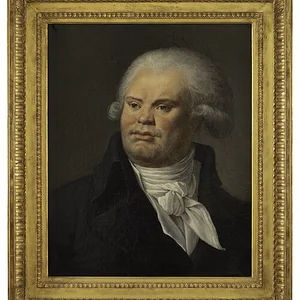

French lawyer and politician (1759–1794), Danton is a major figure of the French Revolution. Known for his eloquence and charisma, he played a key role in revolutionary events before being executed during the Terror.
Danton(1759 — 1794)
Georges Jacques Danton
France
6 min read
Frequently asked questions
Famous Quotes
« We need audacity, and yet more audacity, and always audacity!»
« The revolution devours its children.»
Key Facts
- 1789: Actively participates in the events of the French Revolution and becomes Minister of Justice in 1792
- September 1792: Plays an important role during the September Massacres as a minister
- 1793: An influential member of the Committee of Public Safety, he advocates for moderation in the face of revolutionary radicalization
- March 1794: Arrested along with the Dantonists, accused of corruption and excessive leniency
- April 5, 1794: Executed by guillotine, a victim of the Terror he had helped to unleash
Works & Achievements
Danton was the initiator of the creation of the Revolutionary Tribunal, intended to judge the enemies of the Revolution, an institution that would ultimately condemn him.
Danton helped found this executive body tasked with defending the Republic, threatened by wars and internal insurrections. He was its first president.
This celebrated speech mobilized the nation against the Prussian invasion and became a symbol of revolutionary patriotic resistance.
Danton led alongside Desmoulins the Indulgents movement, demanding an end to the Terror and a return to political moderation.
As a member of the Committee of Public Safety, Danton attempted secret talks to end the war with certain powers allied against France.
Anecdotes
Danton was terribly disfigured in his childhood: he was gored by a bull, trampled by pigs, and nearly drowned. His face bore the scars of these accidents, giving him an imposing appearance that his political adversaries were quick to mock.
On September 2, 1792, as Prussian armies were marching on Paris, Danton delivered his famous speech before the Legislative Assembly: "Boldness, more boldness, always boldness, and France is saved!" This phrase became one of the most celebrated utterances of the Revolution.
On the cart taking him to the scaffold on April 5, 1794, Danton is said to have called out to the executioner Sanson: "Show my head to the people, it is worth seeing." This remark illustrates the courage and pride that characterized him until his final moments.
Danton married Louise Gély, aged sixteen, as his second wife, only a few months after the death of his first wife Gabrielle. To obtain the consent of the young woman's father, a devout Catholic, he agreed to a clandestine religious ceremony — in the midst of the revolutionary de-Christianization movement.
During his trial before the Revolutionary Tribunal in April 1794, Danton defended himself with such vehemence that his voice could be heard as far as the banks of the Seine. The tribunal had to pass a special decree to silence him and condemn him before he could finish his defense.
Primary Sources
We need audacity, more audacity, always audacity, and France is saved!
Let us be terrible so as to spare the people from being so. Let us organize a tribunal, not a good one — that is pointless — but the least bad one possible.
Show my head to the people, it is worth seeing.
I am Danton, well enough known in the Revolution. I am thirty-four years old. My home will soon be nothingness, but my name will live in the Pantheon of history.
Key Places
Danton's birthplace in Champagne, where he grew up in a lower middle-class family. He kept land there and returned regularly.
The Parisian district where Danton lived and was politically active. The Cordeliers convent housed the political club of which he was the charismatic leader.
Meeting place of the National Convention where Danton delivered his most celebrated speeches, notably that of September 2, 1792.
The site where Danton was guillotined on April 5, 1794. This square was where many condemned of the Terror were executed.
Prison where Danton was held before his trial before the Revolutionary Tribunal in April 1794.
Typical Objects

Danton was a lawyer at the Paris Parlement. His black robe symbolized his legal training, which served him well during his great revolutionary speeches.

A badge worn by revolutionary patriots, the blue-white-red cockade was a compulsory symbol for every committed citizen like Danton.

The wooden rostrum of the Manège hall, then of the Tuileries, from which Danton delivered his fiery speeches that galvanized the Assembly.

As Minister of Justice after 10 August 1792, Danton held the great seal of the Republic, symbol of judicial authority.

A red cap symbolizing liberty, worn by the sans-culottes. Danton, close to the Parisian people, encountered this revolutionary emblem on a daily basis.

His friend Camille Desmoulins published Le Vieux Cordelier, a newspaper that echoed Danton's calls for clemency against the Terror.
School Curriculum
Vocabulary & Tags
Key Vocabulary
Tags
Époque
Concept
Daily Life
Morning
Danton rose relatively late for a politician. He had a hearty breakfast at home, in his apartment on the Cour du Commerce-Saint-André, near the Cordeliers district. He would read the day's newspapers and receive visitors and political allies from early in the morning.
Afternoon
The afternoon was devoted to sessions of the National Convention or the Committee of Public Safety. Danton delivered his speeches and took part in debates there. He also frequented political clubs, notably the Club des Cordeliers and occasionally the Club des Jacobins.
Evening
In the evening, Danton enjoyed hosting guests at his home or dining in the restaurants and cafés of the Palais-Royal with political friends such as Camille Desmoulins and Fabre d'Églantine. These suppers were occasions for strategic discussions and convivial gatherings.
Food
Danton was known for his robust appetite. He enjoyed fine food: roasted meats, pâtés, cheeses, and Champagne wines from his home region. Meals were generous, in the manner of the Parisian bourgeoisie of the time.
Clothing
Danton wore the typical dress of the revolutionary bourgeois: dark frock coat, waistcoat, breeches, stockings, and buckled shoes. He sported a white muslin cravat and the tricolor cockade. His attire remained sober yet neat, far from the rags of the sans-culottes.
Housing
Danton lived in an apartment on the Cour du Commerce-Saint-André, in the Cordeliers district of Paris. He also owned a country house in Arcis-sur-Aube, where he liked to retreat to enjoy nature and time with his family.
Historical Timeline
Period Vocabulary
Visual Style
Style néoclassique dramatique inspiré de la peinture de David, avec des clairs-obscurs prononcés, l'architecture imposante du Paris révolutionnaire et l'énergie baroque des assemblées tumultueuses.
Sound Ambience
L'atmosphère sonore du Paris révolutionnaire : foules agitées, tambours militaires, voix puissantes résonnant dans les assemblées, cloches et cris de marchands de journaux dans les rues pavées.
Liens externes & ressources
Références
Œuvres
Organisation du Tribunal révolutionnaire
10 mars 1793
Création du Comité de salut public
6 avril 1793
Discours pour la levée en masse
2 septembre 1792
Politique de clémence (Indulgents)
Hiver 1793-1794
Négociations diplomatiques avec les puissances européennes
1793