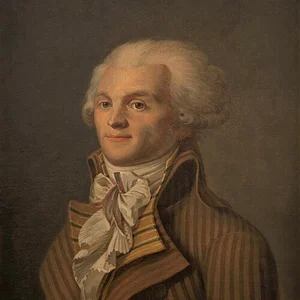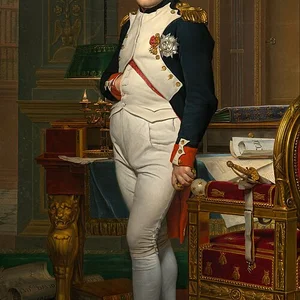

Napoleon Bonaparte (1769-1821) was a French military leader and statesman who seized power in 1799 and proclaimed himself Emperor in 1804. He transformed France and Europe through his reforms and military campaigns, most notably by establishing the Civil Code, which modernized the French legal system.
Napoleon Bonaparte(1769 — 1821)
Napoleon I
France
8 min read
Frequently asked questions
Famous Quotes
« Imagination rules the world.»
« I was born to command.»
« A man without ambition is a man without strength.»
Key Facts
- 1799: Coup of 18 Brumaire, becomes Consul of the French Republic
- 1804: Proclaims himself Emperor of the French and is crowned
- 1804-1810: Promulgation of the Civil Code (also known as the Napoleonic Code), a major reform of French law
- 1803-1815: Napoleonic Wars, creation of the Grande Armée and conquest of much of Europe
- 1815: Defeat at Waterloo, abdication and exile to Saint Helena, where he dies in 1821
Works & Achievements
A vast codification of French civil law comprising 2,281 articles, unifying the laws of the Ancien Régime and the Revolution. Still largely in force today, it has influenced the legal systems of many countries around the world.
An agreement signed with Pope Pius VII that reconciled revolutionary France with the Catholic Church. It settled the question of Church property sold during the Revolution and established a new legal status for the French clergy.
Napoleon established the baccalaureate as the diploma marking the end of secondary education, the first step in a unified national education system. This examination, reformed many times over, remains France's national reference diploma to this day.
A national order of merit rewarding exceptional military and civilian service rendered to the Nation. The Legion of Honor still exists today and remains France's highest distinction.
A financial institution founded to stabilize the French economy after the upheavals of the Revolution and to finance the State. It has remained the central institution of the French banking system to this day.
The law of 28 Pluviôse Year VIII created the prefects, representatives of the State in each department. This centralized system of territorial administration still structures the organization of France today.
A series of military campaigns that extended French influence from Spain to Poland and from Holland to Italy. At its peak, the Napoleonic Empire directly or indirectly controlled the majority of continental Europe.
Anecdotes
During the Siege of Toulon in 1793, the young Captain Bonaparte, then 24 years old, proposed a bold attack plan that allowed the city to be retaken from the British. This victory earned him a promotion to brigadier general at just 24 years old, launching his meteoric military rise.
Napoleon was famous for his extraordinary memory. He knew by heart the names and faces of thousands of his soldiers, which allowed him to address them personally during troop reviews. This attention galvanized the loyalty of his army.
During the Egyptian campaign (1798-1799), Napoleon brought with him a commission of 167 scholars, artists, and engineers. It was during this expedition that French soldiers discovered the Rosetta Stone, which later allowed Champollion to decipher hieroglyphics.
On the evening of his coronation at Notre-Dame de Paris, on December 2, 1804, Napoleon seized the crown from the hands of Pope Pius VII and placed it on his own head, then crowned Joséphine afterwards. This deliberate gesture signified that he held his power from himself alone and not from the Church.
After his defeat at Waterloo in June 1815, Napoleon was exiled to the island of Saint Helena in the South Atlantic. During his last six years, he dictated his Memoirs to his companions, consciously building the Napoleonic legend that would mark all of French culture throughout the 19th century.
Primary Sources
Laws are binding throughout the French Republic from the moment their promulgation could have been made known. The promulgation made by the First Consul shall be deemed known in the department where the government of the Republic sits, one day after promulgation.
Soldiers, you are naked, poorly fed; the government owes you much, yet can give you nothing. Your patience, the courage you display among these rocks, are admirable; but they bring you no glory, no lustre is reflected upon you. I want to lead you into the most fertile plains in the world.
My true glory is not to have won forty battles: Waterloo will erase the memory of so many victories. What nothing will erase, what will live eternally, is my Civil Code.
Frenchmen! Upon my return to the shores of France, I found division and misery reigning throughout all institutions. Factions were openly disputing the government and threatening to plunge the homeland into the horrors of disorganization.
I wish my ashes to rest on the banks of the Seine, in the midst of the French people whom I have loved so dearly. I die prematurely, assassinated by the English oligarchy and its hired killer: the English people will not be long in avenging me.
Key Places
Napoleon Bonaparte's birthplace, born on August 15, 1769 into a family of minor Corsican nobility. The Bonaparte family home, the Maison Bonaparte, is today a national museum.
Napoleon's principal residence as First Consul and then Emperor. It was from this palace that he governed France and directed his empire; it was destroyed in 1871 during the Paris Commune.
Napoleon's favourite imperial residence, where he worked intensively and received Pope Pius VII. It was in the council chamber of this palace that he signed his abdication on April 6, 1814.
Site of the Battle of Austerlitz (December 2, 1805), regarded as Napoleon's tactical masterpiece. He crushed the Austrian and Russian armies there on the first anniversary of his coronation.
A remote British island where Napoleon was exiled after Waterloo in 1815 and where he died on May 5, 1821. It was there that he dictated his memoirs, forging the Napoleonic legend.
The monument where Napoleon's ashes have rested since their solemn return in 1840, beneath the golden dome. His tomb of red porphyry makes it one of the most visited pilgrimage sites in France.
Typical Objects

A two-cornered hat that Napoleon always wore sideways (en bataille), perpendicular to his shoulders, contrary to the fashion of the time. This way of wearing it made him instantly recognizable on the battlefield.

A long grey coat that Napoleon often wore over his uniform during military campaigns. Its deliberate simplicity contrasted with the ornate uniforms of his marshals and reinforced his image as a leader close to his soldiers.

An optical instrument essential to Napoleon for observing battlefields and adjusting his maneuvers in real time. He would spend hours scrutinizing enemy positions before launching his decisive attacks.

A body of laws promulgated in 1804, which Napoleon considered his greatest achievement. He carried a copy with him everywhere, including on campaign, and discussed it regularly with his legal advisors.

Napoleon took a hot bath daily, even in the middle of a military campaign — a remarkable habit for the era. His valets transported a travel bathtub and heated water under the most difficult conditions.

Napoleon considered himself the heir of the great conquerors of Antiquity. He kept several busts and portraits of Caesar in his residences, openly displaying his admiration for the Roman general and his own imperial ambitions.
School Curriculum
Vocabulary & Tags
Key Vocabulary
Tags
Époque
Concept
Daily Life
Morning
Napoleon rose very early, often before 6 a.m., after an hour-long hot bath that was his preferred moment of relaxation. He quickly put on his uniform — always simple, often the attire of the Guard's chasseurs — and immediately set to work, dictating some twenty letters and decrees to his secretaries even before breakfast.
Afternoon
The afternoon was devoted to audiences, sessions of the Council of State that sometimes lasted six to eight hours, and troop reviews. Napoleon worked with remarkable energy, handling dozens of administrative, military, and diplomatic files, memorizing statistics and maps with astonishing precision.
Evening
In the evening, Napoleon dined quickly in about twenty minutes — he ate fast and little, often alone or with Joséphine and later Marie-Louise. He then devoted his evenings to reading, devouring works on history, geography, and military strategy, or to performances at the Opéra and the Théâtre-Français, which he was particularly fond of.
Food
Napoleon had a simple and frugal diet, preferring traditional dishes such as roast chicken, lentils, and bread. He drank little alcohol, favoring Chambertin wine diluted with water, and often ate quickly and irregularly, indifferent to gastronomy despite the richness of his imperial table.
Clothing
Napoleon usually wore the green uniform of the Imperial Guard's horse chasseurs, his everyday working attire, paired with his famous bicorne hat worn sideways. At major ceremonies, he donned the ermine coat and laurel crown, but he disdained excessive pomp and always preferred simplicity over ostentation.
Housing
Napoleon resided primarily at the Tuileries in Paris, but frequently stayed at Fontainebleau, Saint-Cloud, Malmaison (during the Consulate period with Joséphine), and Versailles. On campaign, he often slept under a tent or at post relays, adapting in minutes to any environment, sometimes even bivouacking among his soldiers.
Historical Timeline
Period Vocabulary
Visual Style
Un style néoclassique grandiose inspiré des peintures de David, alternant la magnificence des cérémonies impériales dorées et l'âpreté dramatique des champs de bataille sous des ciels tourmentés.
Sound Ambience
Une atmosphère sonore mêlant fracas des batailles napoléoniennes, roulements de tambours militaires et ambiance solennelle des palais impériaux où se prennent les décisions qui façonnent l'Europe.
Liens externes & ressources
Références
Œuvres
Le Code civil des Français (Code Napoléon)
1804
Concordat avec le Saint-Siège
1801
Création du baccalauréat
1808
Création de la Légion d'honneur
1802
Création de la Banque de France
1800
Réorganisation administrative : les préfets
1800
Campagnes militaires et Grand Empire
1796–1812