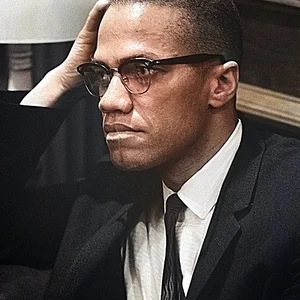

Malcolm X (1925-1965), born Malcolm Little, was an African American civil rights activist and a spokesman for the Nation of Islam. An advocate of Black nationalism, he championed the pride and emancipation of Black Americans before evolving toward a more universalist Sunni Islam.
Malcolm X(1925 — 1965)
Malcolm X
États-Unis
6 min read
Frequently asked questions
Famous Quotes
« By any means necessary.»
Key Facts
- Born on May 19, 1925, in Omaha, Nebraska, under the name Malcolm Little.
- Became the leading spokesman for the Nation of Islam in the 1950s, advocating Black nationalism.
- Made the pilgrimage to Mecca in 1964 and converted to Sunni Islam, taking the name El-Hajj Malik El-Shabazz.
- Broke with the Nation of Islam in 1964 and founded the Organization of Afro-American Unity.
- Assassinated on February 21, 1965, in New York City.
Works & Achievements
An account of his life dictated to Alex Haley and published after his death. Now a worldwide classic, it tells of his transformation from a petty criminal into a political leader.
One of his most famous speeches, calling on Black Americans to exercise their right to vote or resort to other means to achieve equality.
A powerful plea for Black unity and Black nationalism, marking his break with the nonviolence advocated by other leaders.
A religious organization created after he left the Nation of Islam to promote an open, Sunni form of Islam.
A group inspired by Pan-Africanism aiming to unite African Americans beyond religion to defend their human rights.
Anecdotes
Upon his release from prison, Malcolm Little dropped his family name and replaced it with an "X." To him
Little" was the name inherited from the slaveholders who had owned his ancestors, and the "X" symbolized the lost African name, unknown and stolen by slavery.
In prison, Malcolm blamed himself for being unable to express his ideas in writing. So he decided to copy out entire pages of the dictionary by hand, word after word, to build up his vocabulary. This is how he became one of the most formidable orators of his era.
In 1964, Malcolm X made the great pilgrimage to Mecca (the Hajj). Seeing Muslims of every color praying side by side transformed his outlook: he abandoned the idea that all white people were enemies and embraced a more universalist message.
His thick-framed glasses, dark suit, and raised finger have become famous images. But Malcolm lived under constant threat: his house was firebombed a week before his death, and he knew he was being followed.
Shortly before his death, Malcolm X told his life story to journalist Alex Haley. Published after his assassination
The Autobiography of Malcolm X" became a cult book read by millions of people around the world.
Primary Sources
It isn't a question of being a Democrat or a Republican, or Black or White: it's a question of human beings, a question of rights.
You don't have a peaceful revolution. You don't have a turn-the-other-cheek revolution.
I'm the happiest man you could imagine, for I have seen and lived through this change, this transformation among Black Americans.
I have shared the same glass, the same plate and the same bed with brothers whose eyes were the bluest, whose hair was the blondest, and whose skin was the whitest.
Key Places
Birthplace of Malcolm Little in 1925, in a context of intense racial tensions and threats from the Ku Klux Klan against his family.
City where Malcolm spent part of his childhood and where his father died in violent circumstances, deeply marking his youth.
It was in detention, starting in 1946, that Malcolm educated himself, converted to Islam, and began his personal transformation.
Iconic African American neighborhood where Malcolm X became an influential leader of the Nation of Islam and a famous street orator.
Site of the 1964 pilgrimage that transformed his worldview and led him toward a universalist Sunni Islam.
Hall in Washington Heights where Malcolm X was assassinated on February 21, 1965 during a speech. A memorial is now dedicated to him there.
Typical Objects

His thick-framed glasses became one of the activist's most recognizable visual symbols. They embodied the image of the self-taught intellectual he had become.

Malcolm X always wore a neat suit, a mark of the discipline and respectability promoted by the Nation of Islam. This attire asserted the dignity of Black Americans.

An exceptional orator, Malcolm X addressed crowds from platforms in Harlem and meeting halls. The microphone was his main tool of political struggle.

A convert to Islam, Malcolm X read and quoted the Quran, first in the version of the Nation of Islam and then in Sunni Islam after his pilgrimage. The sacred text nourished his spirituality and his speeches.

From his prison cell, where he copied out the dictionary by hand, Malcolm never stopped writing, taking notes, and preparing his speeches. Writing was the tool of his intellectual transformation.

Malcolm X's fame owed much to the photographers and television cameras that captured his rallies and interviews. The images broadcast in the media amplified his message.
School Curriculum
Vocabulary & Tags
Key Vocabulary
Tags
Daily Life
Morning
As a minister of the Nation of Islam, Malcolm X often began his day with prayer and reading. He devoted his mornings to organizing the community, answering mail, and preparing his speeches.
Afternoon
His afternoons were filled with meetings, visits to the temples (mosques), and recruiting new members. He met with journalists and officials to carry his message.
Evening
In the evening, he delivered speeches in halls or on the street corners of Harlem, drawing crowds. He also led debates and took part in radio and television programs.
Food
True to the rules of the Nation of Islam, Malcolm X followed a strict diet: no pork or alcohol, and only one meal a day considered healthy. Dietary discipline was part of his spiritual commitment.
Clothing
He almost always wore an impeccable dark suit, a white shirt, and a tie, along with his distinctive glasses. This neat attire conveyed dignity and discipline.
Housing
For a time he lived in a house in Queens, New York, provided by the Nation of Islam. After his break with the movement, this house was firebombed a week before his assassination.
Historical Timeline
Period Vocabulary
Liens externes & ressources
Références
Œuvres
L'Autobiographie de Malcolm X
1965
Discours « Le bulletin ou la balle »
1964
Discours « Message aux gens du peuple »
1963
Fondation de la Muslim Mosque, Inc.
1964
Fondation de l'Organisation de l'unité afro-américaine (OAAU)
1964