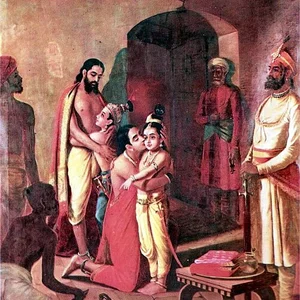

In Hindu mythology, Devaki is the mother of the god Krishna, one of the major incarnations of Vishnu. Imprisoned by her brother, the tyrant Kamsa, she saw her first children killed before giving birth to Krishna, who was miraculously saved. She embodies maternal love and devotion.
Devaki
Devaki
5 min read
Frequently asked questions
Key Facts
- Sister or cousin of the tyrant king Kamsa, she marries Vasudeva in the Krishna legend.
- A prophecy announces that her eighth son will kill Kamsa, prompting the tyrant to imprison her.
- Kamsa has her first six children killed to thwart the prophecy.
- She gives birth to Krishna, her eighth child, who is secretly saved and entrusted to foster parents.
- Her story is mainly told in the *Bhagavata Purana* and the *Harivamsa* (texts from the early centuries CE).
Works & Achievements
Central narrative of Krishna's birth, where Devaki plays the role of the imprisoned divine mother.
Appendix to the Mahabharata detailing the Yadava genealogy and the story of Devaki and Vasudeva.
Vaishnava text describing Vishnu's incarnation in Devaki's womb.
Devotional poem about Krishna that perpetuates the memory of his lineage and his mother.
Annual celebration of Krishna's birth that also commemorates Devaki's motherhood.
Paintings depicting Devaki in her prison and Vasudeva crossing the Yamuna.
Anecdotes
According to the *Bhagavata Purana*, on the day of Devaki's wedding to Vasudeva, a celestial voice warned Kamsa that his sister's eighth child would kill him. To avert this prophecy, the tyrant imprisoned the couple and killed their newborns one by one.
Tradition holds that Devaki's first seven children perished, but the seventh embryo, Balarama, was miraculously transferred into the womb of Rohini, Vasudeva's other wife, thus escaping Kamsa.
At the birth of Krishna, the eighth child, Devaki and Vasudeva's chains are said to have broken by themselves and the guards fell asleep: Vasudeva was able to cross the Yamuna River to shelter the child in Gokul.
The texts describe Devaki as radiant with divine light during her pregnancy with Krishna, so much so that Kamsa himself perceived the glow of Vishnu through his prisoner's body.
After Kamsa's death, Puranic accounts report that Krishna, now grown, brought Devaki's six deceased sons back to life to console his mother, fulfilling a vow of filial piety.
Primary Sources
The eighth child that Devaki will bear, O Kamsa, will be the one who ends your life.
Devaki, radiant, carried within her womb the divine part of Vishnu, and her very prison seemed illuminated.
Vasudeva married Devaki, sister of Kamsa; and from this union was to be born the one who would deliver the earth.
Krishna, son of Devaki and Vasudeva, of the Yadava lineage, came into the world to restore dharma.
Key Places
Royal city of the Yadava on the Yamuna, site of Devaki's prison and Krishna's birth.
Dungeon in Mathura where Devaki and Vasudeva were imprisoned; a sanctuary (Krishna Janmabhoomi) is now venerated there.
Sacred river that Vasudeva crosses at night to bring Krishna to safety; its waters are said to have parted.
Cowherd village where Krishna is entrusted to Nanda and Yashoda to escape Kamsa.
Pastoral region associated with Krishna's childhood, a major pilgrimage site for Vaishnava worship.
Typical Objects

Symbols of the captivity imposed by Kamsa; they miraculously break at Krishna's birth.

An improvised basket in which Vasudeva carries the newborn Krishna across the Yamuna.

Sacred attribute of Vishnu and Krishna, heralding the divine nature of the child borne by Devaki.

Light of dungeons and temples, evoking the divine radiance that would have illuminated Devaki's prison.

Adornments of the Yadava princess, recalling her noble rank despite imprisonment.

Emblematic instrument of her son; in legend it extends the maternal figure of Devaki.
School Curriculum
Vocabulary & Tags
Key Vocabulary
Tags
Daily Life
Morning
Princess Yadava before her imprisonment, Devaki wakes up in the palace of Mathura, performs her ablutions and morning prayers to the household deities. Once captive, her mornings are reduced to the dimness of the dungeon and anxious waiting.
Afternoon
At the palace, she receives servants and relatives, spins and embroiders according to the customs of noble women. In prison, the afternoon is spent in meditation and prayers, under the vigilant guard of Kamsa's men.
Evening
In the evening, oil lamps light the cell; Devaki and Vasudeva exchange their hopes in whispers. It is during a stormy night that Krishna is born and the miracle of his deliverance occurs.
Food
Like the nobles of ancient India, she eats rice, flatbreads, vegetables, milk, yogurt, and ghee. In captivity, her food becomes frugal, brought by the jailers.
Clothing
She wears the draped sari adorned with jewelry, bracelets, necklaces, and earrings, marks of her princely rank. Iconography often depicts her in a blue and gold sari, colors associated with Krishna.
Housing
First the refined apartments of the royal palace of Mathura, then a bare stone cell where she is chained for years by her brother Kamsa.
Historical Timeline
Period Vocabulary
Visual Style
Style de miniature indienne dévotionnelle : mère rayonnante en sari bleu et or dans une prison sombre, illuminée par l'éclat divin du nouveau-né Krishna.
Sound Ambience
Une nuit de mousson dans un cachot de Mathura : pluie, tonnerre, cliquetis de chaînes et cri étouffé d'un nouveau-né, sur fond de conque et de prières sacrées.
Liens externes & ressources
Références
Œuvres
Bhagavata Purana, Chant X
vers VIIIe-Xe siècle
Harivamsha
vers Ier-IIIe siècle
Vishnu Purana
vers Ier-IVe siècle
Gita Govinda de Jayadeva
XIIe siècle
Janmashtami (fête)
Tradition vivante
Miniatures rajpoutes et moghol-hindoues
XVIe-XIXe siècle