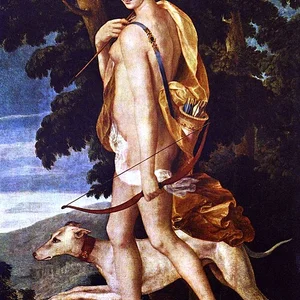

Diana is the Roman goddess of the hunt, the Moon, and the wild, identified with the Greek Artemis. Daughter of Jupiter and Latona, twin sister of Apollo, she is depicted as a huntress carrying a bow and arrows. An eternal virgin, she also protects women in childbirth and presides over lunar cycles.
Diana
Diana
9 min read
Frequently asked questions
Key Facts
- Identified with the Greek goddess Artemis as early as the 5th century BCE
- Her main temples stood on the Aventine Hill in Rome and at Nemi, in the Alban Hills
- Celebrated during the Nemoralia on August 13, a popular festival of slaves and women
- Member of the later Capitoline triad alongside Egeria and Virbius
- Depicted with a crescent moon on her brow and accompanied by a doe
Works & Achievements
The sanctuary of Nemi is one of the oldest and most unusual in Italy. Its ritual of the rex Nemorensis — a priest-king required to kill his predecessor in order to take office — directly inspired James Frazer's foundational work of anthropology, The Golden Bough (1890).
Listed among the Seven Wonders of the Ancient World, this colossal temple symbolised the universal power of the Artemis-Diana cult. It was destroyed and rebuilt several times, drawing pilgrims and offerings from across the Mediterranean world.
An annual Roman festival in honour of Diana, celebrated on 13 August in the forest of Nemi. Women formed torchlight processions to seek the goddess's aid during childbirth and to pray for the health of their children.
Diana inspired a major sculptural tradition in Antiquity. The celebrated Diana of Versailles — a Roman copy of a Greek original from the 4th century BCE — depicts the goddess in motion, holding back a deer, and remains one of the most widely reproduced images in Greco-Roman mythology.
Late Roman theology merged Diana with Hecate (goddess of crossroads and magic) and Selene (the moon), creating a three-faced divine trinity associated with the sky, the earth, and the underworld. This syncretism illustrates the richness and flexibility of ancient religious belief.
Anecdotes
Diana was born on the floating island of Delos, the only place that agreed to shelter Latona, who was being hounded by Juno's jealousy. According to the myth, Diana was born first and immediately helped her mother give birth to her twin brother Apollo — earning her, from the very beginning, the title of protector of childbirth, despite her own eternal virginity.
The hunter Actaeon accidentally came upon Diana bathing in a hidden spring deep in the woods. Furious at having been seen naked by a mortal, the goddess splashed him with water and transformed him into a stag. His own hunting hounds, no longer recognizing their master, tracked him down and tore him apart. This myth, recounted by Ovid in the Metamorphoses, illustrates Diana's unrelenting nature and the absolute reverence owed to the gods.
Callisto, one of Diana's cherished nymphs, was seduced by Jupiter, who took on the goddess's appearance to approach her. When Diana discovered her companion's pregnancy during a communal bath, she banished her from the group in anger. Jupiter transformed Callisto into a bear to protect her, before placing her in the sky as a constellation: the Great Bear, accompanied by her son Arcas, who became the North Star.
Diana avenged offenses against her mother Latona with rare severity. When Niobe, queen of Thebes, boasted of having fourteen children and declared herself superior to Latona, who had only two, Diana and Apollo loosed their arrows and killed every one of Niobe's children. The wretched queen, turned to stone by grief, was transformed into a rock from which eternal tears flow.
In Rome, the sanctuary of Nemi — the sacred grove of the Alban Hills — housed one of the strangest rites in all of ancient religion: the priest of Diana, known as rex Nemorensis, could only claim his office by killing his predecessor in single combat, and was required to remain armed day and night, watching for any potential challenger. This archaic ritual fascinated the anthropologist James Frazer in the nineteenth century, who made it the starting point of his landmark work The Golden Bough.
Primary Sources
Diana sprinkled water from the spring upon his face and said: 'Now go and tell, if you can, that you have seen me unveiled.' Then she made antlers sprout upon his head, lengthened his neck, rounded his ears, changed his hands into hooves, his arms into long legs, and covered his body in a spotted coat.
Artemis, sitting upon your father Zeus's knees, you asked him from your earliest childhood for eternal virginity, the right never to marry, arrows and a quiver, a short tunic for running, and nymphs to accompany you on the hunt in the mountains.
I sing of Artemis of the golden arrows, the chaste huntress, the dear sister of Apollo of the silver bow. She delights in roaming the shadowy mountains and the windy peaks, drawing her golden bow and loosing her whistling arrows.
Diana, guardian of the mountains and the silent forests, you who answer the cries of women in the labor of childbirth, hear the vows we offer you in this sacred time, and may the number of Romans grow under your protection.
Diana, whom the Greeks call Artemis, governs the moon, now waxing, now waning. She is the sister of Apollo, and just as he presides over the sun, she presides over the light of night and the cycles of time.
Key Places
Mythical birthplace of Diana and her brother Apollo. The island, once said to be floating according to legend, became one of the most sacred sanctuaries in the Greek world and a major center of pilgrimage in Antiquity.
Roman sanctuary founded in the 6th century BC, a shared place of worship for the Latin peoples and a recognized refuge for runaway slaves. It made Diana a deity close to the common people, distinct from aristocratic cults.
Sacred forest and lake of the Alban Hills dedicated to Diana Nemorensis, site of the archaic ritual of the rex Nemorensis. The sanctuary fascinated modern anthropologists, including James Frazer, who made it the starting point of *The Golden Bough*.
One of the Seven Wonders of the ancient world, this colossal temple measuring 115 meters in length housed the cult statue of Artemis-Diana and drew pilgrims from across the Mediterranean basin for several centuries.
Sacred hill of Delos where Latona leaned for support while giving birth to Diana and Apollo. The mountain's name gave the goddess the epithet “Cynthia,” which was taken up by Latin poets such as Horace and Propertius.
Typical Objects

Diana's primary attribute and emblem, her silver bow symbolizes both her power as a huntress and the crescent moon. Her arrows can bring sudden and painless death, but also, according to some myths, healing.

Diana is almost always depicted with a quiver on her shoulder, filled with silver arrows. This object underscores her nature as an ever-ready huntress and her status as a warrior goddess of the natural world.

A lunar emblem worn as a diadem on Diana's brow, the crescent recalls her role as goddess of the moon and her identification with Selene. It has become one of the most recognizable symbols of the goddess in both ancient and later iconography.

Diana sometimes carries twin torches, an attribute of her nocturnal and lunar functions. They recall her role as a guide through darkness and her identification with Hecate, goddess of crossroads and nighttime rites.

Diana's sacred animal, the hind she had captured alive numbered among her closest companions. It symbolizes grace, swiftness, and the goddess's bond with the wild nature she protects.

The practical garment of the huntress, the short tunic leaving the legs free is Diana's characteristic dress in ancient art, setting her apart from the other great goddesses who wear long robes.
School Curriculum
Vocabulary & Tags
Key Vocabulary
Daily Life
Morning
Diana begins her day before dawn, when the moon she governs fades to make way for her brother Apollo's sun. She gathers her band of nymphs in forests and on mountains, equips her hunting hounds, and strings her silver bow, ready for the first chase of the day.
Afternoon
In the afternoon, Diana roams wild forests, moorlands, and rivers, hunting deer, boars, and other animals. She watches over the territories consecrated to her and severely punishes anyone who transgresses the laws of the wild — her inviolable domain.
Evening
As evening falls, Diana bathes in a spring or lake sheltered from prying eyes, surrounded by her nymphs, before taking her place in the night sky in the form of the moon. She then presides over childbirths and watches over women in labor, guiding mortals through the darkness with her silvery light.
Food
As a goddess, Diana does not eat as mortals do, but myths describe her feasting on Olympus with ambrosia and nectar — the divine foods that confer immortality. After the hunt, she sometimes shares the spoils of her catch with her nymphs or offers them as a sacrifice to the gods.
Clothing
Diana wears a short tunic (exomis) of light linen, hitched above the knees so she can run freely through the forest. Her sandals are sturdy, suited to rough terrain. Her hair is pinned up in a bun or adorned with a crescent-moon diadem; her quiver and bow never leave her side.
Housing
Diana's domain is not an enclosed palace but the forest itself, of which she is the absolute mistress. She resides on Olympus, home of the gods, but her earthly sanctuaries — such as the forest of Nemi or sacred groves — serve as her living temples, where mortals come to worship her beneath the shelter of the trees.
Historical Timeline
Period Vocabulary
Liens externes & ressources
Références
Œuvres
Culte de Diana Nemorensis au sanctuaire de Némi
depuis au moins le VIe siècle av. J.-C.
Temple d'Artémis à Éphèse
vers 550 av. J.-C. (première grande construction)
Fêtes des Nemoralia (Rome)
13 août (célébration annuelle)
Iconographie classique : Diane chasseresse
Ve siècle av. J.-C. – IIe siècle apr. J.-C.
Syncrétisme Diane-Hécate-Séléné (Triformis)
IIe-Ier siècle av. J.-C.