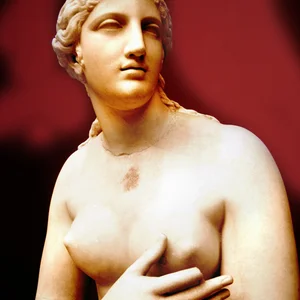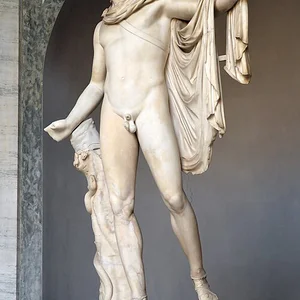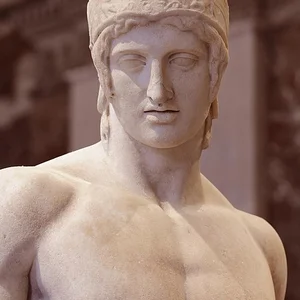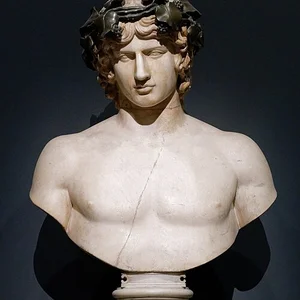

Greek god of wine, theater, fertility, and ecstasy, worshipped in ancient Greece. Son of Zeus and the mortal Semele, he embodies the duality between civilization and the wild, reason and intoxication. A central figure in mystery cults and ancient theatrical performances.
Dionysus
Dionysus
8 min read
Frequently asked questions
Key Facts
- A major deity of the Greek pantheon, associated with the cult of wine and the Dionysian festivals celebrated during the grape harvest
- Patron of Greek theater: tragedies and comedies were performed during the Great Dionysia in Athens (6th–4th centuries BC)
- A figure in the Eleusinian Mysteries, secret initiatory cults where his worship merged with that of Demeter
- A dualistic representation: a civilizing benefactor god and a wild god capable of punishing those who denied him (the myth of Pentheus)
- Identified with Bacchus by the Romans, whose cultural influence spread the Dionysian cult all the way to Rome
Works & Achievements
Dionysus is credited with inventing wine and its production techniques, transforming grapes into a sacred beverage. This mythological innovation symbolizes the transition from a wild state to civilization and stands at the heart of his religious cult.
Dionysus presides over the Dionysia, the great Athenian festivals where Greek dramatic theater — tragedy and comedy alike — was born. These religious celebrations and performances represent one of ancient Greece's greatest cultural achievements.
Dionysus plays a central role in the mystery cults of Eleusis, where initiates took part in secret rites aimed at mystical ecstasy and spiritual renewal. These mysteries had a profound influence on Greek spirituality.
According to mythology, Dionysus leads a triumphant expedition to India, spreading the cult of wine and the vine. This legendary conquest symbolizes the expansion of creative chaos and civilization from East to West.
This mythological episode illustrates the divine power of Dionysus and his dual nature: the god punishes impious mortals by transforming them, demonstrating that he embodies both creation and destruction.
Dionysus rescues the abandoned Ariadne and takes her as his wife, elevating her to the status of a goddess. This mythological event symbolizes redemption through the god and the union of the divine and the mortal.
Dionysus founds the thiasoi, cultic associations of devotees — particularly women — who take part in ecstatic and orgiastic rites. These initiated groups represent a major form of religious organization in the ancient world.
Anecdotes
According to Greek mythology as recorded by Homer and Hesiod, Dionysus was born twice: first from his mother Semele, who was struck down by Zeus's thunderbolt, and then from Zeus himself, who sewed the fetus into his own thigh to carry it to term. This 'double birth' makes him a unique deity — a symbol of transformation and rebirth, themes that stood at the heart of ancient religious mysteries.
The Great Dionysia, an Athenian festival historically documented from the 6th century BCE, were religious celebrations attended by thousands of citizens who gathered to watch theatrical performances in honor of Dionysus. It was at these festivals that the greatest Greek tragedies and comedies were performed, turning religious worship into a major cultural event.
In the Iliad and the Odyssey, Dionysus is portrayed as a god to be feared: Homer tells how the god drives mad those who reject or dishonor him — most notably King Pentheus of Thebes, who refused his cult and was torn apart by the maenads (women possessed by Dionysus). This legend illustrates the dangerous power of the ancient god.
The Eleusinian Mysteries, secret ceremonies practiced in ancient Greece for over a thousand years, included Dionysus alongside Demeter. Thousands of initiates took part in rituals that sought mystical intoxication and religious ecstasy, demonstrating the spiritual importance of the god within mainstream Greek religion.
Artistic depictions of Dionysus preserved on 5th-century BCE ceramics and sculptures show him accompanied by a procession of satyrs, maenads, and panthers. These images confirm that his cult blended religious veneration with the celebration of intoxication, setting Dionysus apart from the other gods of Olympus.
Primary Sources
Dionysus, son of Zeus and Semele, returns to his birthplace of Thebes to establish his cult. He transforms the women into bacchants and punishes those who refuse to recognize him as a god.
From Zeus and the mortal Semele was born Dionysus, the god who brings joy to mortals and immortals alike, the god of wine and the fruitful vine.
I will sing of Dionysus, son of glorious Zeus, born of fair Semele. The goddess Rhea bore him in secret, far from the gaze of the king of the gods.
The Dionysia and the tragic competitions held in honor of Dionysus are at the heart of Athens' religious and cultural life, where playwrights compete to glorify the god of theater.
Dionysus is often depicted wearing panther skins, holding the thyrsus and wearing a diadem, surrounded by his followers in a state of ecstasy, embodying the transformative power of wine and mystic worship.
Key Places
The mythical birthplace of Dionysus, where his mother Semele was struck by Zeus's lightning bolt. This is the city where the god was raised and where his cult first took root in ancient Greece.
A major center of the cult of Dionysus and the birthplace of ancient Greek theater. The City Dionysia, the annual festival held in the god's honor, took place in Athens and gave rise to both tragedy and comedy.
The legendary mountain where Dionysus was raised by nymphs after his miraculous birth. It symbolizes the refuge and wild nature closely associated with the god.
A temple and sanctuary dedicated to Dionysus, built at the foot of the Acropolis. It was the primary venue for theatrical performances and Dionysian festivals in ancient Greece.
The Aegean island where, according to mythology, Dionysus met and married Ariadne. The god is venerated there, and the legend holds particular cultural significance for the island.
The pan-Hellenic sanctuary where Dionysus was worshipped alongside Apollo. The god held an important ritual role there, and his cult was woven into the religious practices of the site.
Typical Objects

A staff adorned with ivy and pine cones, the emblematic symbol of Dionysus. This object represents the god's power over nature and fertility, carried during Dionysiac processions and cultic rituals.

The sacred fruit associated with Dionysus, symbol of wine and abundance. Depicted throughout ancient iconography, it illustrates the god's connection to agriculture and the transformation of grapes into wine.

A ritual object used in Greek theatrical performances held in honor of Dionysus. The mask allowed actors to embody different roles and represents the tragic and comic duality central to the Dionysiac festivals.

A large vessel used to store and transport wine in ancient Greece. An everyday object closely tied to the cult of Dionysus and the social practices of wine consumption in Greek culture.

The sacred plant consecrated to Dionysus, worn as garlands during Dionysiac celebrations. It symbolizes rebirth and immortality, important attributes of the god of ecstasy.

A shallow vessel used for drinking wine at ancient banquets. Often decorated with Dionysiac scenes, it embodies the ritual of the Greek symposium and the worship of the god.

A percussion instrument used during Dionysiac rituals and processions. It accompanied celebratory chants and represents the festive, wild nature of the cult of Dionysus.

A garment worn by Dionysus and his followers during rituals. It symbolizes the god's power over wild animals and his half-divine, half-wild nature.
School Curriculum
Vocabulary & Tags
Key Vocabulary
Daily Life
Morning
As a deity, Dionysus has no ordinary morning routine. In mythology, he is often depicted traveling the world to spread the cult of wine and inspire divine ecstasy. His mornings are devoted to watching over his followers and influencing the grape harvest and the fermentation of wine.
Afternoon
Dionysus's divine afternoons are marked by preparations for festivities and the Dionysia — the great theatrical festivals held in his honor in Athens. He metaphorically presides over actors' rehearsals and the composition of plays written to celebrate him, embodying creative inspiration.
Evening
Dionysus's evenings are associated with banquets, celebrations, and the mystical processions known as thiasoi. He is surrounded by satyrs, maenads, and his devotees, who dance, sing, and drink wine in his honor, celebrating ritual intoxication and union with the divine.
Food
As a deity, Dionysus is sustained by the incense and libations offered by his worshippers. In mythological depictions, he is closely associated with wine, grapes, and the fruit of the vine. Festivals held in his honor featured wine mixed with water, bread, sacrificial meats, and autumn fruits.
Clothing
Dionysus is typically depicted wearing a long tunic (chiton) or draped in a panther or leopard skin. He often wears a crown or garland of ivy and grapes — along with the thyrsus — symbols of his dominion over wild nature and fertility.
Housing
As a deity, Dionysus has no fixed dwelling in classical mythology. He alternates between residing on Olympus with the other gods and wandering the earth and Asia Minor as a divine traveler. In the mystery cults, his principal sanctuaries were located in Athens and Eleusis.
Historical Timeline
Period Vocabulary
Visual Style
Un style inspiré de la céramique grecque antique mêlant la technique sophistiquée des vases à figures rouges avec une ambiance théâtrale et mystique. L'univers visuel combine l'élégance classique grecque, la dynamique des cortèges bachiques et la fusion entre divinité majestueuse et sauvagerie débridée.
Sound Ambience
Une ambiance immersive oscillant entre la festive religieuse organisée des théâtres antiques et le chaos sauvage des rituels bachchiques, mêlant instruments de musique greco-romains, voix en extase et bruits de nature exubérante pour incarner la dualité du dieu du vin et de l'ivresse.
Liens externes & ressources
Références
Œuvres
L'invention de la viticulture et de la vinification
Antiquité grecque
Fondation du théâtre grec et des Dionysies
VIe-Ve siècles av. J.-C.
Les Mystères d'Éleusis
VIe-Ier siècles av. J.-C.
La conquête de l'Inde
Antiquité grecque (mythologique)
Transformation des pirates en dauphins
Antiquité grecque (mythologique)
La résurrection d'Ariane et le mariage divin
Antiquité grecque (mythologique)
L'institution du culte extatique et des thiases
Antiquité grecque