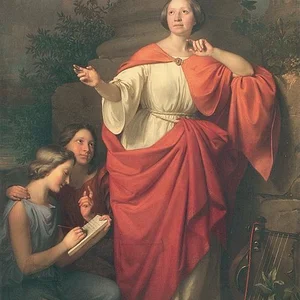

Diotima of Mantinea is a figure presented by Plato in the *Symposium* as the priestess and philosopher who is said to have initiated Socrates into the mysteries of love (Eros). Her historical existence is uncertain, but her teaching on the ascent toward the Beautiful is central to Platonic thought.
Diotima(450 av. J.-C. — 300 av. J.-C.)
Diotima of Mantinea
6 min read
Frequently asked questions
Key Facts
- Appears as a character in Plato's *Symposium*, a dialogue written around 380 BC
- Presented as a priestess of Mantinea who taught Socrates about the nature of love
- Sets out the famous “ladder of love,” the ascent from sensible beauty toward the Beautiful itself
- Her actual historical existence is debated; she may be a literary figure created by Plato
- The only woman to hold a major philosophical role in Plato's dialogues
Works & Achievements
Definition of Eros as an intermediary between mortals and gods, born of Poros and Penia. It reshapes the Greek conception of love.
Theory of the soul's ascent from sensible beauty to Beauty itself. This is the heart of Platonic aesthetics and metaphysics.
The idea that love is the desire to beget in beauty, through the body (children) or through the soul (works and virtue). It links desire to immortality.
An initiatory presentation of love as a gradual ascent, modeled on the Greek religious mysteries. It gives philosophy a sacred dimension.
Anecdotes
Diotima never appears in person in Plato's *Symposium*: it is Socrates himself who reports her words, claiming that she was the one who initiated him into matters of love. This device makes her one of the very few female figures to whom Plato assigns the role of Socrates' teacher.
Her name is full of meaning: Diotima means in Greek “honored by Zeus” or “she who honors Zeus,” a fitting name for a priestess. Many historians believe she is a character partly or entirely invented by Plato to carry his doctrine.
According to Socrates' account, Diotima is said to have advised the Athenians to perform a sacrifice that delayed the arrival of the plague in Athens by ten years. This anecdote serves to establish her authority as a priestess able to intercede with the gods.
It is to Diotima that Plato attributes the famous image of the “ladder of love” (or ladder of Beauty): one rises from the love of a single beautiful body to the love of all beautiful bodies, then of beautiful souls, of beautiful forms of knowledge, up to the contemplation of Beauty itself.
Diotima defines Love (Eros) not as a god, but as a *daimon*, an intermediary between mortals and the gods, the son of Poros (Resource, Expedient) and Penia (Poverty), which is why he is always in search of what he lacks.
Primary Sources
I shall now try to report to you the discourse on Love that was once given to me by a woman of Mantinea, Diotima, who was deeply learned in this matter as in many others.
What is he then, Diotima? — A great spirit, Socrates; for every spirit is intermediate between the god and the mortal. — And what power does he have? — That of interpreting and conveying to the gods what comes from men, and to men what comes from the gods.
One must, beginning from the beauties of this world and ascending ever upward for the sake of that absolute Beauty, climb as if by steps, from one beautiful body to two, from two to all beautiful bodies, from beautiful bodies to beautiful pursuits, then to beautiful forms of knowledge, until one reaches that knowledge which is the knowledge of Beauty itself.
Key Places
City of the Peloponnese from which Diotima takes her name. Famed for its seers and priestesses, it roots the character in a religious tradition.
City where Diotima is said to have taught Socrates and where the *Symposium* takes place. The intellectual capital of Classical Greece.
Home of the tragic poet where the banquet recounted by Plato is held. It is there that Socrates quotes the teaching of Diotima.
Religious heart of the city, crowned by the Parthenon, a symbol of Athenian piety contemporary with the story.
Typical Objects

A flat, footless bowl used by priestesses to pour offerings of wine or oil to the gods. Diotima, portrayed as a priestess, is said to have handled these ritual objects.

A small stone altar on which incense was burned and offerings were laid. It was through this kind of ritual that Diotima is said to have driven back the plague of Athens.

A philosophical image attributed to Diotima describing the soul's ascent from sensible beauties up to Beauty itself. It is a metaphor and not a material object.

A woolen band or plant wreath worn by the officiants of Greek cults. It signaled the sacred status of the woman who wore it.

A stand on which aromatic resins were burned during ceremonies. The smoke was believed to carry prayers up to the gods.

A stringed instrument played during Athenian symposia, the setting in which Diotima's speech is recounted. It accompanied songs and philosophical conversations.
School Curriculum
Vocabulary & Tags
Key Vocabulary
Tags
Daily Life
Morning
A priestess like Diotima would begin the day with rites of purification using clear water and household prayers before the family altar. The morning could be devoted to offerings and to receiving those who sought counsel from the gods.
Afternoon
The afternoon lent itself to conversation and teaching, like the instruction she is said to have given Socrates. Discussions about the divine, love, and beauty took place sheltered from the heat.
Evening
In the evening, the men gathered for a symposion to drink, sing, and debate; it is in this setting that her teaching is reported. A woman was rarely admitted, except as a figure of religious authority invoked by the guests.
Food
The Greek diet rested on the “Mediterranean triad”: barley or wheat bread, olive oil, and wine diluted with water. To this were added pulses, cheese, olives, figs, and rarely meat, mostly from sacrifices.
Clothing
Women wore the peplos or the chiton of wool or linen, draped and fastened with fibulae, covered by a himation. A priestess might wear a sacred headband and plant wreaths during ceremonies.
Housing
Greek houses were arranged around an interior courtyard, with a space reserved for women (the gynaeceum). Built of mudbrick and stone, they often housed a small domestic altar.
Historical Timeline
Period Vocabulary
Liens externes & ressources
Références
Œuvres
Doctrine de l'Amour comme daïmon
rapportée vers 380 av. J.-C.
L'échelle du Beau
rapportée vers 380 av. J.-C.
L'enfantement dans le beau
rapportée vers 380 av. J.-C.
Les mystères de l'amour
rapportée vers 380 av. J.-C.