 flip
flipIngkung Ayam
Ingkung Ayam
Why this dish? Ingkung — whole chicken cooked in spiced coconut milk — is the quintessential ritual dish of Javanese slametan, ceremonial meals marking important events. Diponegoro, deeply pious and rooted in kraton traditions, would have presided over many slametan before launching the holy war: collective prayer, shared ingkung, blessing of weapons and men. The animal's posture, with legs folded as in prostration, symbolizes submission to God.
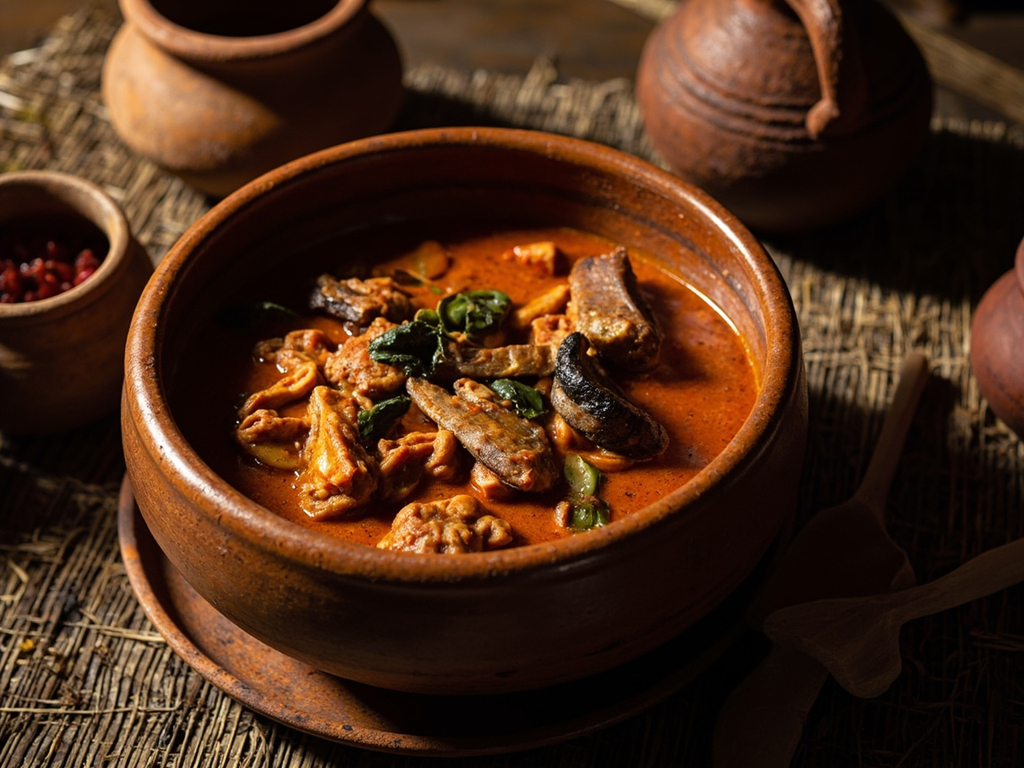
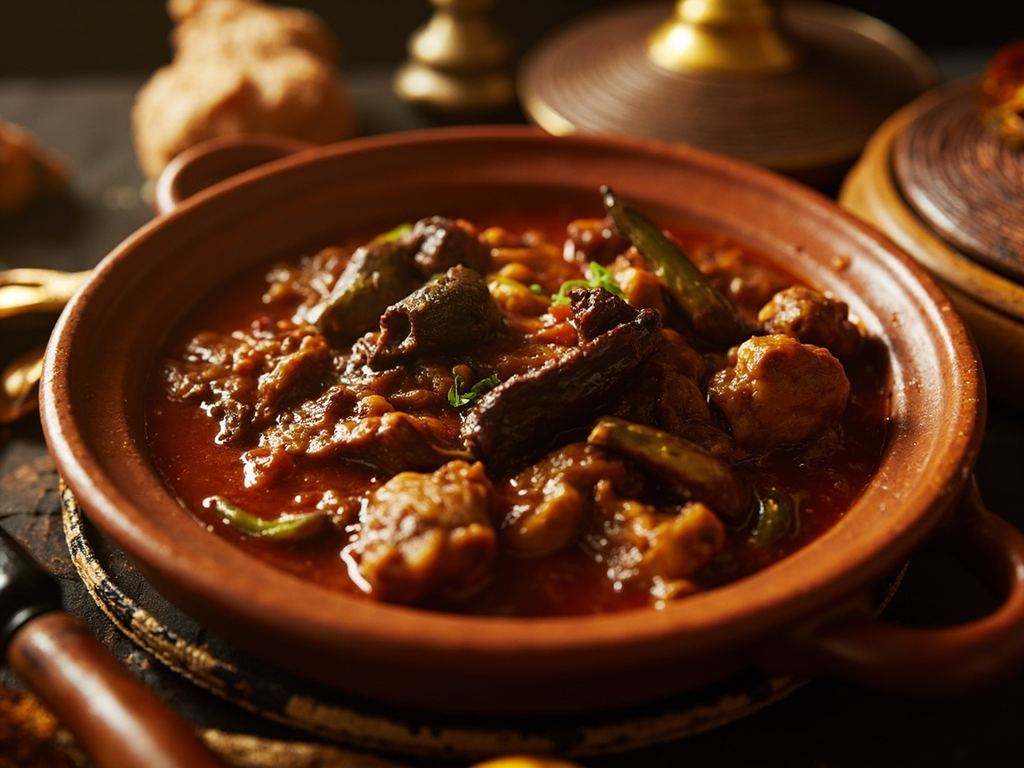
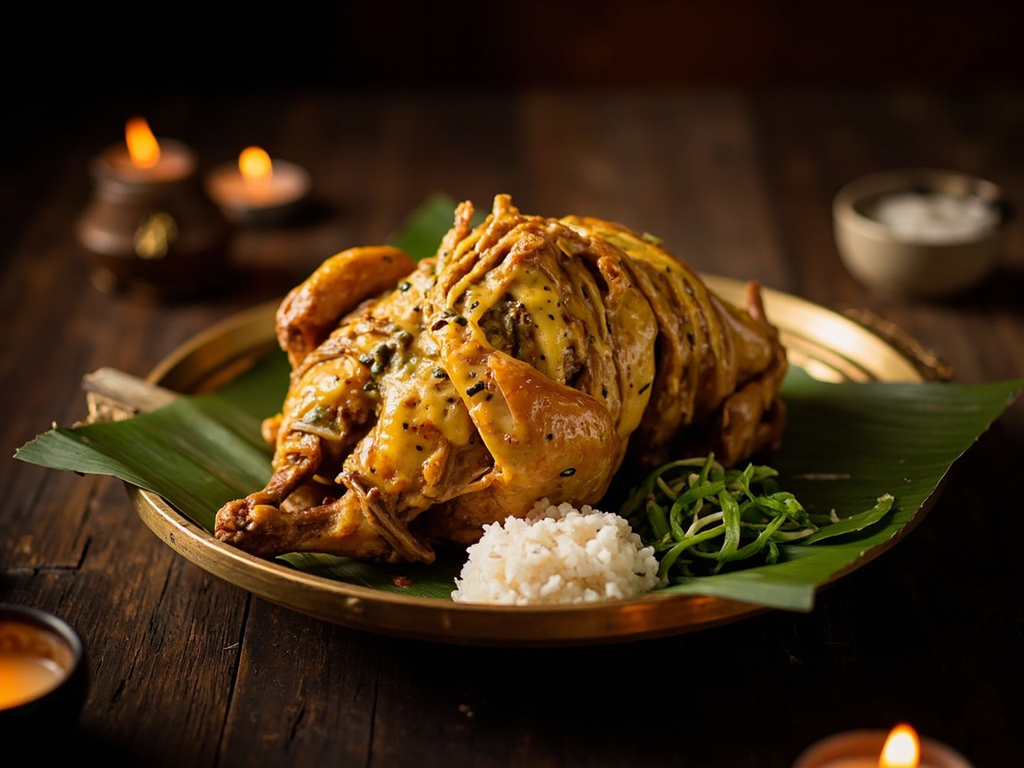
Whole chicken trussed in a prayer position (sujud), slowly cooked in santan spiced with galangal, turmeric, lemongrass, and salam leaves. The meat absorbs the aromatics down to the bone. A solemn and generous dish, it is carved and shared collectively on great occasions.
Before every decisive battle, I gathered my commanders and the ulama for a slametan. The ingkung was brought on a copper tray, the chicken tied in the sujud posture, facing the qibla, as a sign of our submission to the Almighty. I recited the du’a, then the chicken was carved and each man received his portion — the war leader as well as the common soldier. The fragrance of laos and kunyit rose with the steam, and this meal reminded us that we fought not for earthly glory, but for justice and faith. The meat, cooked for hours in santan, fell off the bone — no knife needed.
- •Whole chicken (ayam kampung) — One free-range chicken (Centerpiece of the ritual dish)
- •Fresh coconut milk (santan) — Pressed from two coconuts (Cooking liquid)
- •Galangal (laos) — A good piece, crushed (Main aromatic)
- •Fresh turmeric (kunyit) — Several rhizomes, pounded (Golden color and fragrance)
- •Lemongrass (serai) — A few stalks, crushed (Citrus freshness)
- •Salam leaves — A few leaves (Herbaceous aroma)
- •Garlic and shallots — Generously (Aromatic base)
- •Coriander seeds — A good handful, pounded (Base spice)
- •Kemiri nuts (candlenut) — A few, pounded (Thickener and creaminess)
- •Salt — To taste (Seasoning)
Ingkung Ayam
Whole chicken trussed in a prayer position (sujud), slowly cooked in santan spiced with galangal, turmeric, lemongrass, and salam leaves. The meat absorbs the aromatics down to the bone. A solemn and generous dish, it is carved and shared collectively on great occasions.
Why this dish? Ingkung — whole chicken cooked in spiced coconut milk — is the quintessential ritual dish of Javanese slametan, ceremonial meals marking important events. Diponegoro, deeply pious and rooted in kraton traditions, would have presided over many slametan before launching the holy war: collective prayer, shared ingkung, blessing of weapons and men. The animal's posture, with legs folded as in prostration, symbolizes submission to God.
Before every decisive battle, I gathered my commanders and the ulama for a slametan. The ingkung was brought on a copper tray, the chicken tied in the sujud posture, facing the qibla, as a sign of our submission to the Almighty. I recited the du’a, then the chicken was carved and each man received his portion — the war leader as well as the common soldier. The fragrance of laos and kunyit rose with the steam, and this meal reminded us that we fought not for earthly glory, but for justice and faith. The meat, cooked for hours in santan, fell off the bone — no knife needed.
Ingredients (period version)
- Whole chicken (ayam kampung) — One free-range chicken (Centerpiece of the ritual dish)
- Fresh coconut milk (santan) — Pressed from two coconuts (Cooking liquid)
- Galangal (laos) — A good piece, crushed (Main aromatic)
- Fresh turmeric (kunyit) — Several rhizomes, pounded (Golden color and fragrance)
- Lemongrass (serai) — A few stalks, crushed (Citrus freshness)
- Salam leaves — A few leaves (Herbaceous aroma)
- Garlic and shallots — Generously (Aromatic base)
- Coriander seeds — A good handful, pounded (Base spice)
- Kemiri nuts (candlenut) — A few, pounded (Thickener and creaminess)
- Salt — To taste (Seasoning)
Ingredients
- Whole free-range chicken — 1 (about 1.5 kg) (Centerpiece)
- Coconut milk — 1 liter (Cooking liquid)
- Fresh galangal — 5 cm, crushed (Main aromatic)
- Fresh or ground turmeric — 3 cm fresh or 1 tsp ground (Color and fragrance)
- Lemongrass — 3 stalks, crushed (Freshness)
- Indonesian or European bay leaves — 4 leaves (Aroma)
- Garlic — 5 cloves (Aromatic base)
- Shallots — 8 small (Aromatic base)
- Ground coriander — 1 tbsp (Base spice)
- Macadamia nuts (substitute for kemiri) — 4, crushed (Thickener)
- Kitchen twine — 1 m (Trussing the chicken)
- Salt — 1.5 tsp (Seasoning)
Method
- Pound or blend garlic, shallots, turmeric, coriander, and macadamia nuts into a fine paste (bumbu).
- Wash the chicken, fold the legs against the body, and truss firmly to maintain the traditional folded position.
- In a large pot or Dutch oven, sauté the bumbu in a little oil for 3 minutes until fragrant.
- Pour in the coconut milk, add crushed galangal, lemongrass, and bay leaves. Bring to a simmer.
- Place the trussed chicken in the liquid. The coconut milk should cover it three-quarters.
- Cook over low heat, covered, for 1.5 to 2 hours. Baste the chicken regularly with the broth.
- The chicken is ready when the meat almost falls off the bone and the sauce has reduced and thickened.
- Present the whole chicken on a platter, drizzle with sauce. Serve with white rice and vegetables (urap).
How it was made : Ingkung is attested in the traditions of the kraton of Yogyakarta since its founding in 1755. The chicken is always an ayam kampung (village free-range chicken), trussed with legs folded and head tucked in, evoking prostration (sujud). The dish was inseparable from the slametan, a Javanese ritual meal blending Islam and local traditions. Diponegoro, who led a holy war (perang sabil), would have held many slametan to mobilize his followers and seek divine blessing before battles.
The contemporary twist : Present the chicken on a platter covered with banana leaves, surrounded by small rice cones shaped like miniature tumpeng, each topped with a lemongrass stalk as a pennant — a nod to Diponegoro's war banners.
Sources : Peter Carey, “The Power of Prophecy: Prince Dipanagara and the End of an Old Order in Java, 1785–1855”, KITLV Press, 2007 — life at the kraton and religious practices · Sri Owen, “Indonesian Regional Food and Cookery”, 1994 — culinary traditions of the sultanate of Yogyakarta
Diponegoro · Charactorium