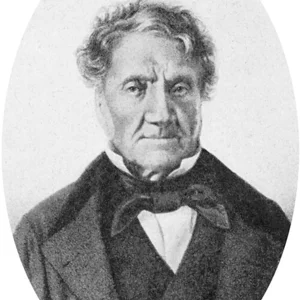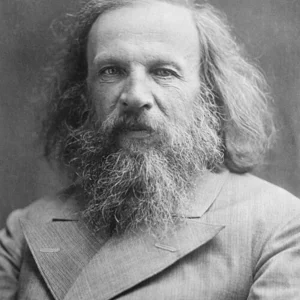

Russian chemist (1834–1907), he established in 1869 the periodic table of chemical elements, classifying elements by increasing atomic mass and recurring properties. His table even made it possible to predict the existence of then-unknown elements.
Dmitri Mendeleev(1834 — 1907)
Dmitri Mendeleev
Empire russe
8 min read
Frequently asked questions
Famous Quotes
« The elements, if arranged according to their atomic weights, exhibit an apparent periodicity of properties.»
Key Facts
- 1834: born in Tobolsk, Siberia
- 1869: publication of the first periodic table of elements
- 1871: predicts the existence of three unknown elements (gallium, scandium, germanium), later confirmed
- 1876: appointed member of the Saint Petersburg Academy of Sciences
- 1907: dies in Saint Petersburg
Works & Achievements
Mendeleev's landmark achievement: a classification of the 63 known elements by increasing atomic mass, revealing the periodicity of their properties. He left blank spaces for elements yet to be discovered and predicted their characteristics with a precision that earned the admiration of the entire scientific community.
A two-volume university textbook written because no existing work matched his course. Translated into several European languages, it served as an international reference for decades and gave Mendeleev the opportunity to formalize his periodic law.
A foundational paper presented to the Russian Chemical Society in March 1869, in which Mendeleev set out the periodic law for the first time and predicted the existence of still-unknown elements along with their estimated properties.
Research conducted in Heidelberg on the properties of liquids at high temperatures, contributing to the establishment of the concept of critical temperature independently of Thomas Andrews, and demonstrating Mendeleev's experimental rigor from the very start of his career.
A study in which Mendeleev proposed a theory of hydration in solution, anticipating modern work in solution chemistry and illustrating the breadth of his interests well beyond the periodic table alone.
Mendeleev made a solo balloon ascent from Klin to observe a total solar eclipse and study the upper layers of the atmosphere, demonstrating a marked taste for direct experimentation and scientific risk-taking.
Anecdotes
Mendeleev reportedly had his illumination about the order of the periodic table during a half-sleep in February 1869, seeing the elements arrange themselves in a dream. He leapt from his bed to write down the structure before it faded. Whether it was a genuine dream or a metaphor, he himself recalled that he had been thinking about this problem for years without respite.
Mendeleev let his beard and hair grow throughout the year and had them cut only once a year, in spring, by a passing peasant. This unkempt appearance, which he fully embraced, gave him an unmistakable silhouette in the corridors of Saint Petersburg University.
In his 1869 table, Mendeleev deliberately left blank spaces for elements he predicted but that had not yet been discovered. He accurately described the properties of three of them: eka-aluminium (gallium, discovered in 1875), eka-boron (scandium, 1879), and eka-silicon (germanium, 1886). These discoveries brilliantly confirmed his theory and made him an international celebrity.
In 1906, the Nobel committee deliberated at length between Mendeleev and Henri Moissan for the chemistry prize. Mendeleev did not receive it, with some members feeling his table was too old. He died in January 1907, just a few months after that vote. In belated recognition, element 101, discovered in 1955, was named “mendelevium” in his honour.
Mendeleev was also a passionate craftsman: he made his own suitcases and spectacle cases by hand. One day while buying fabric in a Saint Petersburg shop, the merchant proudly introduced him to a customer as “the finest suitcase maker in Russia,” completely unaware that he was dealing with the country's greatest chemist.
Primary Sources
The elements, if arranged according to their atomic weights, exhibit an evident periodicity of properties. We may expect the discovery of many yet unknown elements, for example analogues of aluminum and silicon, with atomic weights between 65 and 75.
By arranging all the elements in the order of their atomic weights, a periodic repetition of properties is obtained. This is what I call the periodic law of the elements.
I propose to call this system the ‘periodic table of the elements.’ The empty cells correspond to elements not yet discovered, whose main properties I predict from those of their neighbors.
The periodic law leaves no room for chance in the nature of the simple elements: it affirms that the mass of atoms determines the character of the elements, just as the mass of celestial bodies determines their mechanical motions.
Key Places
Mendeleev's birthplace, where he was born in 1834 into a large family. This Siberian city left a deep mark on his independent character and his curiosity for the natural sciences and the living world.
Mendeleev's primary workplace for more than thirty years: he taught chemistry there, wrote his *Principles of Chemistry*, and developed his periodic table in his office in the chemistry department.
Mendeleev traveled here in 1859–1860 to work in Robert Bunsen's laboratory, where he refined his experimental methods and came to appreciate the importance of atomic weights for classifying the elements.
The city that hosted the first International Chemical Congress in 1860, which Mendeleev attended. The agreements reached there on atomic weights provided him with the dataset he needed to build his periodic table.
Mendeleev was appointed director in 1893. He modernized Russia's measurement standards and contributed to national metrological unification, demonstrating his commitment to the practical applications of science.
A rural property acquired by Mendeleev where he pursued experimental farming and retreated from city life. It was from this estate that he organized his famous 1887 balloon ascent to observe a solar eclipse.
Typical Objects

The original sheet on which Mendeleev drew up his first periodic table is preserved in the archives of Saint Petersburg University. This foundational document shows the blank spaces left for elements still unknown, whose properties he had predicted.

To build his table, Mendeleev used cardboard index cards on which he had written the properties of each known element, arranging and rearranging them like a card game until he found the revealing order.

A central instrument in 19th-century chemistry laboratories, the balance was used to measure the atomic weights of elements — the fundamental data on which Mendeleev built his entire periodic classification.

The major university textbook written by Mendeleev between 1868 and 1871, translated into several European languages, was for decades the standard reference text for chemistry teaching across Europe and Russia.

Mendeleev was keenly interested in the physics of gases and in meteorology. He improved the differential barometer and in 1887 made a solo balloon ascent to observe a solar eclipse and study the upper layers of the atmosphere.

Mendeleev made his own suitcases in his spare time, a craft hobby so well developed that it earned him recognition on the streets of Saint Petersburg as a skilled leather-worker rather than as a great scientist.
School Curriculum
Vocabulary & Tags
Key Vocabulary
Daily Life
Morning
Mendeleev rose early and devoted his mornings to reading and reflection in his office, cluttered with books and notes. He was known for long periods of solitary concentration, pipe or cigarette in hand, before joining his students to deliver his chemistry lectures.
Afternoon
Afternoons were dedicated to laboratory experiments or meetings with colleagues at the University of Saint Petersburg. Mendeleev was a demanding yet well-regarded teacher who closely followed his students' work and was always willing to discuss the great questions of contemporary chemistry with them.
Evening
In the evenings, Mendeleev hosted scientists, artists, and intellectuals in his apartment: he moved in the circles of painters such as Ilya Repin and realist writers. He also spent his evenings writing his treatises or engaged in craftwork — making suitcases, picture frames, and leather goods.
Food
Mendeleev was known for his simple meals, typical of Russian cuisine: soup (shchi or borscht), black bread, smoked fish. He had little interest in gastronomy and often ate quickly so he could return to his work. He drank tea in large quantities and smoked heavily.
Clothing
Mendeleev cut a disheveled figure that hardly matched the academic dress of the time: a loose jacket, a perpetually crooked tie, and above all his famous long hair and beard, which he refused to have trimmed more than once a year — and only by a simple barber or passing peasant.
Housing
He lived in a large apartment at the University of Saint Petersburg, overrun with books, journals, and craft materials. He also owned the rural estate of Boblovo, near Moscow, where he pursued experimental farming and liked to retreat to write and think, away from the bustle of university life.
Historical Timeline
Period Vocabulary
Liens externes & ressources
Références
Œuvres
Tableau périodique des éléments
1869
Principes de chimie (Osnovy Khimii)
1868-1871
Sur la relation des propriétés des éléments avec leur poids atomique
1869
Recherches sur la dilatation des liquides
1861
Sur les solutions et la théorie des hydrates
1887
Ascension en ballon pour l'observation de l'éclipse solaire
7 août 1887