 flip
flipSwedish Banquet Gravlax (Dill-Cured Salmon)
Swedish Banquet Gravlax (Dill-Cured Salmon)
Why this dish? In December 2018, Donna Strickland received the Nobel Prize in Physics in Stockholm — only the third woman to do so. Gravlax, Sweden's iconic cured salmon, evokes the great Nordic celebration and the official feast that crown a lifetime of research.
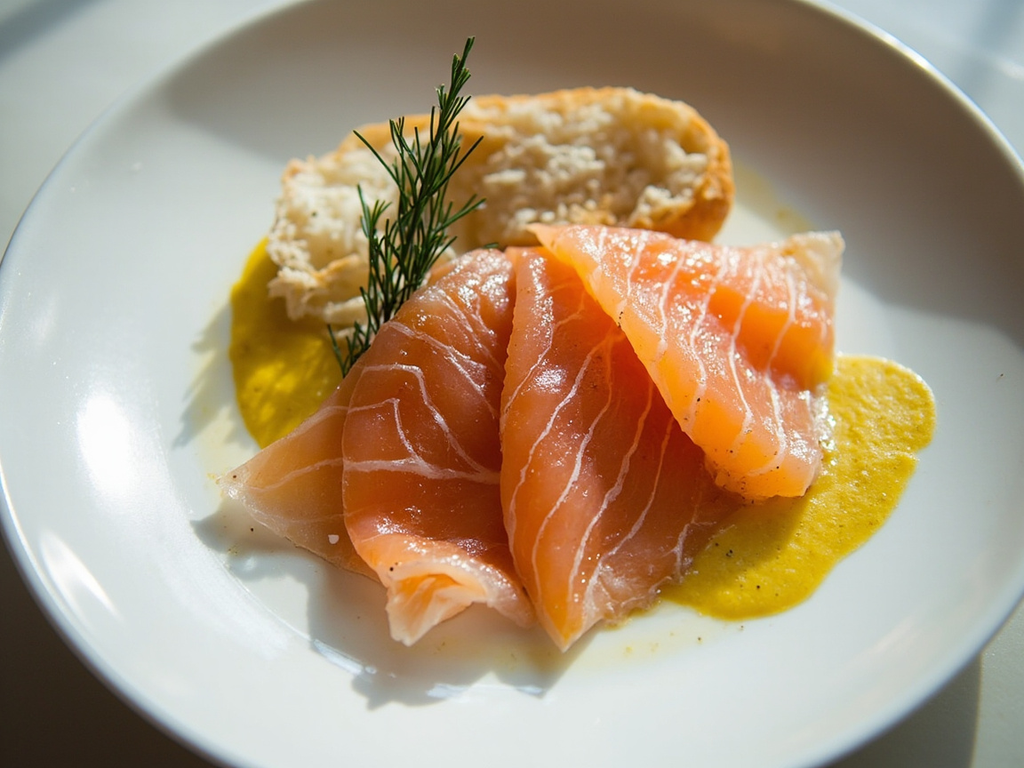
Thin slices of raw salmon, cured for several days in salt, sugar, and dill until silky and translucent. Served with a mustard-dill sauce (hovmästarsås) and rye bread. The cold elegance of the Swedish table.
I'll admit that evening in Stockholm, I was a bit intimidated — you don't get a Nobel every day, and there had only been two women before me in physics. But what a feast! The Swedes have such a refined way of preparing salmon: no cooking, just salt, sugar, lots of dill, and patience for two or three days. The result is melting, fresh, almost delicate. For an Ontario girl used to poutine, it was a whole other world — and a memory I treasure.
- •Very fresh salmon fillet with skin — a nice piece (base)
- •Salt — generous (curing)
- •Sugar — generous (balance curing)
- •Fresh dill — a large bunch (signature Nordic aroma)
- •Coarsely ground pepper — a little (seasoning)
Swedish Banquet Gravlax (Dill-Cured Salmon)
Thin slices of raw salmon, cured for several days in salt, sugar, and dill until silky and translucent. Served with a mustard-dill sauce (hovmästarsås) and rye bread. The cold elegance of the Swedish table.
Why this dish? In December 2018, Donna Strickland received the Nobel Prize in Physics in Stockholm — only the third woman to do so. Gravlax, Sweden's iconic cured salmon, evokes the great Nordic celebration and the official feast that crown a lifetime of research.
I'll admit that evening in Stockholm, I was a bit intimidated — you don't get a Nobel every day, and there had only been two women before me in physics. But what a feast! The Swedes have such a refined way of preparing salmon: no cooking, just salt, sugar, lots of dill, and patience for two or three days. The result is melting, fresh, almost delicate. For an Ontario girl used to poutine, it was a whole other world — and a memory I treasure.
Ingredients (period version)
- Very fresh salmon fillet with skin — a nice piece (base)
- Salt — generous (curing)
- Sugar — generous (balance curing)
- Fresh dill — a large bunch (signature Nordic aroma)
- Coarsely ground pepper — a little (seasoning)
Ingredients
- Extra-fresh salmon fillet with skin (sashimi grade) — 500 g (base)
- Coarse salt — 60 g (curing)
- Sugar — 50 g (balance)
- Chopped fresh dill — 1 large bunch (signature aroma)
- Coarsely ground black pepper — 1 tsp (seasoning)
- Mild mustard + strong mustard — 2 tbsp total (hovmästarsås sauce)
- Vinegar and neutral oil — 1 tbsp + 4 tbsp (sauce)
- Rye bread — as needed (accompaniment)
Method
- Mix coarse salt, sugar, and pepper. Place half the dill in the bottom of a dish.
- Place salmon skin-side down, cover with salt-sugar mixture, then remaining dill.
- Cover with plastic wrap, place a weight (a board + a can) on top, and cure for 48-72 hours in the refrigerator, turning the fillet daily and discarding any liquid that accumulates.
- Rinse quickly, pat dry, then slice very thinly on the bias, leaving the skin.
- Prepare sauce by whisking mustards, a pinch of sugar, vinegar, oil, and chopped dill.
- Serve slices with sauce and rye bread. Such a long cure requires impeccable fish: buy extra-fresh and keep well chilled.
How it was made : Gravlax (from grav, 'buried', and lax, 'salmon') dates back to a medieval Scandinavian technique where fishermen buried salted salmon to lightly ferment it. The modern version, simply cured with salt-sugar-dill, has become a classic of Swedish festive tables and Christmas cuisine (julbord).
The contemporary twist : Arrange the slices in a radiating fan around a dollop of sauce, like a 'light pulse' — a nod to the pulsed laser that earned Strickland her Nobel.
Donna Strickland · Charactorium