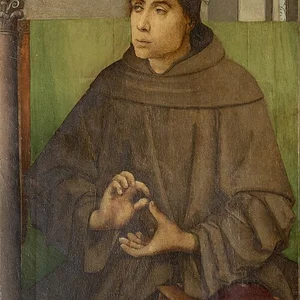

John Duns Scotus was a Scottish Franciscan philosopher and theologian, one of the major figures of late scholasticism. Nicknamed the “Subtle Doctor” for the refinement of his reasoning, he profoundly renewed medieval metaphysics.
Duns Scotus(1266 — 1308)
John Duns Scotus
royaume d'Écosse
6 min read
Frequently asked questions
Key Facts
- Born around 1266 in Duns, Scotland, he entered the Franciscan order and was ordained a priest in 1291
- Taught at the University of Oxford and then in Paris at the turn of the 13th and 14th centuries
- Developed the notion of the univocity of being and the concept of “haecceity” (the principle of individuation)
- Defended the doctrine of the Immaculate Conception of the Virgin Mary, later recognized as dogma
- Died in 1308 in Cologne; he was beatified by the Catholic Church in 1993
Works & Achievements
His masterwork, a personal revision of his commentary on the Sentences. It sets out the essentials of his metaphysics and theology.
The first version of his Oxford lectures on the Sentences, the working basis for the Ordinatio.
Notes taken by his students during his Paris lectures on the Sentences, reflecting the development of his thought.
A short treatise demonstrating the existence and infinity of God, regarded as a high point of medieval natural theology.
Questions on Aristotle's Metaphysics in which he develops his famous thesis of the univocity of being.
Free debates on a variety of questions, a prestigious exercise reserved for established masters of theology.
Anecdotes
John Duns Scotus was nicknamed the “subtle doctor” (Doctor Subtilis) by his contemporaries, so fine and meticulous were his distinctions and his reasoning. This reputation for extreme subtlety earned him immense admiration in medieval universities, where his arguments were studied as models of precision.
In the early sixteenth century, his followers, the “Scotists,” fiercely opposed the disciples of Thomas Aquinas in university debates. Later, opponents mocked these theologians, deemed too hair-splitting, by calling them “dunses”: it is from his name, Duns, that the English word “dunce” comes — an ironic turnaround for one of the sharpest minds of his time.
Duns Scotus vigorously defended the idea that the Virgin Mary had been preserved from original sin from the moment of her conception (the Immaculate Conception), while many theologians, including Thomas Aquinas, doubted it. His argument gradually prevailed, and the Church made it an official dogma in 1854, more than five centuries after his death.
He taught successively at Oxford, Paris, and then Cologne, traveling across the Europe of the universities. He died suddenly in Cologne in 1308, at only about 42 years old, leaving behind an immense body of work that was often unfinished and difficult for his students to reconstruct.
Pope John Paul II beatified him in 1993, recognizing the spiritual value of this Franciscan thinker nearly seven centuries after his death. A persistent legend, almost certainly false, claims that he was buried alive by mistake — which says much about the mysterious aura surrounding his figure.
Primary Sources
In his present state, man needs a revealed supernatural doctrine, for by his natural powers alone he cannot know the end toward which he is ordained.
May You, the First Principle of things, grant me to believe, to understand, and to bring to light what may please Your majesty and raise our minds toward Its contemplation.
Being is predicated of God and of the creature univocally, that is, according to a single and common concept, without which no certain knowledge of God would be possible from creatures.
God could preserve Mary from original sin; it was fitting that He should do so; therefore He did it.
Key Places
Small town in southern Scotland from which John Duns Scotus takes his name. It was there that he was born around 1266.
Great English intellectual centre where Duns Scotus studied and commented on the Sentences of Peter Lombard. There he laid the foundations of his philosophy.
Capital of medieval Christian theology, where Duns Scotus taught and earned the title of master of theology around 1304.
Rhineland city where Duns Scotus was sent to teach in 1307. He died there in 1308 and was buried there.
Place where John Duns Scotus was ordained a priest in 1291 within the Order of Friars Minor.
Typical Objects

Peter Lombard's collection of *Sentences* served as the basic textbook that every theologian was expected to comment upon. **Duns Scotus**'s commentaries on this text constitute his major work.

A robe of brown wool tied with a cord bearing three knots, a sign of the poverty of the order founded by **Saint Francis**. **Duns Scotus** wore it throughout his life as a friar.

The tools of medieval writing — a sharpened goose quill and black ink, indispensable to the drafting work of a scholastic master. **Duns Scotus** often dictated to secretaries.

An elevated seat from which the master read and commented on texts before his students. Teaching “from the chair” was the mark of a doctor of theology.

A large volume of parchment bound in leather and wood, containing works copied by hand. **Duns Scotus**'s writings circulated in this form between **Oxford**, **Paris**, and **Cologne**.

A wax impression authenticating the official acts of medieval universities. It symbolized the official authority granted to graduates and to institutions of learning.
School Curriculum
Vocabulary & Tags
Key Vocabulary
Daily Life
Morning
Woken before dawn by the bells, Duns Scotus would join his fellow Franciscan friars for the offices and the prayer of matins. After Mass, he devoted the morning to careful reading of sacred and philosophical texts.
Afternoon
The afternoon was the time for teaching: from his chair he read and commented on the *Sentences* or Aristotle before students who had come from all over Europe. Then came disputations, intellectual contests in which one defended theses by the sheer force of reasoning.
Evening
In the evening, after the office of compline, he returned to writing, dictating or revising his commentaries by candlelight. The silence of the friary fostered the meditation and meticulous work that made his reputation.
Food
Like every Franciscan, he followed a simple and frugal diet: bread, vegetable soup, beans, sometimes fish, rarely meat. Fasts and abstinences set the rhythm of the liturgical year.
Clothing
He wore the brown homespun habit of the Friars Minor, girded with a cord of three knots recalling the vows of poverty, chastity, and obedience. Barefoot in sandals, he lived without any personal possessions.
Housing
He lodged in the austere cells of the Franciscan friaries of Oxford, Paris, and then Cologne. These communities, close to the universities, combined an ordered religious life with intense intellectual activity.
Historical Timeline
Period Vocabulary
Liens externes & ressources
Références
Œuvres
Ordinatio (Opus Oxoniense)
vers 1300-1304
Lectura
vers 1298-1299
Reportata Parisiensia
vers 1302-1304
Tractatus de Primo Principio
vers 1305
Quaestiones subtilissimae in Metaphysicam Aristotelis
vers 1300
Quaestiones Quodlibetales
vers 1306-1307