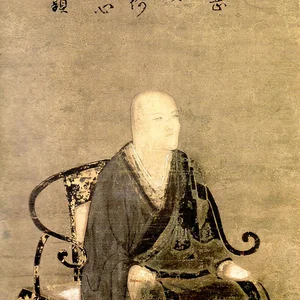

Japanese Buddhist monk of the 13th century, founder of the Sōtō school of Zen in Japan. After a stay in China, he taught the practice of seated meditation (zazen) and wrote the Shōbōgenzō, a major work of Buddhist thought.
Dogen
Dogen
6 min read
Frequently asked questions
Famous Quotes
« To study the Way is to study the self. To study the self is to forget the self.»
Key Facts
- Born in 1200 in Kyoto, into the Japanese aristocracy.
- Traveled to China in 1223, where he received the teaching of master Rujing in the Caodong (Sōtō) tradition.
- Back in Japan around 1227, he introduced and organized the Sōtō school of Zen.
- Wrote the Shōbōgenzō (“The Treasury of the True Dharma Eye”), his masterwork.
- Founded the temple Eihei-ji in 1244; died in 1253.
Works & Achievements
A collection of about a hundred texts written in Japanese, regarded as one of the major philosophical and religious works in the history of Japan.
Dōgen's first text after his return from China, a concise manual setting out the posture and spirit of seated meditation.
A treatise that turns the preparation of meals into a full spiritual practice in its own right, an example of the attention given to everyday acts.
A set of rules organizing communal life at Eihei-ji, from waking to meals and ceremonies.
A short collection of advice meant for disciples committing themselves to the practice of Zen.
By establishing at Eihei-ji the lineage he received from Rujing, Dōgen founded the Sōtō school in Japan, one of the great branches of Zen still alive today.
Anecdotes
Orphaned at a very young age, Dōgen is said to have been deeply shaken upon seeing the incense smoke rise at his mother's funeral: this image of the impermanence of all things reportedly convinced him to become a monk around the age of twelve.
As a young monk, Dōgen was tormented by a question: if all beings already possess the Buddha-nature, why must one train and meditate? No Japanese master could satisfy him, which drove him to leave in search of the answer in China.
In China, Dōgen is said to have attained his awakening upon hearing his master Rujing rebuke a monk who was dozing during meditation, with the phrase “casting off body and mind” (shinjin datsuraku). This experience became the heart of his teaching.
It is said that instead of bringing back precious sutras or relics from China, Dōgen claimed to have returned “empty-handed,” having only understood that “the eyes are horizontal and the nose is vertical”: awakening is nothing other than seeing things as they truly are.
Dōgen attached spiritual importance to the most ordinary tasks: he wrote an entire text of instructions for the monastery cook (*Tenzo kyōkun*), asserting that preparing rice with total attention was worth as much as seated meditation.
Primary Sources
To study the Way of the Buddha is to study oneself. To study oneself is to forget oneself. To forget oneself is to be awakened by the ten thousand things.
Think from the depths of non-thinking. How does one think from the depths of non-thinking? Beyond thinking. This is the essential art of zazen.
When you prepare the meal for the community, handle even a single leaf of a vegetable with sincere care, as if it were your own body.
The time we call "being-time" means that time itself is being, and that all being is time.
Key Places
Imperial capital of Japan, where Dōgen is said to have been born into the aristocracy and where he died in 1253.
Great monastery of the Tendai school overlooking Kyōto, where Dōgen received his first monastic training.
Monastery in Zhejiang where Dōgen studied under Master Rujing and attained enlightenment during his stay in Song-dynasty China.
First independent monastery founded by Dōgen near Kyōto, where he began writing the Shōbōgenzō.
Monastery founded by Dōgen in 1244 in the mountains of Echizen Province; it remains today the great mother temple of the Sōtō school.
Seat of the shogunal government, where Dōgen stayed briefly in 1247 at the invitation of the regent Hōjō Tokiyori.
Typical Objects

A firm, round cushion on which the practitioner sits for zazen, in order to keep the back straight during long periods of stillness.

A rectangular robe made of pieces of cloth sewn together and worn over the shoulder. For Dōgen, it symbolizes the direct transmission of the Buddha's teaching.

A set of nested bowls used by monks to eat according to a precise ritual, without wasting the smallest scrap of food.

A suspended wooden board struck with a mallet to mark the rhythm of the monastery's day, notably the call to meditation.

Calligraphy tools with which Dōgen wrote his masterwork in Japanese rather than Chinese, a rare choice for a scholarly text of the time.

Sticks or powder burned during ceremonies and meditation. Its fleeting smoke evoked for Dōgen the impermanence of all things.
School Curriculum
Vocabulary & Tags
Key Vocabulary
Daily Life
Morning
The day began before dawn: woken by the sound of the struck wooden board, Dōgen and his monks made their way in silence to the meditation hall for a long session of zazen. This was followed by the morning chants and offerings before the altar.
Afternoon
The afternoon combined manual labor (samu) with study: maintaining the monastery, gardening, copying texts, or teaching the disciples. Dōgen insisted that every task, even the humblest, be carried out with full attention.
Evening
In the evening the community gathered once more for zazen and sometimes for a talk by the master commenting on a text or a kōan. Bedtime came early and in silence, in strict observance of the monastic schedule.
Food
The diet was vegetarian and frugal, based on rice, miso soup, vegetables, and grains, in keeping with Buddhist precepts. Meals were taken in silence, using the ōryōki bowls, wasting nothing.
Clothing
Dōgen wore the dark robe of the monks (monastic kimono) covered by the patched kesa, a symbol of the transmitted teaching. His head was shaved and his feet shod in simple sandals.
Housing
He lived in the plain wooden buildings of the monasteries, first near Kyōto and then at Eihei-ji, in the snowy mountains of Echizen. The monks slept and meditated in the common hall (sōdō), on thin mats.
Historical Timeline
Period Vocabulary
Liens externes & ressources
Références
Œuvres
Shōbōgenzō (Le Trésor de l'œil de la vraie Loi)
1231-1253
Fukan zazengi (Règles universelles pour la pratique du zazen)
vers 1227
Tenzo kyōkun (Instructions au cuisinier)
1237
Eihei Shingi (Règles monastiques d'Eihei)
vers 1246
Gakudō yōjinshū (Points de vigilance dans l'étude de la voie)
1234
Fondation de l'école Sōtō
à partir de 1244