 flip
flipBarley and Lentil Soup of the Refectory
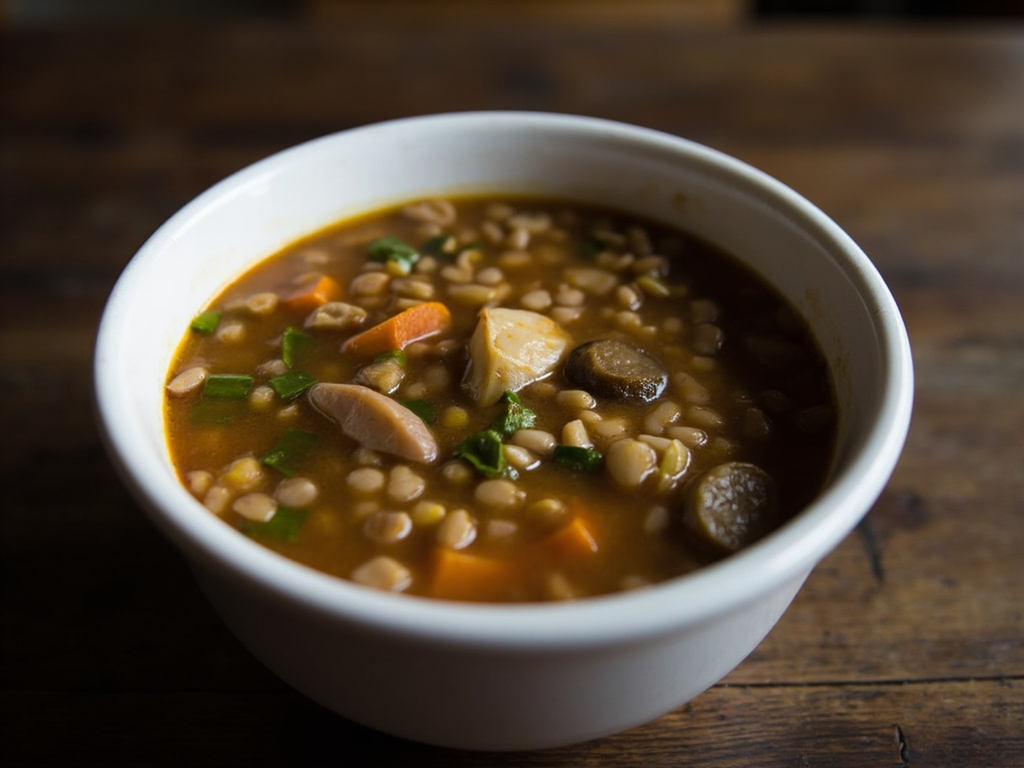
Barley and Lentil Soup of the Refectory
Why this dish? Entering the Carmel of Cologne in 1933 under the name Teresa Benedicta of the Cross, Edith adopted the austere dietary rule of the Discalced Carmelites: simple meals, often without meat, vegetables from the cloister garden, eaten in silence. This thick soup is the very image of that stripped-down life.
A nourishing soup of pearl barley and lentils, flavored with root vegetables and a knob of butter, exactly the kind of meatless dish that satisfied the sisters without breaking abstinence.
At the Carmel, we did not seek the table of the rich. A soup of barley and lentils, a few vegetables from the cloister garden, and that was enough to sustain the body so that it might serve the soul. I tell you simply: there is, in a poor meal eaten in silence and thanksgiving, a fullness that banquets do not know.
- •Pearl barley — a handful (satisfying grain)
- •Lentils — a handful (meatless protein)
- •Carrots, leek, onion — from the garden (base vegetables)
- •Potatoes — two or three (sweetness and body)
- •Butter — a knob (fat binder allowed outside strict fast)
- •Salt, bay leaf, parsley — to taste (simple seasoning)
Barley and Lentil Soup of the Refectory
A nourishing soup of pearl barley and lentils, flavored with root vegetables and a knob of butter, exactly the kind of meatless dish that satisfied the sisters without breaking abstinence.
Why this dish? Entering the Carmel of Cologne in 1933 under the name Teresa Benedicta of the Cross, Edith adopted the austere dietary rule of the Discalced Carmelites: simple meals, often without meat, vegetables from the cloister garden, eaten in silence. This thick soup is the very image of that stripped-down life.
At the Carmel, we did not seek the table of the rich. A soup of barley and lentils, a few vegetables from the cloister garden, and that was enough to sustain the body so that it might serve the soul. I tell you simply: there is, in a poor meal eaten in silence and thanksgiving, a fullness that banquets do not know.
Ingredients (period version)
- Pearl barley — a handful (satisfying grain)
- Lentils — a handful (meatless protein)
- Carrots, leek, onion — from the garden (base vegetables)
- Potatoes — two or three (sweetness and body)
- Butter — a knob (fat binder allowed outside strict fast)
- Salt, bay leaf, parsley — to taste (simple seasoning)
Ingredients
- Pearl barley — 80 g (grain)
- Green lentils — 100 g (legume)
- Carrots — 2 (sweetness)
- Leek — 1 (aromatic)
- Onion — 1 (base)
- Potatoes — 2 medium (body of the soup)
- Butter — 20 g (richness)
- Bay leaf — 1 (flavor)
- Vegetable broth or water — 1.5 L (base)
- Salt, pepper, parsley — to taste (seasoning)
Method
- Rinse the barley and lentils. Slice the onion and leek, dice the carrots and potatoes.
- Melt the butter in a large pot and sweat the onion and leek without browning.
- Add the barley, lentils, carrots, bay leaf, then pour in the broth. Bring to a boil.
- Simmer covered for 30 minutes, add the potatoes and continue for 20 minutes until everything is tender.
- Season with salt and pepper, sprinkle with parsley, and serve very hot, in silence if your heart so desires.
How it was made : The Discalced Carmelites, reformed by Saint Teresa of Avila in the 16th century, followed a rule of almost permanent abstinence from meat and long fasts. The menu relied on vegetables from the garden, legumes, grains, and bread. Soup, economical and warm, was the mainstay of the meal, taken in the refectory while a sister read a spiritual text aloud.
The contemporary twist : A drizzle of hazelnut oil and a few toasted rye croutons make this monastic dish surprisingly chic, without betraying its simplicity.
Sources : Teresa of Avila, Constitutions of the Order of Discalced Carmelites (on abstinence and meatless days) · Henriette Davidis, Praktisches Kochbuch, 1845 (reference German domestic cookbook, barley soups)
Edith Stein · Charactorium