 flip
flipSilesian Schalet (Sabbath Cholent)
Silesian Schalet (Sabbath Cholent)
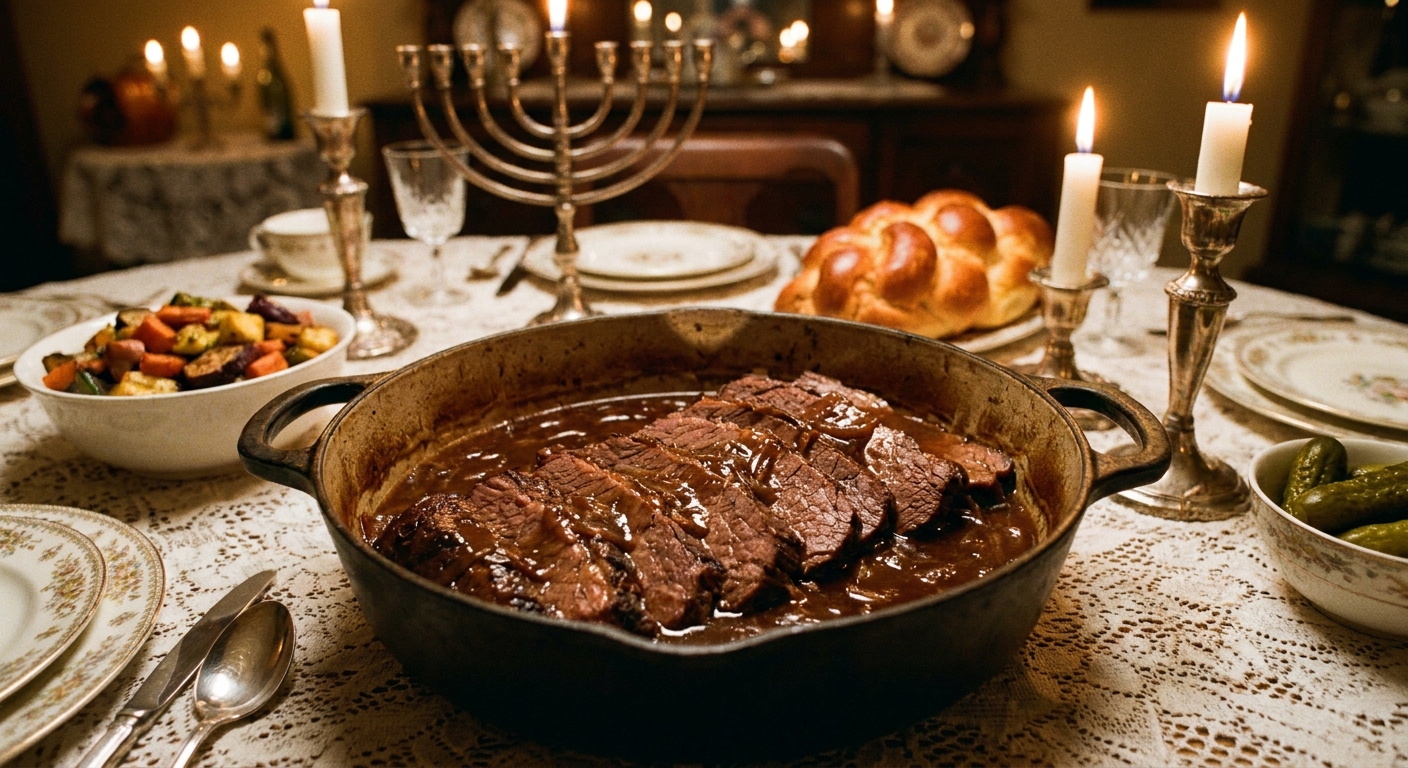
Why this dish? Edith grew up in Breslau in a Jewish family whose mother, Auguste, remained faithful to traditions. Schalet (cholent) is the quintessential Sabbath dish: it is put in the oven on Friday before sunset and cooks all night, because the Law forbids lighting a fire on the holy day. On Saturday noon, it awaits the household, meltingly tender.
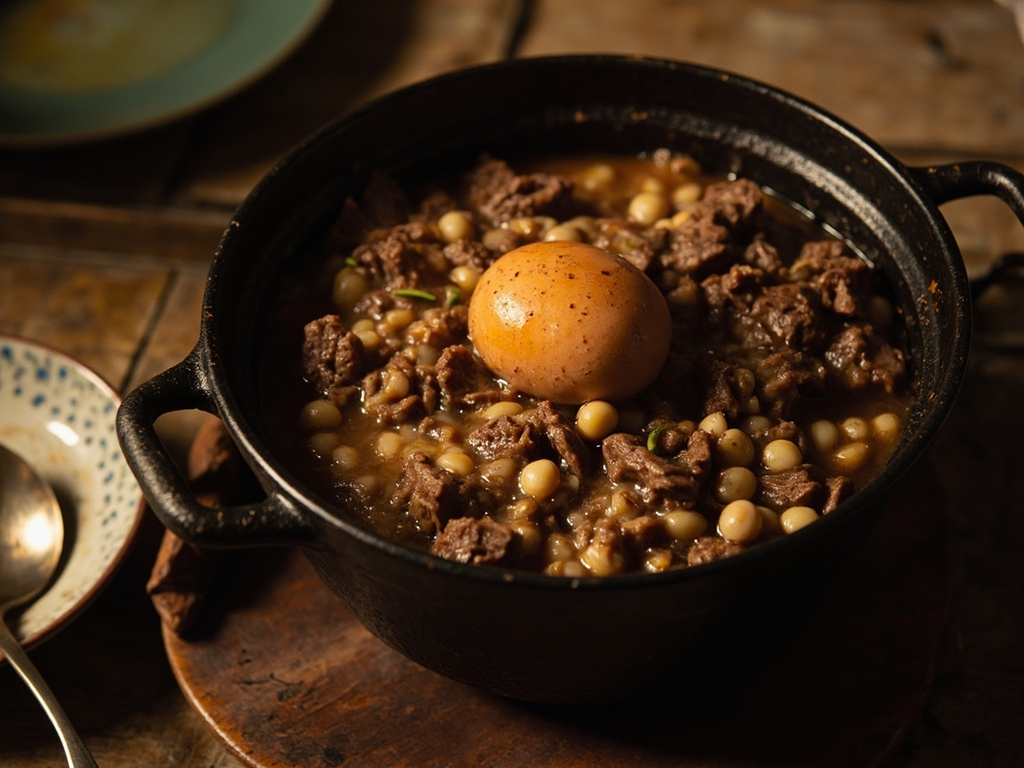
A slow, comforting stew of barley, white beans, beef, and eggs cooked in their shells, which gently caramelize overnight. The perfect dish of patience.
Allow me to take you back to my mother's kitchen in Breslau. On Friday, before the Sabbath evening fell, she would slide the pot into the still-warm oven, for it was not permitted to light a fire on the holy day. All night, the barley, meat, and eggs simmered in silence, and on Saturday noon the dish awaited us, melting, like a gift the whole house had kept warm. I have never forgotten that smell: for me, it is the very face of faithfulness.
- •Beef brisket — a nice piece (meat that melts with slow cooking)
- •Pearl barley — two handfuls (grain that thickens and nourishes)
- •Dried white beans — a good handful, soaked the day before (creamy binder)
- •Onions — two or three (aromatic base)
- •Potatoes — a few (melting sweetness)
- •Whole eggs in their shells — one per guest (brown and flavor)
- •Goose fat (schmaltz) — a spoonful (traditional fat)
- •Sweet paprika, salt, pepper — to taste (seasoning)
Silesian Schalet (Sabbath Cholent)
A slow, comforting stew of barley, white beans, beef, and eggs cooked in their shells, which gently caramelize overnight. The perfect dish of patience.
Why this dish? Edith grew up in Breslau in a Jewish family whose mother, Auguste, remained faithful to traditions. Schalet (cholent) is the quintessential Sabbath dish: it is put in the oven on Friday before sunset and cooks all night, because the Law forbids lighting a fire on the holy day. On Saturday noon, it awaits the household, meltingly tender.
Allow me to take you back to my mother's kitchen in Breslau. On Friday, before the Sabbath evening fell, she would slide the pot into the still-warm oven, for it was not permitted to light a fire on the holy day. All night, the barley, meat, and eggs simmered in silence, and on Saturday noon the dish awaited us, melting, like a gift the whole house had kept warm. I have never forgotten that smell: for me, it is the very face of faithfulness.
Ingredients (period version)
- Beef brisket — a nice piece (meat that melts with slow cooking)
- Pearl barley — two handfuls (grain that thickens and nourishes)
- Dried white beans — a good handful, soaked the day before (creamy binder)
- Onions — two or three (aromatic base)
- Potatoes — a few (melting sweetness)
- Whole eggs in their shells — one per guest (brown and flavor)
- Goose fat (schmaltz) — a spoonful (traditional fat)
- Sweet paprika, salt, pepper — to taste (seasoning)
Ingredients
- Beef brisket or chuck — 800 g (braising meat)
- Pearl barley — 150 g (grain)
- Dried white beans — 150 g (soaked 12 h) (binding legume)
- Onions — 3 large, sliced (base)
- Potatoes — 4 medium, in large chunks (melting garnish)
- Whole raw eggs, in shell — 4 to 6 (cholent 'brown eggs')
- Goose fat or oil — 2 tbsp (fat)
- Sweet paprika — 1 tsp (color and flavor)
- Boiling water — enough to cover generously (cooking broth)
Method
- Soak the white beans the night before, then drain.
- In a cast-iron pot, melt the fat and brown the sliced onions, then sear the meat on all sides.
- Add the barley, beans, potatoes, paprika, salt, and pepper. Nestle the raw eggs in their shells among the ingredients.
- Pour in boiling water to cover generously, bring to a simmer on the stovetop.
- Cover and bake at a very low temperature (110-120°C) for 8 to 12 hours, without disturbing (or in a slow cooker overnight).
- In the morning, shell the eggs that have turned brown and creamy, and serve everything piping hot, straight from the pot.
How it was made : Cholent (schalet in Western Yiddish and Silesia) responds to a religious constraint: no fire may be lit on the Sabbath day. Families used to deposit their sealed pot at the neighborhood baker's, whose oven remained warm all night after the last batch. Each Jewish region had its variant; the Silesian version, close to the Germanic world, favored barley and beans.
The contemporary twist : Serve it in small individual cocottes with the brown egg placed whole on top, like a treasure emerged from the night.
Sources : Edith Stein, Life of a Jewish Family (Aus dem Leben einer jüdischen Familie), unfinished autobiography, written 1933-1939 · Claudia Roden, The Book of Jewish Food, 1996 (chapter on Ashkenazi cholent)
Edith Stein · Charactorium