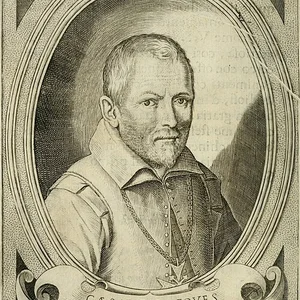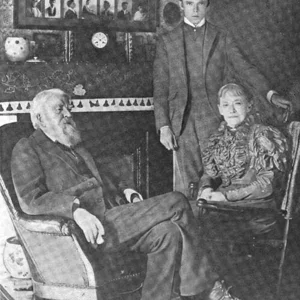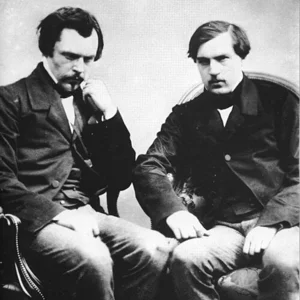

French writer brothers and art critics, they were the co-founders of literary naturalism with novels such as Germinie Lacerteux (1864). Their Journal, kept from 1851 to 1896, is a landmark record of artistic and literary life in the 19th century. In his will, Edmond established the Académie Goncourt, which has awarded France's most prestigious literary prize since 1903.
Edmond and Jules de Goncourt
Edmond de Goncourt and Jules de Goncourt
9 min read
Frequently asked questions
Famous Quotes
« We were the first to write about the woman of the people, the true woman, the woman without pretense or lies. (Preface to Germinie Lacerteux, 1864)»
Key Facts
- 1822: Birth of Edmond de Goncourt; 1830: birth of Jules de Goncourt
- 1851: Beginning of the Journal, kept until Edmond's death in 1896
- 1864: Publication of Germinie Lacerteux, the founding novel of French naturalism
- 1870: Death of Jules de Goncourt; Edmond continues their shared work alone
- 1896: Edmond's will establishes the Académie Goncourt; first Prix Goncourt awarded in 1903
Works & Achievements
The first novel co-signed by the two brothers, it marks their entry into literature through realism and precise documentation. Seldom read today, it already foreshadows their method of clinical observation of reality.
A founding novel of naturalism, inspired by their own servant Rose Malingre, an alcoholic and libertine. The preface asserts the right to write about the working classes with the rigor of a clinician, preceding Zola by more than a decade.
The portrait of an independent and modern young woman clashing with bourgeois conventions. A psychological and social novel admired for the finesse of its writing and the modernity of its heroine.
A novel about the world of painters and models in Montmartre, a direct reflection of the artistic life the Goncourts observed daily. One of the first works to depict the art world with documented realism.
The last novel co-signed by the two brothers, about a woman swept away by Roman mysticism. Considered their most accomplished joint work from a stylistic standpoint, it closes eighteen years of fraternal collaboration.
A daily chronicle of nineteenth-century artistic and literary life, kept for forty-five years. An irreplaceable historical source, the Journal delivers vivid portraits of Flaubert, Zola, Daudet, Turgenev, and Princess Mathilde.
Pioneering monographs devoted to the Japanese masters of the woodblock print, published by Edmond alone. These essays contributed decisively to the recognition of Japanese art in Europe and to nurturing Japonisme among Impressionist and Post-Impressionist painters.
Anecdotes
Edmond and Jules de Goncourt formed such a tightly fused writing partnership that they composed their novels and their Journal together, sentence by sentence. When Jules died of cerebral syphilis in June 1870, Edmond confessed that he felt as though he had lost half of himself; he went on to keep the Journal alone for twenty-six years, like an endless dialogue with his vanished brother.
The Goncourts were among the very first French people to collect Japanese art, long before the word "japonisme" even existed. As early as the 1860s, they were buying ukiyo-e prints, lacquerware, and porcelain from a Parisian shop run by a dealer on the Rue de Rivoli. Their enthusiasm helped bring Japanese aesthetics to artists such as Degas, Monet, and Van Gogh.
The preface to Germinie Lacerteux (1864) is a genuine literary manifesto: in it, the brothers claim the right to write about ordinary working people with the same clinical rigor a physician brings to examining a patient. This short, hard-hitting text is considered the birth certificate of naturalism in France, preceding Zola by several years.
Every Sunday, Edmond de Goncourt hosted a literary *grenier* — an informal attic gathering — at his home in Auteuil, welcoming Zola, Daudet, Maupassant, and many others. These meetings, known as the *dîners du grenier*, were so celebrated that they shaped the entire literary life of Paris throughout the 1880s and 1890s. It was in this spirit of intellectual fellowship that Edmond conceived the Académie Goncourt in his will.
The first Prix Goncourt, awarded in 1903, was immediately controversial: the jury, made up of the ten academicians named in Edmond's will, honored John-Antoine Nau for Force ennemie, a choice that puzzled many readers. Ever since, the prize has been one of France's most talked-about literary events each year, with the power to send a novel's sales soaring.
Primary Sources
Living in the nineteenth century, in an age of universal suffrage, democracy, and liberalism, we asked ourselves whether what are called the lower classes did not have a right to the Novel.
My brother died this morning. I remain alone in an apartment where everything speaks of him, where his hand has touched every object. I feel as though I am no more than half a man.
We found, in a curiosity shop, Japanese albums of such fantasy and unexpectedness that we were enchanted; drawings of a lightness, a vivacity, a naturalness that European art almost never achieves.
My wish is that my income be used to found an annual literary prize awarded to the author of the best imaginative prose work published in the year.
Key Places
Birthplace of Edmond de Goncourt (born **26 May 1822**). Nancy, a city of baroque and rococo art and heir to the Duchy of Lorraine, nurtured Edmond's love of decorative beauty and refined craftsmanship from childhood.
Edmond de Goncourt's home in Auteuil, where he settled after Jules's death. Every Sunday he hosted the celebrated "grenier dinners," gathering Zola, Daudet, Maupassant, and the literary elite of the nascent Third Republic.
A niece of Napoleon I, Princess Mathilde hosted the most celebrated social and intellectual salon of the Second Empire, where the Goncourts mingled with Flaubert, Sainte-Beuve, Turgenev, and Gautier. It was here that they built the core of their literary and artistic network.
Since **1914**, the Académie Goncourt has gathered monthly at Restaurant Drouant to deliberate and, each November, to award the Prix Goncourt. The venue embodies the lasting legacy of Edmond de Goncourt's testamentary bequest.
The country house where Edmond de Goncourt died on **16 July 1896**, while visiting his friend Alphonse Daudet. He often spent summers there writing and entertaining guests in a bucolic setting far from the bustle of Paris.
Typical Objects

The Goncourt brothers recorded every day, with the precision of entomologists, conversations, literary gossip, and observations of social customs. These notebooks, kept without interruption from 1851 to 1896, represent one of the most complete accounts of intellectual and artistic life in nineteenth-century France.

Edmond and Jules collected hundreds of Japanese prints — Hokusai, Utamaro, Hiroshige — long before the general public discovered this art form. Their collection helped spread Japonisme through Parisian artistic circles and influenced the Impressionist painters.

The Goncourts wrote their novels and their Journal with a quill pen, refining a style known as “écriture artiste” — with carefully crafted phrases, rare adjectives, and images borrowed from painting. Each page was worked like a canvas.

Passionate about Rococo art, the brothers filled their apartment and later their Auteuil attic with pastels, Sèvres porcelain, drawings by Fragonard, and Louis XV furniture. Their essays on Watteau and Boucher helped rehabilitate an entire century of French art that official Classicism had long dismissed.

The Goncourts were regular visitors to the Hôtel Drouot and art dealers, poring over catalogues in search of a rare curiosity or an overlooked drawing. This daily practice as collectors nourished their intimate knowledge of art and its markets.

The brothers meticulously corrected their proofs before printing, attaching extreme importance to style and sometimes even to typography. Their handwritten corrections bear witness to a stylistic rigor rarely seen in the literary world of the nineteenth century.
School Curriculum
Vocabulary & Tags
Key Vocabulary
Daily Life
Morning
The Goncourt brothers rose early and devoted their mornings to writing. They worked side by side at the same desk, passing sheets back and forth and correcting each other's sentences. Their method was to first document their subject — visiting working-class neighborhoods, reading medical or judicial archives — before sitting down to write.
Afternoon
Afternoons were reserved for hunting curios and visiting artists' studios. The Goncourts would make the rounds of the Hôtel Drouot, the dealers around the Palais-Royal, and the Japanese print shops, notebook in hand to jot down impressions and prices, steadily gathering material for their art essays.
Evening
Their evenings were thoroughly social: the brothers frequented Princess Mathilde's salon and the famous dinners at Magny's alongside Flaubert and Sainte-Beuve. Back home, they recorded the night's conversations in their *Journal* with the unflinching precision of born chroniclers.
Food
As prosperous Parisian bourgeois, the Goncourts often dined out — at Magny's, Brébant, or Bignon — where the entire intelligentsia gathered. Their *Journal* records hearty meals washed down with good wine, but above all memorable conversations with Flaubert, Gautier, or Turgenev that fed the mind as much as the body.
Clothing
The brothers dressed in the elegant style of the well-to-do bourgeois of the Second Empire: dark frock coat, carefully knotted cravat, and a top hat for outings in town. Edmond, known for his refined taste, paid close attention to the quality of fabrics and cultivated an overall distinguished appearance — polished, but never showy.
Housing
They first lived in well-appointed Parisian apartments before Edmond settled into his house in Auteuil. This *grenier* — in reality a sprawling apartment filled with 18th-century works of art, Japanese lacquerware, and sculpture — served at once as their private museum, their writing studio, and the beating heart of Parisian literary life in the 1880s.
Historical Timeline
Period Vocabulary
Liens externes & ressources
Références
Œuvres
Germinie Lacerteux
1864
Renée Mauperin
1864
Manette Salomon
1867
Madame Gervaisais
1869
Journal (1851-1896)
1851-1896
Utamaro (1891) et Hokousaï (1896)
1891-1896