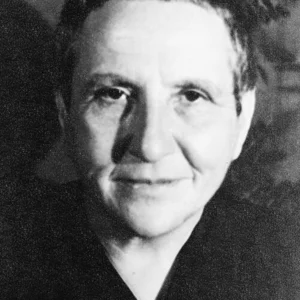

An American writer and art critic living as an expatriate in Paris, Gertrude Stein was a central figure of the literary and artistic avant-gardes of the early 20th century. Her salon on the rue de Fleurus brought together Picasso, Matisse, Hemingway, and Fitzgerald.
Gertrude Stein(1874 — 1946)
Gertrude Stein
États-Unis
8 min read
Frequently asked questions
Famous Quotes
« A rose is a rose is a rose is a rose.»
« America is my country and Paris is my hometown.»
Key Facts
- 1874: Born in Allegheny (Pennsylvania), United States
- 1903: Permanent move to Paris, at 27 rue de Fleurus
- 1909: Publication of *Three Lives*, her first major work
- 1933: Publication of *The Autobiography of Alice B. Toklas*, her popular success
- 1946: Death in Paris, on July 27
Works & Achievements
Stein's first published book, consisting of three portraits of working-class American women. It inaugurates her repetitive style and use of the continuous present, influenced by Cézanne and William James.
A prose poetry collection organized around objects, foods, and rooms of a house. Regarded as one of the founding texts of American literary modernism, it breaks radically with conventional syntax.
A sprawling novel of more than 900 pages tracing the history of an American family across three generations. Written between 1906 and 1908, it remains Stein's most formally ambitious work.
Stein's memoirs written in the first person as though Alice herself were speaking. This lively, witty narrative brought Stein to a wide audience and remains her most widely read work.
An opera libretto set to music by Virgil Thomson and premiered on Broadway with an all-African-American cast. This groundbreaking collaborative project blends poetic abstraction with popular spectacle.
A critical essay devoted to the work of Pablo Picasso, a friend of forty years. Stein analyzes his Cubist genius and his relationship with Spain, asserting that Picasso alone truly represented the twentieth century.
A wartime journal written during the Occupation, published just before Stein's death. It documents daily life under the Vichy regime and the liberation, combining an intimate perspective with a historical one.
Anecdotes
Gertrude Stein is credited with coining the expression “Lost Generation.” A garage mechanic reportedly said to her, referring to his young and careless workers: “You are all a lost generation.” Stein adopted this phrase to describe the American writers living as expatriates in Paris after World War I, such as Hemingway and Fitzgerald. Hemingway immortalized this conversation in his memoir *A Moveable Feast*.
The salon at 27 rue de Fleurus, which Gertrude Stein shared with her companion Alice B. Toklas, was covered wall to wall with paintings by Picasso, Matisse, and Cézanne — purchased for a few francs before these artists became famous. The walls were so densely hung with canvases that visitors said they were walking into a private museum. Picasso came to visit her nearly every week and painted several portraits of her.
During World War I, Gertrude Stein obtained a Ford Model T and drove supply convoys for French military hospitals. She and Alice traveled the country roads delivering medical supplies, an effort that earned them the Médaille de la Reconnaissance française. This experience deeply shaped her vision of war and modernity.
Her literary style, marked by obsessive repetition and stripped-down sentences, baffled her contemporaries. Her most famous line, “Rose is a rose is a rose is a rose,” taken from the poem *Sacred Emily* (1913), was first mocked and then admired as a revolution in language. Stein sought to capture the “continuous present” of consciousness, influenced by her teacher, the philosopher William James.
During the German Occupation (1940–1944), Stein and Toklas remained at their home in Bilignin and later Culoz, in the Ain department, refusing to flee despite being Jewish. They survived through local connections and careful discretion. This troubled period remains one of the most enigmatic in her biography.
Primary Sources
She was not at all timid, she was very particular, always very particular about what she ate and drank, she had to like it enormously or she would not have it at all.
Paris is where the twentieth century is. It is not that one works better here but that one feels there is something going on.
A carafe, that is a blind glass. A kind in glass and a cousin, a spectacle and nothing strange a single hurt color and an arrangement in a system to pointing.
It is not what France gave you but what it did not take away from you that was important.
The French people are the most interesting people in the world and the most civilised and they do not separate these two things, being interesting and being civilised.
Key Places
Gertrude Stein's birthplace, now part of Pittsburgh. She was born there on February 3, 1874, into a Jewish family of Alsatian origin.
The Paris apartment where Stein lived from 1903 to 1938 with Alice B. Toklas. Her Saturday evening salons brought together Picasso, Matisse, Hemingway, Fitzgerald, and the leading figures of the avant-garde movements.
Stein studied there from 1893 to 1897 under William James, the pragmatist philosopher whose theories on consciousness profoundly shaped her literary style.
A country house rented by Stein and Toklas from 1929 onward, where they spent their summers. Stein worked in the garden there and received guests including Thornton Wilder.
Gertrude Stein underwent surgery for cancer there in July 1946 and died on July 27. It was there that her enigmatic last words about “the question” were spoken.
Typical Objects

Gertrude Stein and Alice B. Toklas used a Ford Model T to drive medical supply convoys during the Great War. This vehicle symbolizes their civic commitment and audacity in a world at war.

Stein wrote by hand, often in school exercise books, late in the evening or at night. She wrote slowly, searching for the exact rhythm of each sentence, refusing to make corrections.

The walls of the salon at rue de Fleurus were entirely covered with modernist canvases purchased at modest prices. These works formed both a pioneering collection and the everyday backdrop of Stein's life.

Alice B. Toklas typed up the manuscripts that Stein dictated to her or handed over written by hand. The Underwood typewriter was the central tool of the couple's editorial work.

Stein held court in a large armchair during Saturday evening gatherings, receiving artists and writers. This central seat embodied her role as a guiding figure and arbiter of the avant-garde.

Picasso completed this portrait after a great many sittings. The work, now at the Metropolitan Museum of Art, is one of the enduring symbols of the friendship between the two artists and of the birth of Cubism.
School Curriculum
Vocabulary & Tags
Key Vocabulary
Tags
Daily Life
Morning
Gertrude Stein rose late, rarely before ten o'clock, and had a hearty breakfast prepared by Alice B. Toklas. She never read her mail in the morning, reserving those hours for walks with her dog Basket in the Jardin du Luxembourg.
Afternoon
Afternoons were devoted to visiting artists' studios or receiving young writers whom Stein advised with authority. She could also spend hours contemplating her paintings, claiming that looking at a canvas was an act of creation in itself.
Evening
On Saturday evenings, the salon at the rue de Fleurus opened its doors to artists and intellectuals. The men would talk with Gertrude while Alice entertained their wives in a separate corner. Outside these gatherings, Stein wrote at night, in absolute quiet, sometimes producing entire texts in a few hours of inspiration.
Food
Stein had a generous appetite and a pronounced taste for traditional French bourgeois cooking, which Alice prepared with great care. She was particularly fond of the vegetables from the garden at Bilignin, local cheeses, and country wine. She never ate in a hurry and regarded mealtimes as an essential occasion for conversation.
Clothing
Stein wore loose-fitting clothes, often robes or tunics in heavy fabrics, with no particular concern for vanity. She favored comfort over elegance and was recognizable by her imposing figure and her very short, almost masculine haircut for the era.
Housing
At 27 rue de Fleurus, Stein occupied a studio apartment whose walls were entirely covered with modernist paintings. The workspace and living space blurred into one, turning the home into a living gallery. At Bilignin, she had a stone house with a large kitchen garden that Alice tended with passion.
Historical Timeline
Period Vocabulary
Liens externes & ressources
Références
Œuvres
Three Lives
1909
Tender Buttons
1914
The Making of Americans
1925
The Autobiography of Alice B. Toklas
1933
Wars I Have Seen
1945