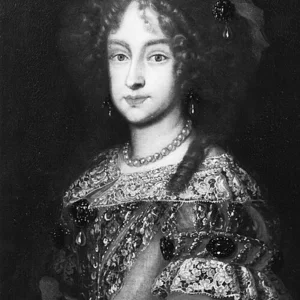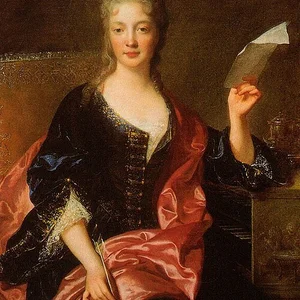

French harpsichordist and composer (1665-1729), a prodigy noticed in childhood by Louis XIV. She was one of the few women of her era to publish and have her musical works performed.
Élisabeth Jacquet de La Guerre(1665 — 1729)
Élisabeth Jacquet de La Guerre
Royaume de France
8 min read
Frequently asked questions
Key Facts
- Born in 1665 in Paris into a family of harpsichord makers and organists
- Noticed at age 5 by Louis XIV, who encouraged and protected her
- Published her Pièces de clavecin in 1687, dedicated to the Sun King
- Composed Céphale et Procris (1694), one of the few operas written by a woman in the 17th century
- Died in 1729, leaving a pioneering body of work including sonatas, cantatas, and sacred music
Works & Achievements
Her first published collection, dedicated to Louis XIV. One of the earliest musical publications by a woman in France, it displays an elegant style and remarkable technical mastery from her very youth.
The only known opera by Élisabeth, performed at the Académie royale de musique. Extraordinarily rare for a woman composer under Louis XIV, it marks the height of her public recognition.
An innovative collection blending harpsichord suites with pieces adapted for the violin, reflecting her ambition to merge French and Italian styles within the national musical tradition.
Among the first Italian-style sonatas published in France by a French composer. They helped introduce this instrumental genre — then highly fashionable across Europe — to French audiences.
Her first book of religious cantatas set to biblical texts, a genre then flourishing in France. They showcase her dual mastery of sacred music and vocal composition.
Her second collection of cantatas on subjects drawn from ancient mythology, illustrating her versatility and complete command of the vocal forms in vogue in early eighteenth-century France.
Anecdotes
Around the age of five, young Élisabeth was presented to Louis XIV at Versailles. The king, astonished by her mastery of the harpsichord, nicknamed her his “little marvel” and placed her under the protection of Madame de Montespan, his royal favorite. Élisabeth performed regularly at court, impressing the entire aristocracy with her virtuosity and prodigious musical memory.
In March 1694, her opera Céphale et Procris was performed at the Académie royale de musique in Paris — the official lyric stage founded by Lully. It was an exceptional event: virtually no female composer had until then succeeded in having a dramatic work staged in this male-dominated venue.
After the death of her husband, the organist Marin de La Guerre, in 1704, followed shortly by their only son, Élisabeth endured tremendous grief. Yet far from giving up, she continued to compose and publish, releasing her Sonatas and Cantatas between 1707 and 1711. Her artistic courage in the face of adversity earned the admiration of her contemporaries.
Élisabeth was one of the first French composers to adopt and publish the Italian-style sonata, a genre that was entirely new to France at the time. In 1707, she published sonatas for violin and harpsichord, helping to introduce this musical form — imported from Italy — into the French repertoire. It was a remarkable act of artistic and editorial boldness for a woman of her era.
The patron and writer Évrard Titon du Tillet cited her in his celebrated Parnasse François (1732), alongside the greatest musicians of the reign of Louis XIV. He noted that she had managed, despite the obstacles imposed on women, to publish her works and have them performed on the most prestigious stages — something extraordinarily rare for a female composer.
Primary Sources
I dedicate these first fruits of my labor to Your Majesty, whose kindness has always encouraged me in the arts, and who has graciously deigned to accept them.
Madame de La Guerre, née Jacquet, displayed a genius and talents for music that were admired by all that was most distinguished in France; the late King often honored her with his presence at the concerts she gave.
I endeavored to compose pieces that might suit both instruments, following the rules proper to each, and blending something of the Italian taste with that which is particular to our nation.
These cantatas are the fruit of my labors; I hope they will find favor with lovers of fine music and persons of piety who will graciously accept their offering.
Key Places
Élisabeth was born and lived in Paris, in the community of musician-craftsmen at the heart of the city. She gave private concerts at her home there and published her works with the music publishers and booksellers of the area.
It was at Versailles that Élisabeth was presented as a child to Louis XIV and where she performed regularly at court. The royal favour she enjoyed opened the doors of French aristocratic society to her.
The official stage of French opera, founded by Louis XIV, where her opera *Céphale et Procris* was performed in 1694. Gaining access to this institution was the greatest musical honour in the kingdom.
The great parish church of the Les Halles district, closely tied to the community of Parisian musicians and craftsmen in which the Jacquet family had been rooted for several generations.
Typical Objects

A plucked-string keyboard instrument at the heart of Élisabeth's entire career. She had played it since childhood before Louis XIV at Versailles and in Parisian salons throughout her life.

Essential tools for musical composition in the 17th century. Élisabeth used them to write out her scores, which she then had engraved on copper plates by Parisian music publishers.

In the Grand Siècle, printed music was reproduced by engraving onto copper plates. Élisabeth's collections circulated in this form among aristocratic and bourgeois circles.

Private concerts and composition sessions often took place in the evening by candlelight. Candlesticks were indispensable in the apartments of musicians of the era.

A large long-necked lute used to realize the basso continuo, often paired with the harpsichord in concerts. The Jacquet family, instrument makers by trade, lived alongside these instruments in their workshop every day.

Élisabeth composed cantatas on sacred texts, drawing on collections of psalms and Scripture to select her religious subjects — most notably for her *Cantates françoises* of 1708.
School Curriculum
Vocabulary & Tags
Key Vocabulary
Daily Life
Morning
Élisabeth began her day with exercises and improvisations at the harpsichord in her Parisian apartment. She then received her students — often young women from the bourgeoisie or minor nobility — for harpsichord and singing lessons.
Afternoon
The afternoon was devoted to composition and correcting scores intended for print. She would sometimes visit music publishers to oversee the engraving of her works, or receive fellow musicians for artistic exchanges and private readings of new pieces.
Evening
Her evenings were often spent at private concerts in aristocratic and bourgeois Parisian salons, where Élisabeth performed at the harpsichord before a select audience. She also took part in the *concerts spirituels* and music academies that were flourishing in Paris at the time.
Food
Like any prosperous Parisian bourgeoise of the *Grand Siècle*, Élisabeth ate white bread, roasted meats, soups, and seasonal vegetables. At musical receptions held at court or in grand private mansions, she had access to more refined tables, with game, pastries, and fine wines.
Clothing
Élisabeth wore the formal gowns typical of 17th-century bourgeois women: a boned bodice, full skirt, lace cuffs and collar. When performing at the court of Versailles, she dressed in her finest silk or velvet attire, in keeping with the court's very strict rules of etiquette.
Housing
Élisabeth lived in Paris with her husband Marin de La Guerre, in a comfortable apartment in the heart of the city. Their home contained at least one large harpsichord — a cumbersome instrument that occupied an entire room — as well as a music library filled with scores by the French and Italian masters she studied.