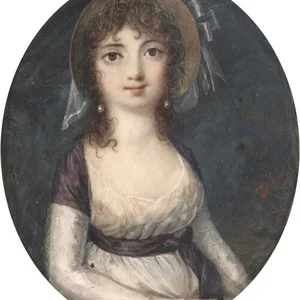

American actress of English origin, a figure of the traveling theater of the early years of the United States. Mother of the famous writer Edgar Allan Poe, she died young of tuberculosis, leaving her children orphaned.
Elizabeth Arnold Poe(1787 — 1811)
Elizabeth Poe
États-Unis, Royaume-Uni de Grande-Bretagne et d'Irlande
5 min read
Frequently asked questions
Key Facts
- Born around 1787 in England, she emigrated to the United States as a child with her mother, who was also an actress
- Pursued a career as a traveling stage actress in the cities of the American east coast
- Mother of Edgar Allan Poe, born in 1809 in Boston
- Died of tuberculosis in Richmond in December 1811, at around 24 years old
- After her death, Edgar was taken in by the Allan family in Richmond
Works & Achievements
From the moment she arrived, the young Elizabeth performed as a singer, launching a career that had begun almost in childhood.
She played light, witty female characters, such as Ophelia or ingénue roles, which were popular with audiences.
Between the acts, she provided songs and dances, demonstrating the versatility demanded of travelling actresses.
In a brief but intense career, she is said to have played about three hundred different roles within various companies.
A small personal painting left as an inheritance to her son Edgar, which became a precious family keepsake.
Her work with travelling companies helped keep theatre alive in the cities of the young American Republic.
Anecdotes
Elizabeth Arnold took to the stage as a child: at barely nine years old, fresh off the boat from England, she was already singing before American audiences. Theater was a family affair, passed down from mother to daughter.
In a single, very short career, she is said to have played nearly 300 different roles, switching from comedy to song and dance sometimes in the same evening. Touring actors had to be versatile to fill the playbills.
When she died in December 1811 in Richmond, she left behind three young children, including Edgar, who was only two years old. A wealthy family in the city, the Allans, took in the little boy, who would become the famous writer Edgar Allan Poe.
It is said that Edgar Allan Poe kept a small portrait of his mother all his life, along with a watercolor she had supposedly painted of Boston Harbor, where he was born. On the back, she is said to have written a message of affection for her son.
A few weeks before her death, notices appeared in the Richmond newspapers calling on the public to support her: ill and destitute, the actress was described as a deserving mother left in poverty.
Primary Sources
The public is reminded that Mrs Poe, long ill, can no longer appear on stage and finds herself, together with her children, in the greatest need; her cause is commended to the charity of the town's inhabitants.
Died yesterday morning, Mrs Poe, one of the actresses of this city's theatre. By this event, lovers of the stage lose one of their most cherished performers.
For this evening, Miss Arnold will appear in the leading role and will sing a new song between the acts, followed by a dance.
Key Places
Birthplace of Elizabeth Arnold, into a family of British actors before they emigrated to America.
City where she often performed and where her son Edgar was born in 1809. A major theatrical center of the young Republic.
City where Elizabeth ended her career and died of tuberculosis in 1811, and where Edgar was subsequently taken in by the Allans.
One of the many cities along the East Coast where her travelling troupe gave performances over the course of the theatrical seasons.
A great theatrical hub of the young nation where Elizabeth performed with the companies of the day.
Elizabeth Poe was buried near this Richmond church; a monument there honors her memory today.
Typical Objects

Printed sheet announcing the plays, the sung interludes and the names of the actors. It was the main way to draw the public in each town the troupe passed through.

Dresses, shawls and accessories used to embody a variety of characters. Travelling actresses often owned their own wardrobe, carried from town to town.

Large travelling chest holding costumes, wigs and personal belongings. Essential to a life spent moving between the theatres of the East Coast.

Sheet of music for the tunes performed between the acts. Singing was a full part of an actress's craft in that era.

A small painting that Elizabeth is said to have made and left to her son Edgar, with an affectionate message on the back. It became a keepsake charged with emotion.

Candles and oil lamps that lit the theatres before gas and electricity. They gave performances a flickering, warm light.
School Curriculum
Vocabulary & Tags
Key Vocabulary
Tags
Daily Life
Morning
The mornings of a touring actress were for rest and preparation, since the evening performances ended late. Costumes and props were maintained, and the children were looked after when there were any.
Afternoon
The afternoon was devoted to rehearsing the evening's plays and learning new roles. Because the repertoire changed constantly, texts, songs, and dance steps had to be memorized in a short time.
Evening
When evening came, it was showtime: Elizabeth applied her makeup, put on her costume, and stepped onto the stage by candlelight. A single evening might blend tragedy, comedy, song, and dance.
Food
The diet of touring actors was simple and irregular, depending on the inns and towns they passed through. Bread, stews, vegetables, and tea made up the ordinary fare, sometimes meager when the takings were poor.
Clothing
In town, Elizabeth wore the high-waisted dresses and shawls fashionable in the early nineteenth century. On stage, she donned richer costumes to embody her characters.
Housing
The itinerant life meant temporary lodgings: rented rooms, inns, and boarding houses following the theatrical seasons. People traveled light, with most of their belongings fitting into a single travel trunk.
Historical Timeline
Period Vocabulary
Liens externes & ressources
Références
Œuvres
Débuts d'enfant chanteuse sur la scène américaine
vers 1796-1797
Rôles de comédie dans le répertoire de Shakespeare
vers 1800-1810
Numéros chantés et dansés en entracte
vers 1800-1811
Près de 300 rôles interprétés
1796-1811
Aquarelle du port de Boston
vers 1808
Tournées des troupes de la côte est
1796-1811