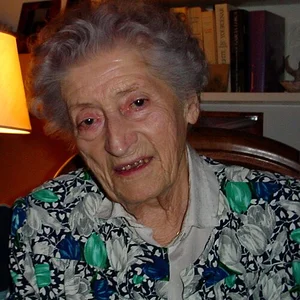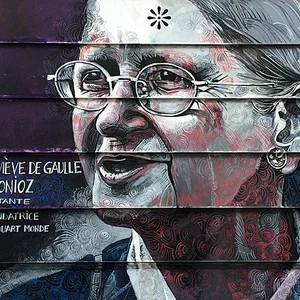

Niece of General de Gaulle, French resistance fighter deported to Ravensbrück (1944–1945). After the war, she committed herself to ATD Fourth World and led the organization from 1964 to 1998, dedicating her life to the fight against extreme poverty.
Geneviève de Gaulle-Anthonioz(1920 — 2002)
Geneviève de Gaulle-Anthonioz
France
9 min read
Frequently asked questions
Famous Quotes
« Poverty is not inevitable.»
« To resist is also to refuse poverty.»
Key Facts
- 1944: arrested by the Gestapo and deported to Ravensbrück concentration camp
- 1945: survived deportation and bore witness to the horrors of the camp
- 1964: became president of ATD Fourth World, which she led until 1998
- 1998: championed the passage of the law on combating social exclusion
- 2015: inducted into the Panthéon alongside Germaine Tillion, Pierre Brossolette, and Jean Zay
Works & Achievements
A sober and deeply moving memoir of her deportation to Ravensbrück, written fifty years after the events. This account has become a landmark testimony on the concentration camp experience and the duty of remembrance.
For more than a decade, Geneviève led the ATD Fourth World movement, transforming it into a recognized policy force acknowledged by national and international institutions in the fight against extreme poverty.
A report presented to the Economic and Social Council, championed by ATD Fourth World and Father Wresinski with Geneviève's active support. This founding document laid the groundwork for a national policy to combat social exclusion.
Geneviève was one of the driving forces behind the official recognition of October 17 as the World Day for Overcoming Poverty — first in France (1992) and then at the United Nations (1993) — elevating the fight against poverty to an international cause.
Geneviève drew on her moral authority as a Resistance member and concentration camp survivor to shape the debates that led to this landmark law — the first legal recognition in France of the right of the poorest citizens to access fundamental rights.
Anecdotes
Arrested by the Gestapo in 1943 while working within the clandestine network 'Défense de la France', Geneviève carefully concealed her identity. Her jailers did not initially know they were holding the niece of General de Gaulle, a living symbol of the Resistance — a revelation that could have earned her even harsher treatment.
At Ravensbrück, for refusing to denounce her fellow prisoners, Geneviève was locked for several months in the 'Bunker', the camp's isolation block. Alone in the cold and silence, she held on through her faith and the certainty that she would one day have to bear witness to what she had seen.
In 1957, Geneviève visited for the first time the shantytown of Noisy-le-Grand, where Father Joseph Wresinski had gathered homeless families living in extreme poverty. The encounter changed her life: she recognized in those faces the same dehumanization she had witnessed at Ravensbrück, and understood that the struggle for human dignity is never over.
In May 2015, the ashes of Geneviève de Gaulle-Anthonioz were enshrined in the Panthéon alongside Germaine Tillion, Jean Zay, and Pierre Brossolette — the first time two women entered together. President Hollande paid tribute to her as the woman who 'had made resistance a permanent way of life'.
During a United Nations hearing, Geneviève deliberately yielded the floor to a woman living in extreme poverty so that she could testify before the delegates herself. This gesture embodied the founding principle of ATD Fourth World: the poor are not objects of pity, but people whose voice carries universal value.
Primary Sources
“Being NN means being nothing. No name, no mail, no packages, no traces. They can make you disappear and no one will ever know. That is what night and fog means.”
“At Ravensbrück, I understood what it meant to be reduced to nothing, to be a number. That experience later made me sensitive to the plight of the poorest: they too are denied their humanity every day.”
“The fight against poverty is the fight of our time. Just as the Resistance was the fight of our youth. It demands the same courage, the same solidarity, the same refusal to accept the unacceptable.”
“Poverty is not inevitable. It is a violence that our societies inflict on their most vulnerable members, and we have a collective duty to eradicate it as one eradicates a disease.”
Key Places
The main Nazi concentration camp for women, located north of Berlin near Fürstenberg. Geneviève was interned there from February 1944 to April 1945, held in solitary confinement as an NN prisoner, and came close to death.
It was in Paris that Geneviève joined the Défense de la France resistance network, taking part in the clandestine production and distribution of a banned newspaper and forged identity papers, before her arrest by the Gestapo in July 1943.
After her arrest, Geneviève was imprisoned in Fresnes, one of the main prisons used by the Nazis to hold French resistance members before deporting them to camps in Germany.
It was in this shantytown on the outskirts of Paris that Father Wresinski founded ATD in 1957. Geneviève visited for the first time in the 1960s and there discovered the reality of persistent extreme poverty in post-war France.
It was here that in 1987, at the initiative of ATD Fourth World, an engraved stone was unveiled declaring that extreme poverty is a violation of human rights. The site has become an international symbol of the fight against poverty, championed by Geneviève.
Geneviève de Gaulle-Anthonioz was inducted into the Panthéon on 27 May 2015, alongside Germaine Tillion, Pierre Brossolette, and Jean Zay, cementing her dual place in French history: as a resistance fighter and as a champion against extreme poverty.
Typical Objects

Documents falsified clandestinely by the Défense de la France network, allowing resistance fighters and persecuted individuals to evade Nazi checkpoints. Geneviève took part in their production and distribution at the risk of her life.

A periodical printed in secret and distributed in hundreds of thousands of copies despite the risk of death. This newspaper informed French citizens about the reality of the occupation and called them to resist.

The uniform imposed on female prisoners in Nazi concentration camps, marking the erasure of individual identity. Geneviève was forced to wear it throughout her detention at Ravensbrück, a symbol of the dehumanization of the concentration camp system.

A Catholic devotional object that Geneviève kept discreetly at Ravensbrück. Her deep faith was one of the spiritual resources that allowed her to endure months of isolation without breaking down.

After the war, Geneviève committed her memories of deportation to paper, producing her only published book, released in 1998. This manuscript symbolizes the duty to bear witness for future generations and to prevent silence from erasing Nazi crimes.

An engraved stone unveiled at the Trocadéro in 1987, bearing the words of Father Wresinski: “Wherever men and women are condemned to live in extreme poverty, human rights are violated.” Geneviève made this stone a symbol of her struggle, linking her past resistance to her present commitment.
School Curriculum
Vocabulary & Tags
Key Vocabulary
Daily Life
Morning
In the 1970s–1990s, Geneviève begins her days very early by reading letters sent by volunteers and families from around the world. She responds personally to many of them, convinced that every account deserves individual attention.
Afternoon
Her afternoons alternate between working meetings with ATD Fourth World teams, encounters with political leaders or delegates from international organizations, and field visits to disadvantaged neighborhoods or emergency shelters — all to stay connected with the realities people live.
Evening
Evenings are devoted to drafting reports, speeches, or in-depth articles. Her Catholic faith, which she describes as a deep wellspring for her commitment, also sustains these quiet moments of reflection; family meals, when they are possible, help her maintain a personal sense of balance.
Food
Her diet is simple and unassuming: after Ravensbrück, material concerns lost their central importance. Meals are often shared with colleagues or volunteers in a spirit of community, reflecting the movement she leads.
Clothing
Geneviève dresses with discretion and practicality, without ostentation. She chooses outfits that allow her equally to meet a government minister or to sit in the apartment of a family in difficulty, deliberately setting aside the outward markers of her social origins.
Housing
She lives in a modest Parisian apartment, with no display of wealth. Since her return from deportation, material conditions have ceased to be a central concern; her home is at once a workspace, a place of prayer, and a family home.
Historical Timeline
Period Vocabulary
Liens externes & ressources
Références
Œuvres
La Traversée de la nuit
1998
Présidence d'ATD Quart Monde
1988-2001
Contribution au rapport « Grande pauvreté et précarité économique et sociale »
1987
Action pour la Journée mondiale du refus de la misère (17 octobre)
1987-1993
Engagement pour la loi d'orientation relative à la lutte contre les exclusions
1998