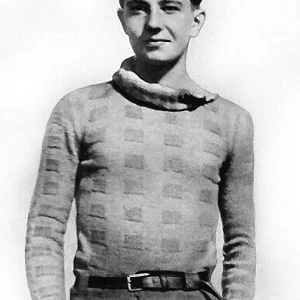

Young French communist militant, arrested at 16 in 1940 and shot as a hostage at Châteaubriant on October 22, 1941, at the age of 17. His farewell letter to his family, written a few hours before his execution, became a symbol of the French Resistance.
Guy Môquet(1924 — 1941)
Guy Môquet
France
9 min read
Frequently asked questions
Famous Quotes
« Courage, courage, onward into life! Courage to you, my dear little mother whom I love so much, and to my father.»
Key Facts
- Born on April 26, 1924, in Paris
- Arrested on October 13, 1940, at age 16, for distributing communist leaflets
- Imprisoned at Clairvaux, then at the Choisel camp in Châteaubriant
- Shot on October 22, 1941, at Châteaubriant, in reprisal for the assassination of a German officer
- His farewell letter has been read aloud in French schools every October 22 since 2007
Works & Achievements
Written a few hours before his execution and addressed to his parents and his brother Serge, this letter has become one of the most moving documents of the French Resistance. Displaying a remarkable maturity and dignity for a 17-year-old adolescent, it is preserved in the French National Archives and has been read aloud in high schools every year since 2007.
Though not a written work, this concrete political action represents Guy Môquet's commitment against the occupier. By distributing leaflets for the banned Communist Party in the Paris Métro at age 16, he took part in one of the earliest forms of resistance to the Occupation, at the risk of his freedom.
Several inmates of the Choisel camp testified after the war about the courage and serenity Guy Môquet displayed during his internment. These accounts, gathered by historians, deepen our understanding of his character and his commitment right up to his final moments.
Anecdotes
On October 13, 1940, Guy Môquet is arrested at age 16 by the French police at the Gare de l'Est metro station while distributing clandestine communist leaflets. He is still carrying his schoolboy satchel. This arrest takes place against a backdrop in which the Communist Party has been banned since September 1939, and handing out such documents is an act of resistance punishable by imprisonment.
Among the 27 hostages designated to be shot at Châteaubriant on October 22, 1941, Guy Môquet is by far the youngest. Negotiations reportedly attempted to substitute him with another prisoner on account of his age, but the German authorities refused. He was executed at 17, alongside his fellow prisoners.
A few hours before his execution, Guy Môquet was given paper and a pencil to write one last letter to his parents and his 8-year-old brother Serge. In a few lines of heart-rending dignity, he expressed his love for his family and his courage in the face of death, writing: “Courage! I embrace you all with all my child’s heart.” This letter, preserved in the French National Archives, has become one of the most moving documents of the French Resistance.
Guy Môquet's father, Prosper Môquet, was a Communist member of parliament for Paris. Arrested in 1940 and deported, he learned of his son's death from inside a concentration camp. This double arrest — father and son — illustrates the systematic repression of militant communist families under the Occupation, which struck at their very offspring.
In 2007, President Nicolas Sarkozy decided that Guy Môquet's letter would be read every year in all French high schools on October 22. The decision sparked fierce debate: some historians and teachers argued that using the letter without fully explaining its political context — the communist struggle against Nazism — distorted historical reality. Others saw it as a fitting tribute to sacrificed youth, revealing the complexity of how the memory of the Resistance continues to be contested.
Primary Sources
My darling little Mum, my beloved little brother, my dear little Dad, I am going to die! What I ask of you, you especially my darling Mum, is to be brave. I am, and I want to be as brave as those who came before me. Of course, I would have liked to live. But what I wish with all my heart is that my death should serve some purpose.
In atonement for this crime, I have ordered fifty hostages to be shot. Fifty more hostages will be shot if the guilty parties are not arrested by midnight on 23 October 1941.
The individual named Môquet Guy, born 26 April 1924, residing in Paris 20th arrondissement, was apprehended in the act of distributing Communist leaflets at the Gare de l'Est metro station. He is the son of Communist deputy Prosper Môquet, currently detained.
They marched in step, heads held high, singing La Marseillaise and The Internationale. Guy Môquet was among them, the youngest, his cheeks still round with childhood. They wanted to die on their feet, and they did.
Key Places
A working-class district where Guy Môquet grew up with his family. His father, Prosper Môquet, served as the area's Communist Party deputy, and it was in this labor-movement, politically active environment that Guy developed his political convictions from childhood.
It was on the platform of this station that Guy Môquet was arrested on October 13, 1940 — schoolbag on his back — while distributing clandestine leaflets for the banned Communist Party. This place marks the beginning of his captivity.
The first prison where Guy Môquet was held after his arrest, before being transferred to Clairvaux and then to Châteaubriant. During the Occupation, Fresnes was used on a massive scale to imprison resistance members and political activists.
An internment camp where Guy Môquet spent the final months of his life. On October 22, 1941, he was taken along with 26 other hostages to the nearby Sablière quarry to be shot.
The execution site of the 27 hostages of Châteaubriant on October 22, 1941. Now a national memorial, it stands as a symbol of the sacrifice made by these resistance fighters, including Guy Môquet — the youngest among them at 17 years old.
Typical Objects

Small printed pamphlets illegally distributed bearing slogans from the banned Communist Party. It was the distribution of these leaflets in the Paris Métro that led to Guy Môquet's arrest on October 13, 1940, at the age of 16.

Guy Môquet was still a student at a Parisian high school when he was arrested. The satchel he was carrying at the moment of his detention symbolizes a youth brutally cut short by the war and Nazi repression.

A few hours before his execution, Guy Môquet was given paper and a pencil to write his farewell letter. These simple writing materials allowed him to leave his family and posterity a testament of extraordinary dignity.

Guy Môquet joined the Young Communist League following in the political footsteps of his father Prosper, a PCF member of parliament. His membership in an organization outlawed after 1939 made him a clandestine militant from adolescence.

Introduced in France in September 1940, these coupons entitled their holders to a limited quantity of food. Like all working-class Parisian families, the Môquets used them every day — symbols of the deprivations imposed by the Occupation.

In his farewell letter, Guy dwells at length on his mother, his brother Serge, and his absent father. The family photograph represents for him the last emotional bond before his execution — everything he loves and must leave behind at the age of 17.
School Curriculum
Vocabulary & Tags
Key Vocabulary
Daily Life
Morning
Before his arrest, Guy Môquet begins his days like any ordinary high school student: an early rise in the family apartment in the 20th arrondissement, a frugal breakfast, then heading off to school with his bag on his back. Under the Occupation, these mornings already bear the marks of war: queues outside shops for ration tickets, German soldiers in the streets, propaganda posters plastered on the walls.
Afternoon
In the afternoons, Guy combines his school duties with clandestine militant activities. He takes part in the banned Communist Youth organization, picks up and distributes party leaflets, and passes information between comrades. All of this unfolds in secrecy, under constant wariness of informers and German patrols.
Evening
Evenings are spent with family in a modest apartment in a working-class neighborhood. His father, already arrested in 1940, has left mother and children to face daily hardships alone. The radio, sometimes listened to in secret, picks up broadcasts from the BBC or Radio Moscow with news from the front. Life is shaped by rationing, the curfew, and the ever-present anxiety of arrest.
Food
Under the Occupation, Parisians' food was governed by the ration tickets introduced in September 1940. The Môquet family, like other working-class families, ate little and poorly: low-quality bread, vegetables, and almost no meat. In prison and at the camp, rations were even more meager, often consisting of thin soup and black bread.
Clothing
The son of a working-class militant, Guy Môquet wears simple, practical clothes: woolen trousers, a shirt, a knitted sweater, and a jacket for school days. Under the Occupation, clothes wore out with no easy way to replace them, due to a shortage of fabric and money. At the Châteaubriant camp, internees wore uniform outfits that erased all individuality.
Housing
The Môquet family lives in a rented apartment in the 20th arrondissement of Paris, a predominantly working-class neighborhood. The home is modest — a few shared rooms with no particular comforts. This environment, marked by solidarity and political engagement, profoundly shapes Guy's values from an early age.
Historical Timeline
Period Vocabulary
Liens externes & ressources
Références
Œuvres
Lettre d'adieu à sa famille
22 octobre 1941
Activité militante clandestine (distribution de tracts, 1940)
1940
Témoignages de codétenus sur son attitude au camp de Châteaubriant
1941-1945