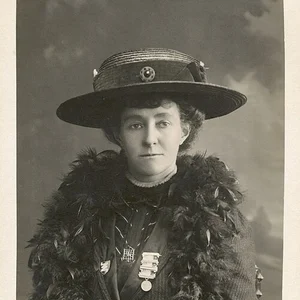

British suffragette activist and a leading figure of the movement for women's voting rights. She died after throwing herself under King George V's horse at the 1913 Epsom Derby, becoming a martyr for the suffragette cause.
Emily Wilding Davison(1872 — 1913)
Emily Davison
Royaume-Uni de Grande-Bretagne et d'Irlande
5 min read
Frequently asked questions
Key Facts
- Born in London in 1872, she pursued her studies and became a governess and then a schoolteacher
- Joined the Women's Social and Political Union (WSPU), founded by Emmeline Pankhurst, in 1906
- Imprisoned on several occasions, she endured force-feeding during hunger strikes
- On 4 June 1913, she threw herself under Anmer, King George V's horse, at the Epsom Derby
- Died of her injuries on 8 June 1913, her funeral becoming a vast suffragette demonstration
Works & Achievements
Her commitment to the militant movement made her one of the most determined and active suffragettes.
By hiding inside Parliament, she carried out a powerful symbolic act demanding political citizenship for women.
Her repeated fasts, endured despite force-feeding, made her a symbol of resistance against the State.
She wrote texts defending the suffragist cause, including reflections on sacrifice for the sake of freedom.
Her fatal act in front of the King's horse became the most famous event of the British suffragist movement.
Her funeral procession, organised by the WSPU, mobilised thousands of people and left a lasting mark on public opinion.
Anecdotes
On 4 June 1913, during the famous Epsom Derby, Emily Davison slipped under the railing and threw herself in front of Anmer, the horse belonging to King George V. Struck violently, she never regained consciousness and died four days later. Two flags in the suffragette colours (purple, white, green) were found on her.
A brilliant graduate, Emily achieved first-class results in English literature at Oxford, but the university refused at the time to award degrees to women: she therefore never received the degree she had earned.
During the 1911 census, Emily hid all night in a broom cupboard at the Palace of Westminster, the seat of the British Parliament. Her aim: to be able to declare the House of Commons as her address and thus protest against the political exclusion of women.
Imprisoned on several occasions, Emily went on hunger strikes. The authorities subjected her to force-feeding many times, a brutal practice denounced by the suffrage movement as a form of torture.
Her funeral, on 14 June 1913, gave rise to an immense procession through London: thousands of suffragettes dressed in white accompanied her coffin, transforming her death into a powerful symbol of the cause.
Primary Sources
A woman threw herself under the hooves of the King's horse, Anmer, and was knocked down with terrible violence.
Deeds not words, the motto of the suffragette movement.
She gave her life for the cause of women, faithful unto death to the freedom she loved.
Declared address: crypt of the House of Commons, Palace of Westminster.
Key Places
District in southeast London where Emily Wilding Davison was born in 1872.
Racecourse in Surrey where, during the 1913 Derby, Emily threw herself under King George V's horse.
Seat of the British Parliament where Emily hid all night long during the 1911 census.
Women's prison where Emily was incarcerated and subjected to force-feeding during her hunger strikes.
Cemetery in Northumberland where Emily was buried; her grave bears the motto "Deeds not words".
Institution where Emily studied before continuing at Oxford; women could not yet earn official degrees there.
Typical Objects

A band of purple, white, and green fabric worn by activists. Purple symbolized dignity, white purity, and green hope.

The movement's small tricolor banner. Emily carried two of them hidden on her person the day of the Derby.

A decoration awarded by the WSPU to activists who had gone on hunger strike in prison. It honored their sacrifice for the cause.

A printed flyer handed out in the streets to win over public opinion and recruit supporters for women's right to vote.

A large piece of cloth carried during marches, adorned with slogans like 'Deeds not words'. It made the processions visible and solemn.

Emily bought a return ticket to the Derby, an item historians cite when debating whether she intended to survive her action.
School Curriculum
Vocabulary & Tags
Key Vocabulary
Tags
Daily Life
Morning
When she wasn't in prison, Emily began her day by reading the newspapers to keep up with political news. A trained teacher and governess, she often devoted her mornings to writing pamphlets and letters for the cause.
Afternoon
Her afternoons were filled with WSPU meetings, handing out pamphlets in the streets of London, and preparing demonstrations. She also took part in riskier actions, such as confronting politicians.
Evening
In the evening, she attended suffragist meetings or met up with other activists to plan upcoming actions. A passionate reader, she also loved to immerse herself in the English literature she had studied.
Food
Her diet was that of a middle-class Edwardian woman: bread, tea, vegetables, and meat when the budget allowed. In prison, her hunger strikes deliberately deprived her of all food, at great risk to her health.
Clothing
Emily wore the long skirts and strict bodices of the Edwardian era. During demonstrations, she displayed the movement's colours — purple, white, and green — on sashes or ribbons.
Housing
She lived modestly, staying in rented rooms and moving frequently, partly because of her activism and her repeated stays in prison.
Historical Timeline
Period Vocabulary
Liens externes & ressources
Références
Œuvres
Engagement à la WSPU
1906
Protestation du recensement de 1911
1911
Grèves de la faim en prison
1909-1912
Articles et écrits militants
1908-1913
Action du Derby d'Epsom
4 juin 1913
Funérailles-manifestation
14 juin 1913