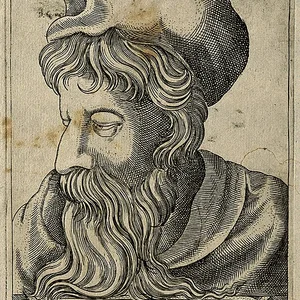

Greek philosopher, physician, and statesman of the 5th century BC, from Akragas in Sicily. He is famous for his theory of the four elements (earth, water, fire, air) and two cosmic forces (Love and Strife). A major figure in Presocratic philosophy, he also had deep interests in medicine and natural phenomena.
Empedocles(493 av. J.-C. — 433 av. J.-C.)
Empedocles
Agrigente
7 min read
Frequently asked questions
Famous Quotes
« Hear first the four roots of all things: shining Zeus, life-bringing Hera, Aidoneus, and Nestis.»
« There are two fates for mortals: one is born, and the other dies.»
Key Facts
- Born around 493 BC in Akragas (Sicily) and died around 433 BC
- Formulated the theory of the four fundamental elements: earth, water, fire, air
- Introduced two opposing forces governing the universe: Love (union) and Strife (separation)
- Reportedly carried out hydraulic engineering works to drain marshes in Sicily
- Precursor to evolutionary theory, describing primitive imperfect living forms
Works & Achievements
A philosophical poem in hexameters setting out the theory of the four elements and two cosmic forces (Love and Strife). This is Empedocles' major work, of which around 350 verses survive.
A poem of mystical and religious character on the transmigration of souls and spiritual purification. It reveals the Orphic and Pythagorean influences on Empedocles' thought.
A medical text attributed to Empedocles by later sources, in which he reportedly outlined his theories on health, disease, and respiration. Only indirect references to it survive.
A collection of oral and written interventions through which Empedocles worked to establish a democratic government in Akragas, opposing attempts to restore tyranny.
Anecdotes
Empedocles believed he was capable of raising the dead, and reportedly kept alive for thirty days a woman whom everyone considered deceased, according to the testimony of Diogenes Laërtius. This episode illustrates his reputation as a wonder-worker and extraordinary healer, straddling the line between science and mystery.
A famous legend holds that Empedocles threw himself into the crater of Mount Etna to feign his own divinity and vanish without a trace. But the volcano allegedly spat back one of his bronze sandals, exposing the deception. While the story is almost certainly apocryphal, it reflects the fascinating and mysterious figure he was in the eyes of his contemporaries.
Empedocles was among the first to explain respiration in aquatic animals: according to him, fish breathe through their gills using the same principle as the clepsydra — a water clock that alternately draws in and expels water. Though imperfect, this analogy reveals his commitment to observing nature.
As much a statesman as a philosopher, Empedocles refused the kingship offered to him by the citizens of Akragas after the fall of the tyrants, choosing instead to support the establishment of a democratic government. This gesture earned him enormous popularity throughout Greek Sicily.
Empedocles himself described his walks through the city as triumphal processions: crowds would flock to see him, seeking prophecies or cures, convinced he was a god made flesh. He willingly played the part, moving through the streets dressed in purple, crowned with laurel, and accompanied by a retinue of admirers.
Primary Sources
I will tell you a twofold truth: at one time the Many grows into One from plurality, at another time the One divides again to give birth to the Many. Double is the birth of mortal things, double their passing away.
There is an oracle of Necessity, an ancient decree of the gods, eternal, sealed by broad oaths: when a daemon has sinfully defiled his hands with blood, he must wander far from the Blessed for three times ten thousand years.
Empedocles says that vision occurs through the emission of something from the eye, and that the light issuing from it meets the light coming from the object.
Empedocles was the son of Meton, son of Empedocles, a native of Akragas. Timaeus, in the fifteenth book of his Histories, says that Empedocles the grandfather was an illustrious man. It is attested that Empedocles was a magnificent man, an enemy of tyranny and a friend of equality.
Hear first the four roots of all things: shining Zeus, life-giving Hera, Aidoneus, and Nestis whose tears feed the mortal springs of humankind.
Key Places
Empedocles' hometown, one of the most prosperous Greek cities in the western Mediterranean during the 5th century BC. It was here that he developed his theories and pursued political action in support of democracy.
Sicily's iconic volcano, associated with the legendary death of Empedocles, who is said to have thrown himself into its crater. The site carries deep symbolic weight in ancient accounts of this philosopher, who was fascinated by fire as a fundamental element.
A Greek city in Sicily where Empedocles is said to have performed one of his most celebrated medical feats, draining pestilential marshes to end an epidemic of fevers that was decimating the local population.
A Panhellenic colony founded in 444 BC in southern Italy, where Empedocles is said to have settled after his exile from Agrigentum. This intellectual hub drew philosophers and physicians from across the Greek world.
The great Panhellenic sanctuary where the Olympic Games were held. Empedocles is said to have recited his philosophical poems there, helping to spread his ideas throughout the Greek world.
Liens externes & ressources
Références
Œuvres
Sur la Nature (Peri Physeos)
vers 450 av. J.-C.
Les Purifications (Katharmoi)
vers 450 av. J.-C.
Traité de médecine (perdu)
milieu Ve siècle av. J.-C.
Discours politique à Agrigente
vers 470-460 av. J.-C.
See also
Related Characters
Alexander II of Macedon
Phidias
499 av. J.-C. — 429 av. J.-C.
Alaric I
370 — 410
Annabella Milbanke
1792 — 1860
Anne Thérèse de Marguenat de Courcelles, marquise de Lambert
Cardinal Mazarin
1602 — 1661