 flip
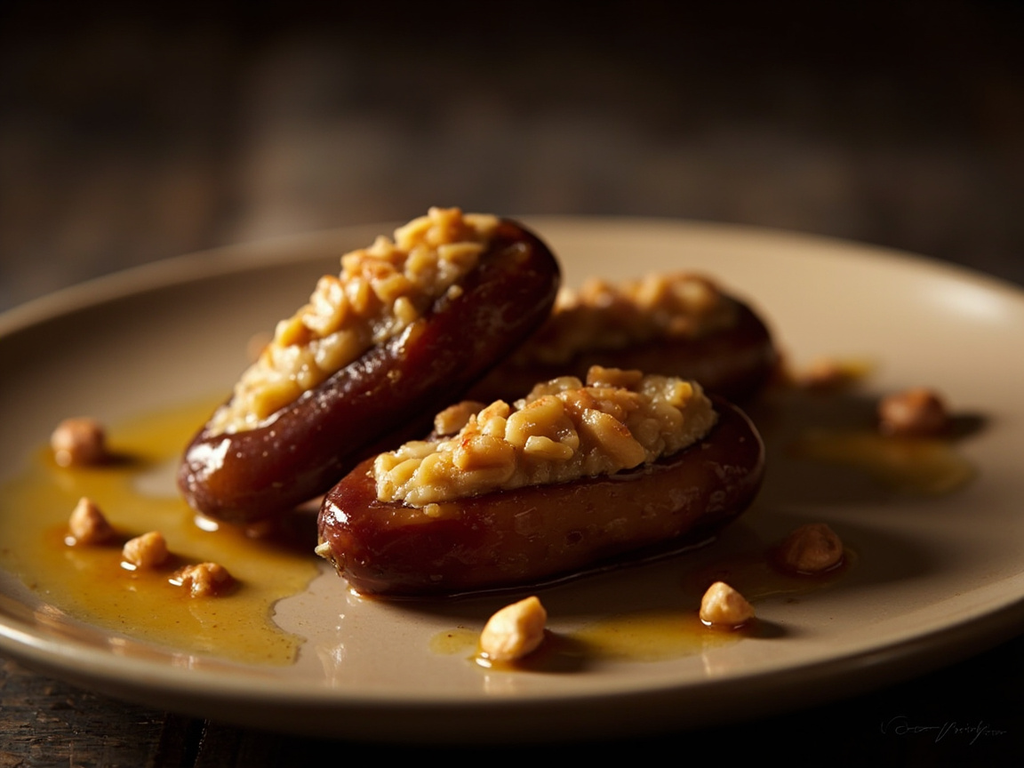
flipHoney and nut stuffed dates (dulcia domestica)
Honey and nut stuffed dates (dulcia domestica)
Why this dish? Dido's banquet ends in splendor, and the Roman mensa secunda—fruits and sweets—crowned every grand meal. Dates, imported from the East and Mediterranean, also evoke Aeneas's sea route between Trojan Asia and the West. This sweet-and-sour treat connects his two worlds: the Orient of Troy and the Italy of his destiny.
Pitted dates, stuffed with walnuts or pine nuts, rolled in salt then candied in hot honey. A tiny morsel where the fruit's sweetness, the nut's crunch, and the salt's edge respond to each other: the Roman candy to finish the feast beautifully.
When the meal draws to a close and the cups slowly empty, the sweets are brought. Take the dates from the East—the very ones my Troy knew—remove the pit, slip a walnut in its place, roll them in salt then brown them in warm honey. Taste how sweet and salty marry: thus go things, sweet and bitter mixed, like the destiny of a man who lost everything to found everything anew.
- •Dates — a cup (candied fruit)
- •Walnuts or pine nuts — according to number of dates (crunchy filling)
- •Salt — a pinch (salty contrast)
- •Honey — to coat (candying)
- •Pepper (optional) — a hint (spice)
Honey and nut stuffed dates (dulcia domestica)
Pitted dates, stuffed with walnuts or pine nuts, rolled in salt then candied in hot honey. A tiny morsel where the fruit's sweetness, the nut's crunch, and the salt's edge respond to each other: the Roman candy to finish the feast beautifully.
Why this dish? Dido's banquet ends in splendor, and the Roman mensa secunda—fruits and sweets—crowned every grand meal. Dates, imported from the East and Mediterranean, also evoke Aeneas's sea route between Trojan Asia and the West. This sweet-and-sour treat connects his two worlds: the Orient of Troy and the Italy of his destiny.
When the meal draws to a close and the cups slowly empty, the sweets are brought. Take the dates from the East—the very ones my Troy knew—remove the pit, slip a walnut in its place, roll them in salt then brown them in warm honey. Taste how sweet and salty marry: thus go things, sweet and bitter mixed, like the destiny of a man who lost everything to found everything anew.
Ingredients (period version)
- Dates — a cup (candied fruit)
- Walnuts or pine nuts — according to number of dates (crunchy filling)
- Salt — a pinch (salty contrast)
- Honey — to coat (candying)
- Pepper (optional) — a hint (spice)
Ingredients
- Medjool dates — 12 (fruit)
- Walnut halves (or pine nuts) — 12 (filling)
- Fine salt — 1 pinch (contrast)
- Honey — 4 tbsp (honey caramel)
- Ground black pepper — 1 pinch (optional) (ancient note)
Method
- Carefully pit the dates by slitting them open on one side.
- Insert a walnut half (or a few pine nuts) into each date and close.
- Lightly roll each date in the fine salt.
- Heat the honey in a small pan until fluid and simmering.
- Add the dates and turn them for 2-3 minutes to coat and candy.
- Arrange on a plate, drizzle with remaining honey, lightly pepper if desired, and serve warm.
How it was made : The recipe for "dulcia domestica" appears almost as-is in Apicius: pit dates, stuff with walnuts, pine nuts, or ground pepper, salt, then cook in cooked honey. It is one of the best-documented ancient desserts, still reproducible identically today.
The contemporary twist : Sprinkled with a little long pepper and grated lemon zest, arranged on a bay leaf—an "Apicius 2.0" mignardise to serve with coffee.
Sources : Apicius, De re coquinaria, Book VII (dulcia domestica)
Aeneas · Charactorium