 flip
flipTuʾu — barley stew with mutton and leeks
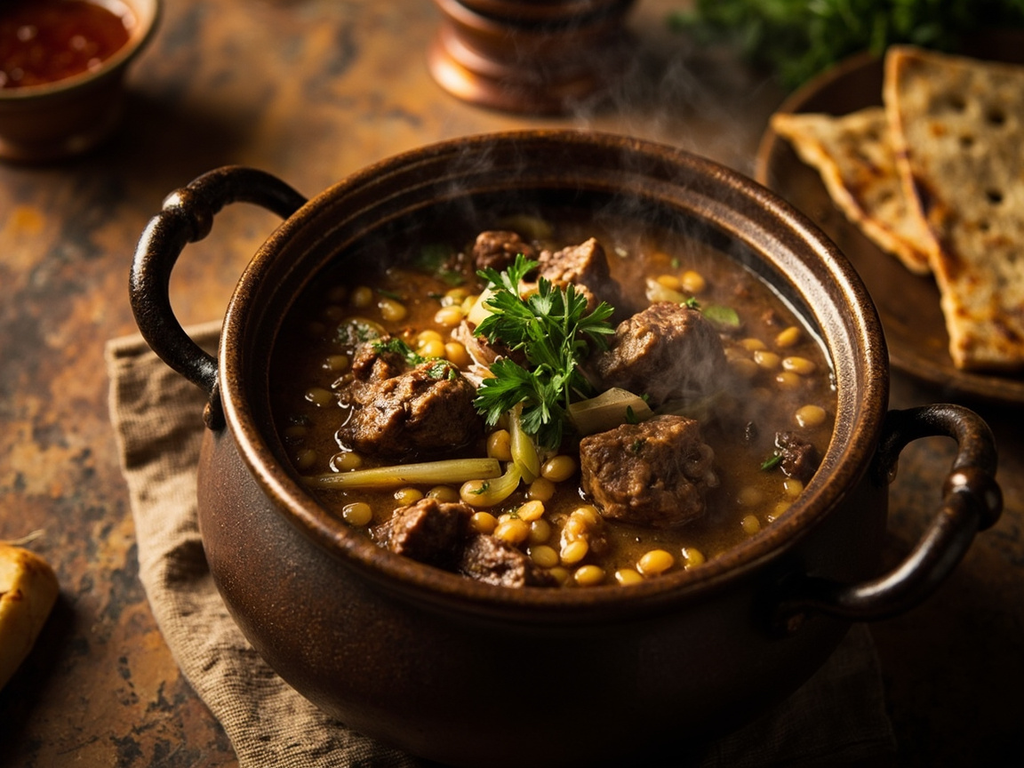
Tuʾu — barley stew with mutton and leeks
Why this dish? Enkidu and Gilgamesh are warrior heroes; after slaying the Bull of Heaven and the guardian Humbaba, one imagines the banquets of Uruk where long-boiled meat was served, the dish of kings and great victories. This thick stew evokes those post-combat feasts.
A simmered stew of mutton and barley, thickened with blood, flavored with garlic, onion, leek and coriander — close to the stews described on the world's oldest culinary tablets.
After we felled the Bull of Heaven, we feasted like kings! Throw the mutton into the cauldron, pour in water, salt, crushed onion and leek, let the fire work all day. The fat rises, the broth thickens with barley, and garlic perfumes the house. Eat it burning hot with bread, friend: it is the meal of those who have conquered and want to forget they will die.
- •Mutton shoulder in pieces — a good cut (meat)
- •Mutton tail fat — a piece (richness)
- •Cracked barley — a handful (thickener)
- •Onions, leeks, garlic — as desired (aromatics)
- •Coriander and cumin — to taste (flavor)
- •Salt and water — as needed (broth)
Tuʾu — barley stew with mutton and leeks
A simmered stew of mutton and barley, thickened with blood, flavored with garlic, onion, leek and coriander — close to the stews described on the world's oldest culinary tablets.
Why this dish? Enkidu and Gilgamesh are warrior heroes; after slaying the Bull of Heaven and the guardian Humbaba, one imagines the banquets of Uruk where long-boiled meat was served, the dish of kings and great victories. This thick stew evokes those post-combat feasts.
After we felled the Bull of Heaven, we feasted like kings! Throw the mutton into the cauldron, pour in water, salt, crushed onion and leek, let the fire work all day. The fat rises, the broth thickens with barley, and garlic perfumes the house. Eat it burning hot with bread, friend: it is the meal of those who have conquered and want to forget they will die.
Ingredients (period version)
- Mutton shoulder in pieces — a good cut (meat)
- Mutton tail fat — a piece (richness)
- Cracked barley — a handful (thickener)
- Onions, leeks, garlic — as desired (aromatics)
- Coriander and cumin — to taste (flavor)
- Salt and water — as needed (broth)
Ingredients
- Boneless lamb shoulder in cubes — 700 g (meat)
- Pearl barley — 120 g (thickener and texture)
- Sliced onions — 2 (aromatic base)
- Sliced leeks — 2 (aromatic)
- Crushed garlic cloves — 4 (flavor)
- Fresh coriander + cumin seeds — 1 bunch + 1 tsp (flavor)
- Salt — to taste (seasoning)
- Water or broth — 1.5 liters (simmering)
Method
- Brown the lamb cubes in a little fat until colored.
- Add onions, leeks and garlic; sweat for a few minutes.
- Pour in the water, cumin and salt; bring to a simmer.
- Add the pearl barley, cover and simmer for 1.5 hours over low heat, stirring occasionally.
- The broth should thicken and the meat fall apart. Adjust salt.
- Sprinkle with fresh coriander and serve hot with the barley flatbread (r1).
How it was made : The three Babylonian culinary tablets from the Yale collection (circa 1730 BCE) are the oldest known written recipes: they describe about twenty stews ('tuʾu') of meat and vegetables, thickened with water, fat and sometimes blood, seasoned with onion, leek, garlic, coriander and cumin. Mesopotamian cooking relied on simmering in earthenware or bronze cauldrons. No New World products: no tomato, chili, or potato.
The contemporary twist : Serve in a black cast-iron pot placed on the table like a banquet cauldron, and let everyone tear bread into it: Gilgamesh's feast at home.
Enkidu · Charactorium