
Epona is a goddess of Gaulish Celtic mythology, the protector of horses, mares, foals, donkeys and mules. Her cult, tied to fertility and the protection of riders, was widely adopted by the Roman cavalry and spread throughout the Empire.
Epona
Epona
6 min read
Frequently asked questions
Key Facts
- Gaulish goddess whose name derives from the Gaulish *epos meaning “horse”
- The only deity of Celtic origin to have been integrated into the official Roman pantheon
- Honored with a festival in the Roman calendar on 18 December
- Cult spread throughout the Empire between the 1st and 3rd centuries AD, notably by the auxiliary cavalry
- Often depicted seated in profile on a mare or surrounded by horses and symbols of fertility (cornucopia, sheaves of grain)
Works & Achievements
The most widespread iconographic type: Epona seated side-saddle on a mare, spread throughout the Empire. It established the lasting image of the horsewoman goddess.
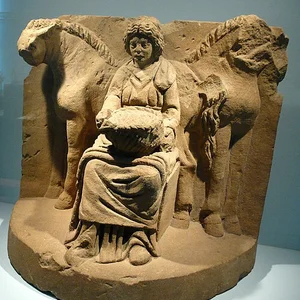
An iconographic variant in which Epona, seated, is flanked by two horses or foals turned toward her, emphasising her role as protector of the herds.
Numerous altars inscribed by private individuals and soldiers, the main epigraphic source attesting to the geographic extent of the cult.
The institution of an official feast day for Epona, a unique distinction for a Gaulish deity in the Roman calendar.
Rare written evocations of the cult of Epona that complement the abundant archaeological documentation.
Anecdotes
Epona is the only Gaulish deity to have been honored with an official public holiday in the Roman calendar: December 18 was dedicated to her, as attested by a rustic calendar found at Guidizzolo, in Italy. No other Celtic deity received such an honor in the Roman world.
Hundreds of depictions of Epona have been found throughout the Roman Empire, from Britain to the Balkans: she is by far the deity of Gaulish origin best attested by archaeology. Most show her seated sidesaddle on a mare, or surrounded by horses.
Roman cavalry soldiers, many of whom were recruited in Gaul, venerated Epona so that she would protect their mounts. Altars and statuettes were dedicated to her in the stables of military camps, sometimes adorned with fresh roses.
Epona appears in a Latin novel, the *Metamorphoses* (or *The Golden Ass*) by Apuleius in the 2nd century: the hero describes a small statue of the goddess placed in a stable niche, decorated with garlands of roses. It is one of the few literary mentions of her cult.
Her name comes from the Gaulish word *epos, meaning “horse,” related to the Latin equus and the Greek hippos. Epona thus literally means “the great mare” or “the divine horsewoman.”
Primary Sources
In a niche carved right in the middle of the posts that supported the stable's roof beams, one could see an image of Epona, reverently adorned with garlands of freshly bloomed roses.
You swear by the altars and by the Eponas painted on the reeking stables.
Mention of 18 December as a day consecrated to Epona (Eponae), the only deity of Gaulish origin inscribed in the Roman calendar.
Eponae… : a dedication engraved on an altar, the typical formula “to Epona” accompanied by the dedicant's name and the offering.
Key Places
Gallo-Roman site where remains of the cult of Epona were uncovered, attesting to her worship in central Gaul.
Gallo-Roman town that has yielded several dedications and depictions of Epona, an important centre of her cult.
A major military camp on the Rhine where the Roman cavalry left numerous altars and reliefs dedicated to Epona.
Capital of the Empire where the cult of Epona took root; her images adorned the stables, as Juvenal and Apuleius report.
Place where the rustic calendar mentioning the festival of Epona on 18 December was discovered.
Typical Objects

A shallow bowl that the goddess often holds in her depictions, used to pour libations. It symbolizes her nurturing role and her connection to ritual.

A horn overflowing with fruit and grain that Epona sometimes carries, marking her role as a goddess of fertility and agricultural abundance.

Agricultural attributes frequently associated with Epona, a sign of her patronage over harvests and rural prosperity.

Garlands of roses used to adorn statuettes of Epona in the stables, mentioned by Apuleius. They expressed devotion and the protection sought for the mounts.

Equestrian gear placed under the protection of Epona, who was venerated by the cavalrymen and grooms of the Roman army.

An object sometimes held by Epona in certain depictions, which may evoke a role as a guide to the afterlife or as a guardian.
School Curriculum
Vocabulary & Tags
Key Vocabulary
Daily Life
Morning
A mythological figure, Epona had no human daily life; but in worship, the morning could belong to the grooms and riders who, before taking the horses out, would leave an offering before her small statue tucked away in the stable. People prayed to her for the health and safety of their mounts.
Afternoon
In the afternoon, breeders and the soldiers of the auxiliary cavalry honored her in connection with the care of mares and foals. Fresh roses or garlands were renewed before her image to secure her favor.
Evening
When the horses returned to the stable, a new libation or an evening prayer might be addressed to Epona to thank her for her protection throughout the day. Seasonal festivals, such as the one on 18 December, gave rise to more solemn rites.
Food
As a goddess, Epona did not eat; but the offerings made to her — fruits, grains, cakes, and sometimes libations of wine — reflected her nourishing role and her connection to the abundance of the harvests.
Clothing
She is depicted wearing a long tunic and a draped cloak in the Gallo-Roman fashion, sometimes crowned with a diadem. Her amazon's posture, seated sidesaddle on the mare, became her hallmark.
Housing
Her “home” was the sanctuary or the simple niche set up in stables and military camps, where her statue stood. Temples and chapels were also dedicated to her in Gaul and across the provinces.
Historical Timeline
Period Vocabulary
Liens externes & ressources
Références
Œuvres
Reliefs et statuettes de la « déesse à la jument »
Ier-IIIe siècle apr. J.-C.
Type de la déesse encadrée par deux chevaux affrontés
Ier-IIIe siècle apr. J.-C.
Autels votifs portant la dédicace « Eponae »
Ier-IIIe siècle apr. J.-C.
Fête du 18 décembre (calendrier rustique)
IVe siècle apr. J.-C.
Mentions littéraires (Juvénal, Apulée, Minucius Felix)
Ier-IIe siècle apr. J.-C.