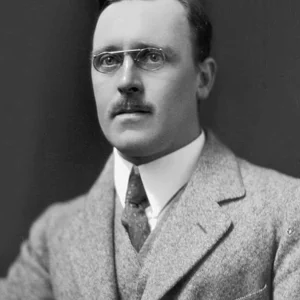

English–New Zealand physicist and collaborator of Ernest Rutherford. In 1909, together with Hans Geiger, he carried out the famous experiment scattering alpha particles off a gold foil, which revealed the existence of the atomic nucleus.
Ernest Marsden(1889 — 1970)
Ernest Marsden
Royaume-Uni
6 min read
Frequently asked questions
Key Facts
- Born in 1889 in Manchester (England), died in 1970 in Wellington (New Zealand)
- Carried out the Geiger–Marsden experiment (alpha particle scattering) in 1909 under Rutherford's direction
- This experiment enabled Rutherford to formulate his model of the atom with a central nucleus in 1911
- Appointed professor of physics in Wellington (New Zealand) in 1915
- Played a major role in organizing scientific research in New Zealand
Works & Achievements
The observation of the unexpected bounce-back of alpha particles off a sheet of gold foil. This is the foundational experiment that revealed the existence of the atomic nucleus.
A paper co-authored with Geiger reporting the measurements of the particles' rebound. It provided the data that pushed Rutherford to rethink the atom.
The application of physics to locating enemy artillery by the sound of its fire. Marsden put his scientific skills at the service of the army.
Marsden built up New Zealand's scientific institutions and shaped their programmes. His name is today attached to a major national research fund.
The direction of wartime scientific work, notably the development of radar in New Zealand. He applied science to the defence of the country.
Anecdotes
In 1909, Ernest Marsden was only in his early twenties and still a student when Rutherford gave him a seemingly trivial task: to check whether alpha particles could bounce backward when striking a thin sheet of gold. To his great surprise, about one particle in 8,000 came back, a result no one expected.
Rutherford later summed up his amazement with a phrase that became famous: it was "almost as incredible as if you fired a 15-inch shell at a piece of tissue paper and it came back and hit you." This impossible rebound revealed that the atom contained a tiny, hard, concentrated nucleus.
The accepted model of the atom at the time, Thomson's so-called "plum pudding" model, imagined the positive charge spread throughout the whole atom. The experiment by Marsden and Geiger shattered it: it forced scientists to invent the atomic nucleus, the foundation of all modern nuclear physics.
After his career as a researcher, Marsden emigrated to New Zealand, the home country of his mentor Rutherford. There he became a professor and then a great organizer of New Zealand science, and was knighted, becoming Sir Ernest Marsden.
During the First World War, Marsden served as an officer and worked on "sound ranging," a technique for locating enemy guns by the noise of their fire — proof that his rigor as a physicist also served on the battlefield.
Primary Sources
It seems surprising that some of the alpha particles, as the experiment shows, can be turned back through a single collision with an atom.
The scattering of charged particles through large angles is explained by assuming that the atom contains a central charge concentrated within a very small volume.
It was the most incredible event that has ever happened to me in my life. It was almost as incredible as if you fired a 15-inch shell at a piece of tissue paper and it came back and hit you.
Key Places
Industrial village in northern England where Ernest Marsden was born in 1889. This is where the journey began for a son of textile country who became a physicist.
Physics laboratory led by Rutherford where Marsden, as a student, carried out the gold foil experiment with Geiger in 1909. Birthplace of the discovery of the atomic nucleus.
Institution where Marsden was appointed professor of physics in 1915. There he continued teaching and research after leaving England.
New Zealand capital where Marsden organized the country's national scientific research and where he died in 1970. A large part of his career as a science administrator unfolded here.
Typical Objects

A thin sheet of gold only a few atoms thick, used as the target for alpha particles. Its thinness let the particles pass through while revealing the rare bounces.

A small radioactive sample emitting alpha particles used as projectiles. It was the offensive tool of the experiment.

A fluorescent screen that produced a tiny flash (scintillation) each time an alpha particle struck it. It had to be observed in the dark.

A movable microscope that allowed the flashes on the screen to be counted by the naked eye, from different angles. The counting demanded patience and eyes accustomed to the dark.

An air-evacuated chamber in which the alpha particles traveled, to prevent them from being deflected by air molecules. The heart of the experimental setup.

A notebook in which the scintillation counts and the conditions of each measurement were recorded. Without these patient records, the statistical analysis of the bounces would have been impossible.
School Curriculum
Vocabulary & Tags
Key Vocabulary
Tags
Daily Life
Morning
A young researcher at Manchester, Marsden began his day in Rutherford's laboratory, checking the radioactive sources and the vacuum seal of the instruments. The morning was spent preparing the gold foils and adjusting the observation microscope.
Afternoon
The afternoon was devoted to long series of scintillation counts, often in a darkened room so the tiny flashes could be made out. This work demanded great patience and eyes long accustomed to the dark.
Evening
In the evening, he recorded the figures in his notebooks and discussed the results with Geiger and Rutherford. The first analyses of the unexpected rebounds fuelled lively conversations about the nature of the atom.
Food
Marsden shared the simple diet of a British academic of the early 20th century: bread, meat, potatoes, and tea taken regularly throughout the day. Meals were ordinary and functional, paced by the rhythm of the laboratory.
Clothing
Like the scientists of his time, he wore a dark suit, a stiff-collared shirt and a tie, sometimes covered by a lab coat. His attire remained formal, in keeping with Edwardian academic custom.
Housing
As a student and young researcher, he lodged in boarding houses or modest accommodation near the University of Manchester. Later, in New Zealand, he lived in a house in Wellington, an established figure of scientific life.
Historical Timeline
Period Vocabulary
Liens externes & ressources
Références
Œuvres
Expérience de diffusion des particules alpha (avec Hans Geiger)
1909
« On a Diffuse Reflection of the α-Particles » (Proceedings of the Royal Society)
1909
Travaux de repérage par le son (Première Guerre mondiale)
1915-1918
Organisation de la recherche scientifique néo-zélandaise
1922-1947
Coordination scientifique de la défense (Seconde Guerre mondiale)
1939-1945