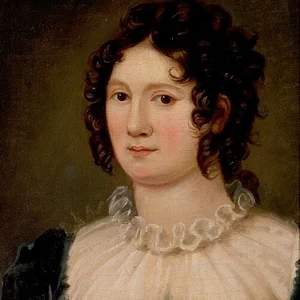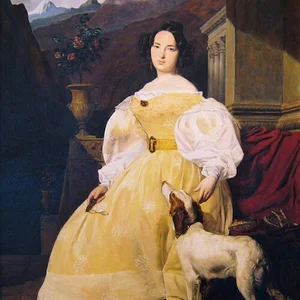

Polish countess famous for her long correspondence with the writer Honoré de Balzac, whom she married in 1850 after eighteen years of exchanging letters. Her relationship with the novelist fed an important part of Balzac's correspondence.
Ewelina Hańska(1805 — 1882)
Ewelina Hańska
Empire russe
5 min read
Frequently asked questions
Key Facts
- Born in 1805 into a family of the Polish nobility (the Rzewuski family)
- Began a correspondence with Honoré de Balzac in 1832 after writing to him under the name “the Stranger”
- Married Balzac on 14 March 1850 in Berdychiv, after eighteen years of relationship
- Widowed as early as August 1850, Balzac dying a few months after their marriage
- Died in 1882, guardian of Balzac's memory and work
Works & Achievements
Hundreds of letters exchanged, forming one of the richest testimonies to Balzac's life and thought. Ewelina was both their inspiration and their recipient.
Ewelina fed Balzac's imagination, and he dedicated works to her such as *Séraphîta*. She is among the female figures who left their mark on *The Human Comedy*.
After the writer's death, she watched over his manuscripts and the publication of his work. Her efforts helped pass *The Human Comedy* on to posterity.
A countess and landowner, she managed an immense agricultural estate in Ukraine. This fortune lay at the heart of Balzac's hopes of settling his debts.
Anecdotes
Ewelina Hańska first wrote to Balzac in 1832, signing simply "The Stranger
without revealing her name. Intrigued and moved by his novels, this Polish countess thus set off one of the longest epistolary love stories in French literature.
For eighteen years, Balzac and Ewelina exchanged hundreds of letters even though they met only rarely. Married to a wealthy landowner much older than herself, she could not marry the writer until after her husband's death and a long series of legal proceedings.
When they finally married in March 1850 in a church in Berdychiv, Ukraine, Balzac was already gravely ill. He died in Paris barely five months later, leaving Ewelina a widow after a union she had hoped for so long.
Ewelina owned a vast estate, Wierzchownia, in Ukraine, with hundreds of serfs in her service. Balzac, dazzled by this wealth, hoped that the marriage would rescue him from the colossal debts he had accumulated over the course of his life.
After Balzac's death, Ewelina devoted herself to protecting his memory and his work. She watched in particular over the publication of his writings, helping to keep alive the literary legacy of *La Comédie humaine*.
Primary Sources
You are to me everything that is most dear in the world, and the only happiness I have lies in your letters and in the thought of seeing you again.
Your soul embraces centuries, Monsieur; its philosophical convictions seem those of a long experience, and yet the cheerfulness of your writings reveals a young man.
Three days ago I married the only person I have ever loved, whom I love even more than before and whom I shall love until death.
Key Places
Ewelina's vast estate, where she lived surrounded by serfs and where Balzac stayed. The contrast between this rural luxury and Parisian life fascinated the writer.
The town where Ewelina and Balzac met for the first time in 1833, after a year of letters. The founding place of their story.
The town where the marriage of Ewelina and Balzac was celebrated in a church in March 1850. The culmination of eighteen years of waiting.
The Parisian house where the couple settled and where Balzac died in August 1850. Ewelina later spent part of her widowhood here.
The place where Balzac was buried and where Ewelina also rests. Their shared grave seals their union beyond death.
Typical Objects

The instruments with which Ewelina wrote her countless letters to Balzac. Their correspondence was the heart of their relationship for nearly twenty years.

Letters traveled sealed with a blob of wax that often bore a personal seal. This seal guaranteed that the mail had not been opened along the way.

An elegant outfit worn by women of the high nobility at receptions and on travels across Europe. Lavish dress signaled a countess's social rank.

The ring exchanged at the long-awaited marriage of 1850. It sealed a union hoped for over eighteen years.

A horse-drawn vehicle that made possible long journeys across Europe, from Ukraine to Switzerland or Paris. The lovers' meetings depended on these grueling trips.

The pages covered in Balzac's handwriting and corrections, which Ewelina inherited. She watched over this literary treasure after the writer's death.
School Curriculum
Vocabulary & Tags
Key Vocabulary
Daily Life
Morning
On her estate at Wierzchownia, Ewelina often began the day by reading her mail and the newspapers. The morning was also the time to write or reread the letters she received from France.
Afternoon
The afternoon was divided between managing the estate, visits from the neighboring nobility, and reading novels. A cultivated woman, she followed the literary and political life of Europe closely.
Evening
Evenings were devoted to parlor conversations, music, and sometimes the writing of long letters. It was often in the evening, in the quiet, that she confided her intimate thoughts to Balzac.
Food
Like the aristocracy of the period, she enjoyed an abundant table blending Polish, Russian, and French cuisine. Game, fish, pastries, and imported wines featured at her formal meals.
Clothing
Ewelina wore the refined attire of the high nobility: silk gowns, shawls, lace, and jewels. Her wardrobe reflected both Parisian fashion and the customs of the courts of Eastern Europe.
Housing
She lived in the vast manor of Wierzchownia, surrounded by lands and servants, before settling in Paris. Her residences combined the luxurious comfort and elegant decor befitting her rank.
Historical Timeline
Period Vocabulary
Liens externes & ressources
Références
Œuvres
Correspondance avec Balzac (Lettres à Madame Hanska)
1832-1850
Inspiration de personnages balzaciens
années 1830-1840
Préservation de l'héritage de Balzac
après 1850
Tenue du domaine de Wierzchownia
1841-années 1850