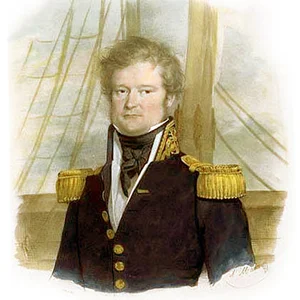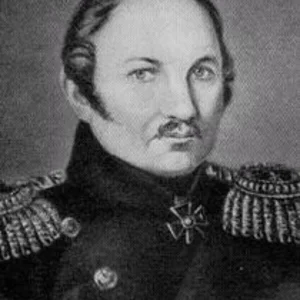

A Russian naval officer and explorer of Baltic German origin, he commanded the first Russian Antarctic expedition (1819-1821). He was one of the first navigators to sight the Antarctic continent, on 28 January 1820.
Fabian von Bellingshausen
Fabian Gottlieb von Bellingshausen (Faddey Faddeyevich Bellinsgauzen)
6 min read
Frequently asked questions
Key Facts
- Born in 1778 on the island of Ösel (Saaremaa, in present-day Estonia), a Baltic German subject of the Russian Empire
- Commands the Russian Antarctic expedition from 1819 to 1821 aboard the ships Vostok and Mirny
- Sights the Antarctic continent on 28 January 1820, among the first navigators in history
- Discovers Peter I Island and Alexander I Land in 1821
- Becomes an admiral of the Russian Imperial Navy and dies at Kronstadt in 1852
Works & Achievements
A voyage that completely circumnavigated Antarctica and explored the Southern Ocean, one of the greatest feats of polar navigation.
One of the very first sightings of Antarctica, placing Russia among the discoverers of the sixth continent.
The first land ever sighted beyond the Antarctic Circle.
A large island named in honour of Tsar Alexander I, long thought to be part of the continent.
Mapping of several Pacific islands, including Vostok Island, named after Russian heroes.
An illustrated work describing the voyage, the ice and the islands, which became a major source for historians.
Anecdotes
For his expedition to the south, Bellingshausen commanded two aptly named ships: the Vostok (“the East”) and the Mirny (“the Peaceful”). The Mirny was led by a young officer, Mikhail Lazarev, who would later become one of the great Russian admirals. The two ships almost never parted during the two years of the voyage.
On 28 January 1820, the Russian ships drew near an immense wall of ice stretching as far as the eye could see: it was the edge of the Antarctic continent, which no one had ever seen before. Landing was impossible: the pack ice formed an insurmountable cliff. Bellingshausen cautiously noted in his journal that he had reached “a field of ice covered with small hummocks.”
Between the two Antarctic summers, rather than staying in the cold, the expedition headed north toward the tropics and put in at Sydney, Australia. During this passage through the Pacific, Bellingshausen explored the Tuamotu archipelago and charted several islands still unknown to Europeans, one of which today bears the name of his ship: Vostok Island.
In January 1821, the expedition discovered an isolated land in the heart of the ice and named it Peter I Island, in honor of the tsar who founded the Russian navy. It was the first land ever sighted beyond the Antarctic Circle. Here again, the ice prevented any landing.
In February 1821, near the South Shetland Islands, the Russians crossed paths with a tiny American sailing ship, the Hero, commanded by the young seal hunter Nathaniel Palmer. The two captains politely exchanged information about these dangerous waters: a rare moment of encounter between explorers at the end of the world.
Primary Sources
We pressed on southward through fields of ice covered with small hummocks, where no ship had ever penetrated before.
On 16 January (Old Style) we reached a latitude of 69°21′ South, where we met with unbroken ice stretching from east to west as far as the eye could see.
We encountered ice of extraordinary height; it stretched as far as the eye could see, but the bad weather prevented us from drawing any closer to it.
Key Places
Island in the Baltic Sea, in present-day Estonia, where Bellingshausen was born into the Baltic German nobility.
Russian naval base near Saint Petersburg where he studied, from which the expedition set sail, and where he died as the town's governor.
Region of the southern ice where he sighted the continent on 28 January 1820; a sea there now bears his name.
First land discovered beyond the Antarctic Circle, named in honour of Peter the Great.
Australian harbour where the expedition put in between the two Antarctic campaigns to resupply.
Typical Objects

Mirror instrument with which Bellingshausen measured the altitude of the sun or the stars to calculate his latitude on the open sea.

Precision clock kept on board to determine longitude; indispensable for accurately charting the islands he discovered.

Telescope used by the lookouts and the officer to scan the horizon and spot ice or land.

Bellingshausen was a renowned cartographer: he drew up precise maps of the icy coasts and the islands of the Pacific.

A register kept every day, in which he recorded the position, the weather, and his observations, such as that of the ice shelf on 28 January 1820.

A dark cloth coat with gilt buttons and epaulettes, worn by Bellingshausen as a captain and later as an admiral.

Flagship of the expedition, which braved the storms and ice of the Southern Ocean for more than two years.
School Curriculum
Vocabulary & Tags
Key Vocabulary
Tags
Daily Life
Morning
At daybreak, the captain takes the watch, observes the sky, and has the ship's position measured with the sextant. He inspects the rigging and the condition of the men, especially in bitter cold when frost coats the ropes.
Afternoon
The afternoon is devoted to navigating among the ice, to charting surveys, and to recording observations in the logbook. When land or an iceberg comes into view, the entire crew rallies to sketch and locate it.
Evening
In the evening, Bellingshausen updates his charts by the light of a lantern and plans the next day's route with his officers. A glass of grog is sometimes handed out to warm the crew and lift their spirits.
Food
On board, the men eat mainly hardtack, salted meat, and sauerkraut. Lemon, vinegar, and preserves are brought along to fight scurvy, the scourge of long voyages.
Clothing
In polar regions, sailors pulled on several layers of wool, oilskin jackets against the water, and fur caps. Over these, the officer wore his dark cloth uniform with gilt buttons.
Housing
Bellingshausen lodged in a cramped cabin at the stern of the Vostok, furnished with a bunk, a chart table, and his instruments. The space was narrow, damp, and constantly tossed by the swell of the Southern Ocean.
Historical Timeline
Period Vocabulary
Liens externes & ressources
Références
Œuvres
Première expédition antarctique russe (Vostok et Mirny)
1819-1821
Observation du continent antarctique
28 janvier 1820
Découverte de l'île Pierre Ier
janvier 1821
Découverte de la terre Alexandre Ier
janvier 1821
Exploration de l'archipel des Touamotou
1820
Récit de l'expédition (Double exploration dans l'océan Glacial austral)
1831