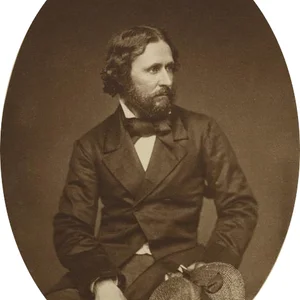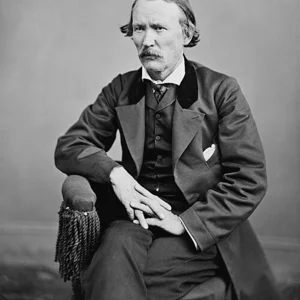

American trapper, guide, and soldier, an iconic figure of the conquest of the West. As guide for John C. Frémont's expeditions to the Rockies and California, he later became a Union Army officer and Indian agent, marked by the deportation of the Navajo.
Kit Carson(1809 — 1868)
Kit Carson
États-Unis
6 min read
Frequently asked questions
Key Facts
- Born in 1809 in Kentucky, he left his family as a teenager to become a trapper on the Santa Fe Trail
- Beginning in 1842, he guided John C. Frémont's three exploratory expeditions to the Rockies, Oregon, and California
- Served as an officer during the Mexican-American War (1846-1848), then became an Indian agent in New Mexico in 1853
- During the Civil War, he fought in the Union Army and was promoted to brevet brigadier general
- In 1863-1864, he led the campaign against the Navajo that resulted in their forced deportation (“The Long Walk”), then died in 1868
Works & Achievements
Carson led three expeditions across the Rockies, the Sierra Nevada, and California, helping to map the West.
During the Mexican-American War, he fought at San Pasqual and carried military messages across hostile territory.
Responsible for relations with the Utes and other peoples, he sometimes defended their interests before the American government.
A Union officer, he fought the Confederates at Valverde, then led campaigns against several Native American nations.
His scorched-earth campaign forced the Navajo to surrender; at Adobe Walls, he faced a large Comanche and Kiowa coalition.
An autobiographical account dictated because he was illiterate, a valuable source on the life of the mountain men.
Anecdotes
At sixteen, Kit Carson was apprenticed to a saddler in Missouri. Hating the work, he ran away in 1826 by hiding in a merchant caravan heading toward Santa Fe. His employer posted a notice offering... one cent reward for his return, a sign he was not eager to get him back.
Carson never learned to read or write his entire life. Yet dime novels turned him into a legendary hero during his own lifetime. One day, so the story goes, he found in an abandoned cabin one of these novels in which a "Kit Carson" single-handedly rescued a woman from dozens of Indians — he was embarrassed by the gap with reality.
During Frémont's expedition, Carson guided the explorers across the Rockies and the Sierra Nevada. It was largely thanks to his tracking skills that Frémont's widely circulated reports encouraged thousands of pioneers to set out for the West.
In 1863–1864, under army orders, Carson led a scorched-earth campaign against the Navajo: destroying crops, herds, and the peach orchards of Canyon de Chelly. Starving, thousands of Navajo had to surrender and were deported on foot during the "Long Walk" to Bosque Redondo, where many perished.
Carson married in succession an Arapaho woman, then a Cheyenne woman, before wedding Josefa Jaramillo, from a Hispanic family of Taos. He spoke Spanish, several Native American languages, and the French of the trappers, but had to dictate every one of his letters.
Primary Sources
Carson is described by Frémont as a guide of remarkable courage and composure, whose knowledge of the terrain ensures the expedition's survival.
Unable to write, Carson dictated his recollections around 1856; in them he recounts his flight to Santa Fe and his years as a trapper in the Rocky Mountains.
The army's orders and dispatches from 1863-1864 describe the destruction of crops and herds intended to force the Navajo into surrender.
Key Places
Birthplace of Kit Carson in 1809, before his family moved to Missouri.
Town where Carson made his home, married Josefa Jaramillo, and served as an Indian agent. The center of his family and administrative life.
Trading post on the Santa Fe Trail where Carson worked as a hunter. A crossroads of commerce among trappers, merchants, and Native Americans.
The heart of Navajo territory, where Carson led the destruction of orchards and crops in 1864 that forced the surrender of the Navajo people.
Deportation camp where the Navajo were interned after the “Long Walk.” A place of famine and high mortality.
Military post where Kit Carson died on May 23, 1868, shortly after his wife, from the effects of an aneurysm.
Typical Objects

A long, accurate black-powder rifle prized by the mountain men for hunting bison and for self-defense. A symbol of the trapper's self-reliance in the wild West.

A spring-loaded metal trap set in rivers to catch beavers, whose fur was sold to make hats. The basic tool of the fur trade.

A large hunting knife with a sturdy blade, used to butcher game, prepare hides, and for close combat. An emblem of the American frontier culture.

Soft, fringed leather clothing made from tanned hides, sometimes using Native American techniques. Well suited to outdoor life and the climate of the mountains.

An indispensable mount for the guide and the soldier, used to cover vast distances across the plains and mountains. The saddle also served as a pillow at camp.

Surveying tools used during Frémont's expeditions to map the routes to the West. Carson guided while the officers recorded measurements and coordinates.
School Curriculum
Vocabulary & Tags
Key Vocabulary
Tags
Daily Life
Morning
As a trapper, Carson rose before dawn to check his beaver traps in the icy rivers. The cold of the water and constant alertness to danger set the rhythm of these harsh mornings.
Afternoon
Afternoons were spent skinning game, tanning hides, and maintaining weapons and gear. As a guide, he scouted trails, watering holes, and mountain passes.
Evening
In the evening, around the campfire, the mountain men shared meals and stories. Carson, a silent observer, listened to the tales and prepared for the next day's leg of the journey.
Food
Their diet relied on hunting: bison, deer, and elk meat, sometimes roasted on a spit. When game was scarce, the trappers ate mules, dogs, or roots, supplementing with flour, coffee, and sugar bought at trading posts.
Clothing
He wore fringed buckskin clothing, moccasins, and a felt hat, blending frontier and Native American styles. A wool blanket and fur coat protected him from the mountain winters.
Housing
In the field, Carson slept under a tent, a simple tarp, or out in the open, with his saddle for a pillow. In Taos, he lived in an adobe house built around a courtyard, in the Hispano-Mexican style.
Historical Timeline
Period Vocabulary
Liens externes & ressources
Références
Œuvres
Guide des expéditions de John C. Frémont
1842-1846
Participation à la conquête de la Californie
1846-1847
Fonction d'agent indien à Taos
1853-1861
Commandement du 1er régiment de volontaires du Nouveau-Mexique
1861-1865
Campagne contre les Navajos et bataille d'Adobe Walls
1863-1864
Mémoires dictés (Kit Carson's Own Story)
1856