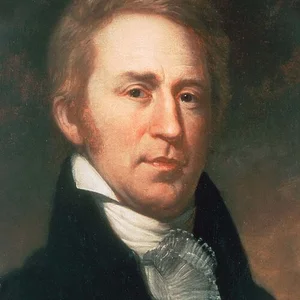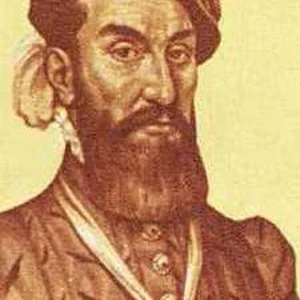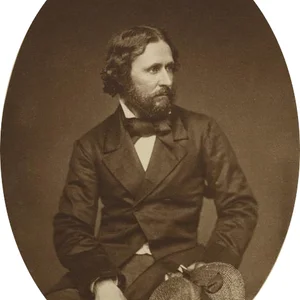

American explorer, military officer and politician nicknamed “the Pathfinder.” He mapped the American West and the Oregon Trail, played a role in the conquest of California, and then became the first Republican candidate in the 1856 presidential election.
John C. Frémont(1813 — 1890)
John Charles Frémont
États-Unis
7 min read
Frequently asked questions
Key Facts
- 1842-1846: leads several expeditions to map the American West (Rocky Mountains, Oregon Trail, Great Basin)
- 1846: takes part in the conquest of California during the Mexican-American War (Bear Flag Revolt)
- 1850: becomes one of the first two senators for the State of California
- 1856: first Republican Party candidate in the presidential election, defeated by James Buchanan
- 1861: Union general at the start of the Civil War, controversial for having proclaimed the emancipation of enslaved people in Missouri
Works & Achievements
Account of the first expedition along the Oregon Trail, published by Congress and read by thousands of future migrants.
Report on the second expedition, accompanied by accurate maps; a genuine best-seller that guided the settlement of the West.
The first reliable maps of the Oregon and California trails, which transformed geographical knowledge of the continent.
A geographical memoir on California in which Frémont officially named the “Golden Gate.”
Frémont became the Republican Party's first candidate for the presidency, running on a platform opposing the extension of slavery.
An act freeing the slaves of Missouri's rebels, a bold forerunner of the national Emancipation of 1863, overruled by Lincoln.
Autobiography in which Frémont recounts his expeditions and his public career.
Anecdotes
In 1841, the young lieutenant Frémont secretly married Jessie Benton, daughter of the powerful senator Thomas Hart Benton, who opposed the marriage. The senator, furious at first, eventually forgave the couple and became his son-in-law's greatest political supporter, helping fund his expeditions to the West.
The accounts of his expeditions, written jointly with Jessie, sold like best-sellers and were reprinted by Congress. Thousands of families set out for Oregon and California following these reports as genuine travel guides, which earned Frémont his nickname of “The Pathfinder.”
In 1846, while gazing at the strait separating the Pacific Ocean from San Francisco Bay, Frémont named it the “Golden Gate,” well before the Gold Rush of 1849. The famous bridge built a century later, the Golden Gate Bridge, thus owes its name to the explorer.
During the conquest of California, Frémont found himself caught in a clash of authority between two superiors, General Kearny and Commodore Stockton. Court-martialed for insubordination in 1848 and found guilty, he was pardoned by President Polk but resigned from the army, his honor wounded.
In 1856, Frémont became the very first candidate of the young Republican Party for the presidency of the United States, with the slogan “Free Soil, Free Men, Frémont.” Opposed to the expansion of slavery, he lost to James Buchanan, but his showing paved the way for Lincoln's victory four years later.
Primary Sources
I sprang upon the summit, and another step would have precipitated me into an immense snow field... We had climbed the loftiest peak of the Rocky Mountains and unfurled the national flag where flag had never waved before.
To this gate I gave the name of “Chrysopylae,” or “Golden Gate,” for the same reasons that the harbor of Byzantium was called Chrysoceras, or Golden Horn.
The property, real and personal, of all persons in the State of Missouri who shall take up arms against the United States... is declared confiscated to the public use, and their slaves, if any they have, are hereby declared freemen.
The great object was to open a practicable road across the continent to the Pacific Ocean, and to link by knowledge the still unknown lands of our territory.
Key Places
Port city in the American South where Frémont was born in 1813.
Peak in the Rocky Mountains climbed during the first expedition of 1842, where Frémont raised the American flag. The peak now bears his name.
Strait that Frémont named the “Golden Gate” in 1846, the setting for his role in the conquest of California.
Gateway to the West, the starting point of his expeditions and the seat of his military command in 1861.
Snow-covered range where the disastrous fourth expedition (1848-49) became lost, causing the deaths of several men from cold and hunger.
City where Frémont died in 1890, in difficult financial circumstances.
Typical Objects

Optical instrument mounted on a tripod used to measure angles in order to precisely record the position of mountains, rivers, and passes. Indispensable to Frémont's mapping work.

Instrument carried on muleback to measure atmospheric pressure and thereby calculate the altitude of climbed peaks. Frémont used it to estimate the height of the summits in the Rockies.

Small, light cannon that Frémont dragged along during his second expedition across the Sierra Nevada. He ultimately had to abandon it in the snow, unable to haul it any further.

The Star-Spangled Banner that Frémont unfurled atop a peak in the Rockies as a symbol of the expansion of the United States. A highly political gesture of “Manifest Destiny.”

Maps drawn by the draftsman Charles Preuss from Frémont's surveys, showing for the first time with precision the trails to Oregon and California.

The first photographic process, brought along on the fifth expedition (1853) with photographer Solomon Carvalho to capture the landscapes of the West. One of the earliest attempts at photography on an expedition.

Soft leather garments inspired by those of the trappers and Native Americans, suited to the harsh conditions of the Rockies. Frémont and his men wore them on expedition.
School Curriculum
Vocabulary & Tags
Key Vocabulary
Tags
Daily Life
Morning
On expedition, the day began before dawn: the fire was rekindled, a quick breakfast of coffee and dried meat was wolfed down, then the mules and horses were loaded. Frémont often took advantage of sunrise to make his first theodolite readings, when the clear air made observations easier.
Afternoon
The afternoon was devoted to marching across plains, rivers, and mountain passes, sometimes for dozens of miles. Frémont constantly recorded altitudes, latitudes, and landforms, while the draftsman Charles Preuss sketched the terrain and the guide Kit Carson scouted the route.
Evening
In the evening, camp was set up near a water source. Around the fire, Frémont entered his observations in his journal and worked on his report, while the men repaired equipment and stood guard against wild animals or hostile encounters.
Food
The usual fare consisted of dried meat, hardtack, coffee, and game hunted along the way (bison, antelope, sometimes horse or mule in times of famine). During the failed expeditions in the snow, hunger drove the men to terrible extremes.
Clothing
In the field, Frémont wore rugged buckskin and wool clothing, leather boots, and a wide-brimmed hat, in the manner of the trappers. In the city and in politics, he donned an officer's uniform or the dark suit of the 19th-century public figure.
Housing
On the trails, the men lived under canvas or beneath the open sky, wrapped in blankets. Between journeys, Frémont lived in comfortable homes, in Washington with Senator Benton, and later on his Las Mariposas estate in California once gold had made him wealthy.
Historical Timeline
Period Vocabulary
Liens externes & ressources
Références
Œuvres
Report of the Exploring Expedition to the Rocky Mountains
1843
Report of the Exploring Expedition to Oregon and North California
1845
Cartes de l'Ouest dressées avec Charles Preuss
1845
Geographical Memoir upon Upper California
1848
Candidature présidentielle républicaine
1856
Proclamation d'émancipation du Missouri
1861
Memoirs of My Life
1887