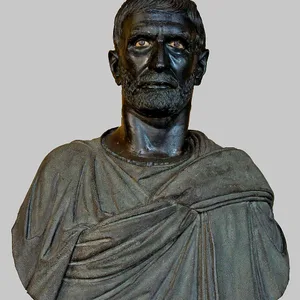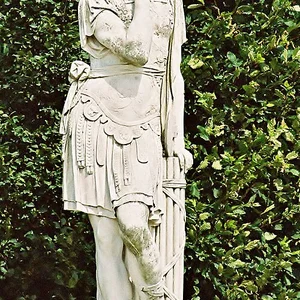

Roman general and statesman of the late 3rd century BC. Appointed dictator after the disaster at Lake Trasimene (217 BC), he opposed Hannibal through a strategy of attrition and avoidance of pitched battle, earning him the nickname Cunctator, “the Delayer.”
Fabius Cunctator
Quintus Fabius Maximus Verrucosus
Rome antique
6 min read
Frequently asked questions
Key Facts
- Born around 275 BC into the patrician gens of the Fabii, he served as consul of Rome several times
- Appointed dictator in 217 BC after the Roman defeat at Lake Trasimene against Hannibal
- Implemented a strategy of attrition (harassment, refusal of pitched battle) to wear down the Carthaginian army in Italy
- His caution, at first criticized and mocked, was vindicated after the disaster at Cannae in 216 BC
- Died in 203 BC, nicknamed “the Shield of Rome” in contrast to Marcellus, “the Sword of Rome”
Works & Achievements
A military doctrine of attrition that avoided decisive battle, which saved Rome after Lake Trasimene and still inspires modern strategists under the name “Fabian strategy.”
An exceptional magistracy held to turn the situation around after the disaster at Lake Trasimene, during which he imposed his strategy against popular opposition.
The reconquest of the great port city allied with Hannibal, a major victory that deprived Carthage of a strategic base in southern Italy.
A decisive political action to prevent panic in Rome after the defeat, organizing the city's defense and restoring the citizens' confidence.
A long career at the summit of the Roman state, consul five times and augur, making him one of the most respected men of his day (princeps senatus).
Anecdotes
After the disaster at Lake Trasimene in 217 BC, Rome appointed Fabius dictator. Rather than confronting Hannibal in a pitched battle, he shadowed him from hill to hill, harassed his rearguards, and cut off his supplies. This unprecedented tactic earned him the nickname Cunctator, “the Delayer.”
To trap the Roman army in the plain of Falernum, Hannibal devised a spectacular ruse: he had blazing torches tied to the horns of several thousand oxen and drove them by night toward the heights. The Roman sentries, believing it was an enemy maneuver, abandoned their posts, and the Carthaginian army slipped out of the pass.
As Fabius's master of the horse, Minucius criticized his caution and persuaded the people to grant him an equal command. But when his army fell into one of Hannibal's ambushes, it was Fabius who rushed to its rescue. In gratitude, Minucius publicly called him “father” and restored him to sole command.
Hoping to discredit Fabius in the eyes of the Romans, Hannibal ordered his raiders to spare the dictator's lands while ravaging those of his neighbors, so as to make him look like a traitor. Fabius foiled the scheme: he sold the estate and used the money to ransom Roman prisoners.
After the disaster at Cannae (216 BC), which tragically proved his strategy right, Fabius embodied Roman composure. He walked the streets to prevent panic and forbade overly loud mourning, restoring order and confidence in a city on the brink of collapse.
Primary Sources
One man, by his delaying, restored the State to us: for he set its safety above the talk of the crowd. And so, from day to day, his glory shines ever brighter.
Fabius, unshaken by the mockery, held fast to his plan, enduring everything for the public good, convinced that to overcome the time and fortune of Hannibal was worth more than to defeat Hannibal himself in arms.
Fabius, judging that he must not risk a decisive battle but wear down the enemy through time and starvation, followed Hannibal while always holding the heights and the strong positions.
Unus homo nobis cunctando restituit rem — One man, by delaying, restored the State to us.
Key Places
Capital of the Republic, the center of power where Fabius carried out his duties as dictator and consul. It was there that he restored calm after Cannae.
Site of the Roman disaster of 217 BC, where the consul Flaminius was killed in an ambush set by Hannibal. This defeat led to Fabius being appointed dictator.
Rich plain in Campania where Fabius tried to trap Hannibal. The Carthaginian escaped by night thanks to the trick of the oxen with flaming horns tied to their heads.
Great port city in southern Italy that went over to Hannibal's side. Fabius recaptured it in 209 BC, one of his most striking military successes.
Site of the deadliest Roman defeat of the war, in 216 BC. The disaster tragically confirmed how right Fabius had been to adopt his cautious strategy.
Typical Objects

Short double-edged sword, the main weapon of the Roman legionary for close combat. Its handiness made it a fearsome weapon in tight formation.

Large rectangular, curved shield protecting the legionary from head to knees. Assembled together, the scuta formed the famous “tortoise” (testudo).

White toga edged with a band of purple, worn by senior magistrates such as the dictator. It signaled the authority and rank of the one who wore it.

A bundle of rods tied around an axe, carried by the lictors before the magistrates. For the dictator, twenty-four lictors symbolized supreme power over life and death.

Iron-tipped throwing spear, hurled by the legionaries before contact to break the enemy lines. Its shaft bent on impact to render opposing shields unusable.

Standard carried by each maniple to mark its position and relay orders on the battlefield. Losing it was considered an absolute disgrace.
School Curriculum
Vocabulary & Tags
Key Vocabulary
Daily Life
Morning
On campaign, the general rises before dawn to consult the auspices and receive his officers. He studies the scouts' reports on Hannibal's movements and carefully chooses the heights on which to establish the day's camp.
Afternoon
The afternoon is devoted to the army's cautious march, following the enemy at a distance without ever descending into the plain. Fabius inspects the camp's fortifications and organizes the detachments tasked with harassing the Carthaginian foragers.
Evening
In the evening, in his tent (praetorium), he holds council with his legates and listens to opinions, often critical ones, such as those of Minucius. In Rome, he dines soberly and receives clients and senators to prepare public affairs.
Food
The diet of a Roman aristocrat remains frugal, based on wheat porridge (puls), bread, vegetables, olive oil, and wine diluted with water. On campaign, the general shares the army's provisions: wheat and salted meat.
Clothing
In battle, he wears the cuirass, the helmet, and the commander's red cloak (paludamentum). In Rome, he dons the toga, edged with purple when he holds a magistracy, a visible mark of his senatorial rank.
Housing
On campaign, he lodges in the general's tent at the heart of the Roman camp, laid out in a regular grid. In Rome, his residence (domus) on his patrician estates is home to family life and domestic rituals.
Historical Timeline
Period Vocabulary
Liens externes & ressources
Références
Œuvres
Stratégie de la temporisation (« tactique fabienne »)
217 av. J.-C.
Dictature de 217 av. J.-C.
217 av. J.-C.
Reprise de Tarente
209 av. J.-C.
Rétablissement de l'ordre après Cannes
216 av. J.-C.
Cinq consulats et fonctions religieuses
233-209 av. J.-C.