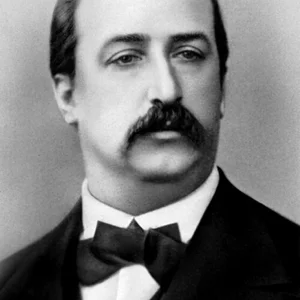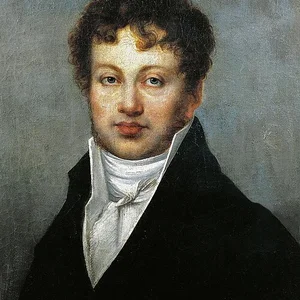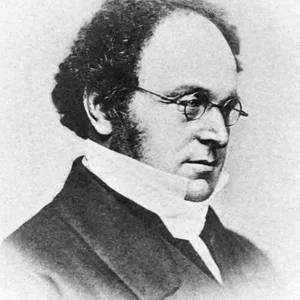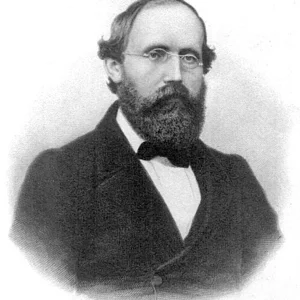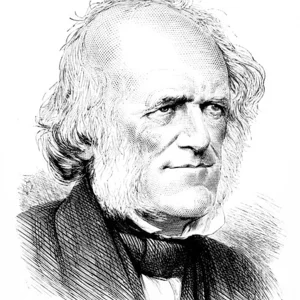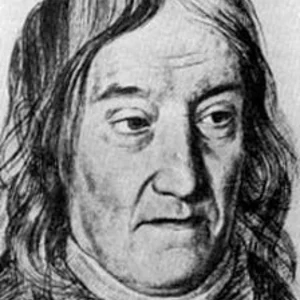

Farkas Bolyai was a Hungarian mathematician, known for his work on the foundations of geometry. He was the father of János Bolyai, one of the founders of non-Euclidean geometry, whom he encouraged despite his own reservations.
Farkas Bolyai(1775 — 1856)
Farkas Bolyai
empire d'Autriche
5 min read
Frequently asked questions
Key Facts
- Born in 1775 in Bolya, in Transylvania (Kingdom of Hungary).
- Studied at Göttingen, where he became friends with the mathematician Carl Friedrich Gauss.
- Became a professor of mathematics, physics, and chemistry at the Reformed College of Marosvásárhely (1804).
- Published the Tentamen in 1832-1833, a treatise on the foundations of mathematics.
- Died in 1856; his son János developed the non-Euclidean geometry that he had foreseen.
Works & Achievements
His major work: a systematic treatise on elementary mathematics written in Latin, made famous by **János**'s appendix founding non-Euclidean geometry.
By incorporating his son's appendix into his own book, he enabled the spread of one of the most important mathematical discoveries of the 19th century.
His second mathematical work, a condensed presentation of his ideas, in which he notably returns to the question of parallel lines.
Nearly half a century of scientific exchanges with one of the greatest mathematicians in history, a precious testimony to the geometric thinking of the time.
Plays, translations, and teaching manuals that illustrate the breadth of his learning and his commitment to education.
Anecdotes
Farkas Bolyai was a youthful friend of the great mathematician Carl Friedrich Gauss, whom he met at the University of Göttingen around 1796. The two men kept up a correspondence for nearly fifty years, discussing in particular the problem of the parallel postulate.
For years, Farkas struggled to prove Euclid's fifth postulate on parallels. When his son János took up the same problem, he warned him in a famous letter: he should flee this question “like sensual passions,” for it could deprive a man of his health and his peace of mind.
When János sent him his revolutionary work founding a new geometry, Farkas had it published as an appendix to his own book, the Tentamen, in 1832. Gauss replied that he could not praise the work without praising himself, since he had thought of it long ago — which deeply wounded the young János.
A man of many talents, Farkas Bolyai also wrote plays, composed music, drew, and took an interest in building stoves and furnaces. He is said to have designed his own coffin and asked that an apple tree be planted on his grave rather than a headstone.
A teacher at the Reformed College of Marosvásárhely (now Târgu Mureș) for more than forty years, he taught mathematics, physics, and chemistry for a modest salary, often living in material hardship.
Primary Sources
A two-volume work setting out the foundations of elementary mathematics, whose appendix, written by his son János, presents the absolute science of space.
You must not attempt this approach to the parallels; I know this path to its very end: I have traversed this bottomless night, and every light, every joy of my life was extinguished there.
An exchange of letters between Farkas Bolyai and Carl Friedrich Gauss, carried on for nearly half a century, dealing notably with the theory of parallels.
Key Places
Birthplace of Farkas Bolyai, in Transylvania, then part of the Habsburg Empire. The noble Bolyai family took its name from it.
German university where he studied from 1796 and formed a lasting friendship with Carl Friedrich Gauss. A leading center of European mathematics.
The institution where he taught mathematics, physics, and chemistry for more than forty years. The center of his professional life.
Major city in Transylvania where he completed part of his early studies before leaving for Germany.
Typical Objects

Writing tools with which he composed his Tentamen and his thousands of pages of correspondence with Gauss. The sharpened goose quill remained the scholar's instrument at the start of the 19th century.

Instruments of Euclidean geometry, at the heart of his research on constructions and the parallel postulate. They embodied the limits of classical geometry that his son would go on to surpass.

His great manual of elementary mathematics published in Latin in 1832, famous above all for the appendix written by his son János. A dense and ambitious book intended for teaching.

The supports of his daily teaching at the Reformed College of Marosvásárhely for more than forty years. On them he drew figures and calculations in front of his pupils.

A musical instrument that he played, reflecting his many artistic talents beyond mathematics. He also composed music.

An everyday object whose design he studied and improved, showing his taste for technique and practical ingenuity. Masonry heaters warmed the homes of Central Europe.
School Curriculum
Vocabulary & Tags
Key Vocabulary
Daily Life
Morning
Farkas would rise early to prepare his lessons at the Reformed College of Marosvásárhely. Before joining his students, he set aside a moment for his calculations or for reading letters from Germany.
Afternoon
His afternoons were taken up with teaching mathematics, physics, and chemistry. Between two lessons, he would grade his students' work and make progress on his own geometric research.
Evening
In the evening, he wrote to Gauss, composed music, or played the violin. He often discussed mathematics with his son János or wrote plays.
Food
His diet was the simple, frugal fare of a Transylvanian provincial teacher: bread, soups, vegetables, sometimes meat and local wine. His modest life left him little room for refinements.
Clothing
He wore the sober attire of the Transylvanian teacher and gentleman: a dark frock coat, a linen shirt, a waistcoat, and boots. The middle-class dress of early-19th-century Central Europe.
Housing
He lived in modest lodgings in Marosvásárhely, attached to the college, often heated by a faience stove whose design he liked to perfect. Material hardships marked his life.
Historical Timeline
Period Vocabulary
Liens externes & ressources
Références
Œuvres
Tentamen juventutem studiosam in elementa matheseos purae introducendi
1832-1833
Appendix (édition et publication de l'œuvre de János)
1832
Kurzer Grundriss eines Versuchs
1851
Correspondance avec Gauss
1799-1853
Œuvres littéraires et pédagogiques
première moitié du XIXe siècle