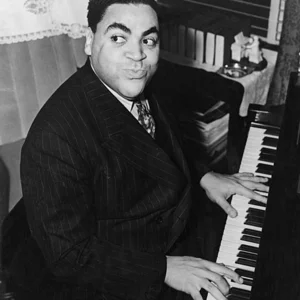

African-American jazz pianist, organist, composer and singer, major figure of stride piano. A virtuoso showman, he marked jazz in the 1920s-1930s with standards like "Ain't Misbehavin'" and "Honeysuckle Rose."
Fats Waller(1904 — 1943)
Fats Waller
États-Unis
8 min read
Frequently asked questions
Famous Quotes
« Ain't misbehavin', I'm savin' my love for you»
Key Facts
- Born May 21, 1904 in New York (Harlem)
- Composed "Ain't Misbehavin'" and "Honeysuckle Rose" in 1929 for musical revues
- Pioneer of stride piano, heir of his mentor James P. Johnson
- Recorded many hits with his group "Fats Waller and his Rhythm" in the 1930s
- Died prematurely on December 15, 1943 aboard a train near Kansas City
Works & Achievements
Composed with lyricist Andy Razaf, "Ain't Misbehavin'" became Fats Waller's masterpiece. This affectionate song about fidelity in love captivated American audiences and remains one of the most recorded jazz standards.
Composed with Harry Brooks, "Honeysuckle Rose" is a piano piece characterized by a graceful melody and sophisticated arrangements. This jazz standard demonstrates Fats Waller's compositional and instrumental mastery.
Co-written with Razaf and Brooks, "Black and Blue" addresses themes of racial discrimination and suffering while retaining a characteristic swing musical signature. The song became an anthem of African American jazz.
A purely instrumental composition, "Jitterbug Waltz" showcases Fats Waller's piano virtuosity with rapid passages, complex harmonies, and exceptional creative verve. It remains a staple of the jazz repertoire.
A humorous jazz song, "Spoonful of Sugar" illustrates Fats Waller's showmanship with its witty lyrics and lively performance. It represents the entertaining and comedic side of his repertoire.
A collaborative piece with Thomas Waller and Spencer Williams, "Squeeze Me" is a jazz classic that benefited from Fats Waller's distinctive piano signature and charismatic stage presence.
Although composed by others, Fats Waller's interpretation of "Body and Soul" as a piano solo remains legendary. It demonstrates his talent for transforming standards with his personal style and expressive playing.
Anecdotes
Fats Waller was as much a comedian as a musician: on stage, he sang with humor, made funny faces, and interacted with the audience, turning his concerts into true variety shows. This combination of musical talent and comedic art made him a star of American entertainment.
Before becoming famous, Fats Waller played the organ in church. His father, a minister, initially disapproved of his interest in jazz, which was considered sinful music. Fats nevertheless pursued his passion and blended liturgical organ techniques with jazz, creating a unique style.
“Ain’t Misbehavin’,” composed in 1929 with lyricist Andy Razaf, became his most famous standard and brought him national fame. The song is about a man faithful to his beloved, and Waller’s vocal charm made it a lasting jazz hit.
Fats Waller was a prodigious stride pianist, capable of playing complex bass lines with his left hand while improvising elaborate melodies with his right. This style, inherited from the pioneers of New York jazz, demanded exceptional virtuosity and rare physical endurance.
Fats Waller collaborated with the greatest jazz figures, including Louis Armstrong and Duke Ellington. These encounters between top-tier musicians mutually enriched their styles and contributed to the constant innovation of American jazz in the 1930s.
Primary Sources
Fats Waller delivers a virtuoso performance on piano, alternating complex stride jazz passages with humorous songs that have the audience roaring with laughter. His combined talent as a musician and comedian makes him a complete entertainment attraction.
I owe my technique to the church organ and the stride pianists of New York I listened to for years. The piano, for me, is like speaking with hands and voice.
Thomas Wright Waller, known as Fats Waller, was one of the greatest composers and performers of American jazz, with over 400 compositions to his credit and recordings that influenced generations of musicians.
The piece, written by Fats Waller and Harry Brooks, quickly became a jazz classic. The arrangement demonstrates Waller's exceptional mastery of the keyboard and his innate sense of swing.
Key Places
Birthplace and artistic development neighborhood of Fats Waller, Harlem was the cultural heart of the African American community and the cradle of the Harlem Renaissance. It was here that Waller honed his musical talents and established his initial reputation.
Iconic Harlem performance venue, the Apollo Theater hosted the greatest African American artists. Fats Waller gave many triumphant performances there before enthusiastic audiences.
Prestigious Harlem nightclub despite its segregationist policy, the Cotton Club showcased the best Black musicians for a wealthy white audience. Fats Waller performed there, participating in the intense musical life of the Harlem Renaissance.
Second great center of American jazz, Chicago hosted a vibrant music scene. Fats Waller played and recorded there, contributing to jazz's national influence and establishing connections with other major musicians.
Fats Waller made triumphant tours in France, a country where jazz was enthusiastically embraced by the cultural intelligentsia. These European stays consolidated his international reputation and influenced French musicians.
Typical Objects

The piano was Fats Waller's instrument of choice. He mastered the stride style, a technique where the left hand plays complex alternating bass lines while the right hand improvises the melody. This technique, born in Harlem, demands exceptional virtuosity.

An instrument favored by Fats Waller, especially in the 1930s–1940s, the Hammond organ offered a rich, warm sound ideal for jazz. Waller explored the sonic possibilities of this innovative instrument.

Fats Waller was known for his impeccable, colorful suits worn during performances. These outfits, in keeping with the Art Deco style of the era, reflected his status as a entertainment star and his deep awareness of stage image.

The rise of radio broadcasting in the 1930s allowed Fats Waller to reach millions of listeners. He used the microphone to convey his charisma and humor, becoming a familiar figure in American homes.

A prolific composer, Fats Waller regularly wrote new compositions and arrangements. His scores, filled with annotations and corrections, testify to his creative process and musical perfectionism.

Fats Waller recorded about 300 titles on 78 rpm records, the dominant format of the era. These recordings immortalized his performances and enabled international distribution, contributing to his worldwide fame.
School Curriculum
Vocabulary & Tags
Key Vocabulary
Tags
Daily Life
Morning
After a night of musical performance, Fats Waller would wake up late in the mid-morning, often tired but energetic. He would have a hearty breakfast at his Harlem home or a local café, discussing music with fellow musicians and reading reviews of his shows in the newspapers.
Afternoon
The afternoon was devoted to composing new songs, rehearsing with his accompanists, and recording records. Fats Waller would work at the piano for several hours, experimenting with new arrangements and perfecting his compositions. He regularly received his collaborators, including Andy Razaf and other composers.
Evening
In the evening, Fats Waller would prepare for his performances at the Cotton Club, the Apollo Theater, or other prestigious venues in Harlem and beyond. He would don his elegant suits, warm up at the piano, and take the stage to deliver energetic shows blending virtuoso music and comedic humor until midnight or later.
Food
Living in urban Harlem, Fats Waller enjoyed traditional African American cuisine: fried chicken, southern greens, cornbread, and pastries. He frequented Harlem's restaurants and diners, particularly appreciating hearty and flavorful meals. His love of good food was notorious, and he maintained a certain stoutness that did not affect his pianistic virtuosity.
Clothing
Always elegantly dressed, Fats Waller preferred impeccable three-piece suits, pinstripe suits, white tuxedo jackets, and felt hats befitting his status as a entertainment star. His colorful ties and pocket squares added a touch of personal elegance. He embodied the sophisticated urban African American style of Harlem.
Housing
Fats Waller lived in a comfortable Harlem residence, reflecting his status as a successful musician of the 1930s. His home regularly hosted fellow musicians and collaborators for informal jam sessions. The atmosphere was generally warm and lively, filled with music and creativity.
Historical Timeline
Period Vocabulary
Visual Style
Le style visuel de Fats Waller incarnait l'élégance Art Deco des années 1930, avec ses costumes impeccables contrastant avec sa présence dynamique et joviale au piano. Son image alliait sophistication urbaine et charisme naturel, se démarquant dans les clubs enfumés de Harlem par son allure distinguée et ses expressions faciales expressives.
Sound Ambience
L'univers sonore de Fats Waller était celui du jazz stride new-yorkais de l'entre-deux-guerres, où les pianos virtuoses dominaient les clubs de Harlem, accompagnés de trompettes chaudes et de l'humour inépuisable du musicien. Les sons évoquent une époque de liberté créative et de joie musicale insouciante malgré les tensions sociales et économiques.