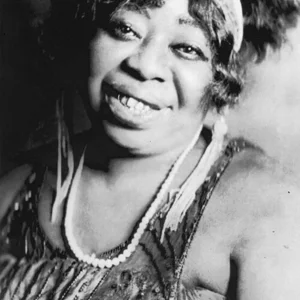

Ethel Waters (1896-1977) was an African American singer and actress. A pioneer of jazz and vocal blues, she broke racial barriers on Broadway, in film, and on American television, becoming one of the most famous Black artists of the first half of the 20th century.
Ethel Waters(1896 — 1977)
Ethel Waters
États-Unis
6 min read
Frequently asked questions
Key Facts
- Born October 31, 1896 in Chester, Pennsylvania; died September 1, 1977
- Recorded landmark hits such as "Dinah" (1925), "Am I Blue?" (1929), and "Stormy Weather" (1933)
- In 1939, became one of the first African Americans to host her own television show (The Ethel Waters Show)
- Nominated for the Academy Award for Best Supporting Actress for Pinky (1949), becoming the second African American nominated for an Oscar
- Triumphed on Broadway in Cabin in the Sky (1940) and The Member of the Wedding (1950)
Works & Achievements
First hit recordings that launched her career as a blues singer and helped popularize the Black-owned label Black Swan.
One of her first major popular hits, becoming a standard covered by many artists.
Her most famous song, premiered at the Cotton Club, now a timeless classic of vocal jazz.
First major dramatic role for a Black woman headlining on Broadway, a critical triumph.
All-Black-cast musical film in which she reprised her stage role.
Drama about racial prejudice that earned her an Academy Award nomination for Best Supporting Actress.
First American television series headlined by an African-American star.
Best-selling memoirs tracing her rise from poverty to fame; title taken from the spiritual she made famous.
Anecdotes
In 1933, Ethel Waters became one of the best-paid Black artists on Broadway, performing “Stormy Weather” at Harlem’s Cotton Club. The song—melancholic and powerful—became her major hit and remained linked to her voice for decades.
In 1939, she became the first African American woman to play a leading dramatic role on Broadway with the play “Mamba’s Daughters.” The audience and critics were so moved that she received a long ovation—a rare event for a Black actress in that era of segregation.
In 1950, Ethel Waters became the first African American to star in a leading role on an American television series, “Beulah.” Television was then a brand-new medium, and her on-screen presence marked an important step for Black representation.
That same year, 1950, she became the second African American nominated for an Oscar (Best Supporting Actress) for the film “Pinky,” which tackled the delicate subject of racial prejudice.
Toward the end of her life, in the 1950s and 1960s, Ethel Waters joined the great evangelical crusades of pastor Billy Graham, where she sang the spiritual “His Eye Is on the Sparrow”—a song she had popularized and from which she took the title of her autobiography.
Primary Sources
I never was a child. I never was coddled, or liked, or understood by my family.
I am somebody. I am God's child.
account of her later years and spiritual involvement with Billy Graham's crusades
Key Places
City where Ethel Waters was born in 1896 and grew up in extreme poverty.
Iconic neighborhood of Black culture where she performed at the Cotton Club and participated in the Harlem Renaissance.
Avenue of grand theaters where she broke racial barriers with “Mamba’s Daughters” and “Cabin in the Sky.”
Center of American cinema where she filmed “Cabin in the Sky” and “Pinky,” a film that earned her an Oscar nomination.
Los Angeles neighborhood where Ethel Waters passed away in 1977.
Typical Objects

Microphones from the 1920s–1930s enabled a more intimate and nuanced singing style; Ethel Waters was praised precisely for her clear diction and delicate phrasing.

The medium for her earliest recordings with Black Swan label starting in 1921, which spread her blues and jazz voice across the country.

The song she popularized in 1933 and which became the emblem of her singing career.

Typical attire for Harlem cabaret and revue singers, which she wore at the Cotton Club and Broadway theaters.

Billboards advertising shows at the Cotton Club or Black theaters where she performed at the height of the Harlem Renaissance.

In the 1930s–1940s, radio broadcast her voice into American homes and made her a national star.

A central object of her deep faith, especially in her later years spent singing spirituals during Billy Graham's crusades.
📷 CC BY-SA 2.0 · Wikimedia Commons ↗School Curriculum
Vocabulary & Tags
Key Vocabulary
Tags
Daily Life
Morning
On tour, Ethel Waters woke up late, since shows ended in the middle of the night. Mornings were for resting her voice, rehearsing new songs, and finalizing contract details with theater managers.
Afternoon
Afternoons were dedicated to orchestra rehearsals, costume fittings, and studio recording sessions. During her film years, she spent long hours on Hollywood sets between takes and makeup.
Evening
Evening brought the performance: Harlem cabaret, Broadway stage, or concert hall. Under the spotlight, she sang and performed before an often captivated audience, sometimes late into the night.
Food
Raised in poverty, she enjoyed African American Southern cuisine, 'soul food': fried chicken, collard greens, cornbread, and sweet potatoes. Touring artists often grabbed quick meals between two shows.
Clothing
On stage, she wore sumptuous long sequined gowns, gloves, and sparkling jewelry. In town, she adopted the polished elegance of the stars of her time: fur coats, hats, and fashionable tailored suits.
Housing
As a child, she experienced miserable, unstable housing in Pennsylvania's poor neighborhoods. Once famous, she lived in comfortable New York apartments and later a house in California, despite financial difficulties at the end of her life.
Historical Timeline
Period Vocabulary
Visual Style
Esthétique glamour mêlant la Renaissance de Harlem et l'âge d'or hollywoodien, entre clichés sépia, scènes de cabaret art déco et lumière chaleureuse des revivals gospel.
Sound Ambience
Ambiance feutrée d'un cabaret de jazz de Harlem mêlée au souffle d'un gospel de revival, portée par la voix chaude et expressive d'Ethel Waters.