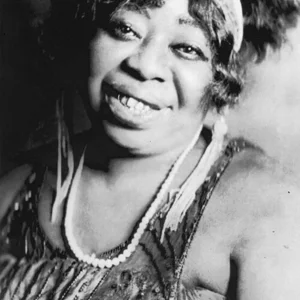

American blues singer, known as the "Mother of the Blues." A pioneer of classic blues, she was one of the first African American artists to record records in the 1920s and influenced an entire generation of female singers.
Ma Rainey(1886 — 1939)
Ma Rainey
États-Unis
9 min read
Frequently asked questions
Key Facts
- Born in 1886 in Georgia (USA), died in 1939.
- Known as the "Mother of the Blues".
- Performed from the early 20th century in traveling shows (vaudeville, minstrel shows) throughout the southern United States.
- Recorded over 90 songs between 1923 and 1928 for Paramount Records.
- Mentor and godmother to singer Bessie Smith, the "Empress of the Blues."
Works & Achievements
One of Ma Rainey's very first recordings for Paramount Records, this song evokes the ravages of the cotton boll weevil that devastated Southern plantations, a metaphor for the sufferings of the rural African American community.
A vivid testament to Prohibition and the production of illegal alcohol in the American South, this track illustrates the blues' ability to address social issues with verve and humor while depicting the daily reality of the Black working class.
One of Ma Rainey's most famous songs, which became a blues standard covered by countless 20th-century artists. Blending heartache and a longing for freedom, this song showcases the universal emotional power of classic blues.
A song dedicated to a popular dance of the Roaring Twenties, the Black Bottom, which took cabarets and ballrooms by storm. This track highlights Ma Rainey's role in spreading African American dances and popular culture to a wide audience.
One of Ma Rainey's most daring songs, with lyrics that openly allude to unconventional loves. Accompanied by a controversial advertisement depicting her in men's clothing, this song is now regarded as a pioneering statement of self-assertion beyond imposed norms.
Long before her recordings, Ma Rainey built her stage reputation with this famous traveling troupe that toured the American South. It was here that she honed her craft, mentored Bessie Smith, and forged the flamboyant image that would become her trademark.
Anecdotes
Around 1902, while performing in a traveling show in Missouri, Ma Rainey first heard a young woman singing a melancholy melody about lost love. She was so captivated by this plaintive, novel music that she immediately added it to her repertoire — one of the earliest documented instances of the oral transmission of blues to a professional artist.
On stage, Ma Rainey wore a unique necklace: a row of $20 gold coins that sparkled under the spotlights. This lavish ornament was much more than jewelry — in an industry where Black artists were systematically underpaid and exploited, she proudly displayed her financial independence and star status.
Around 1912, an unknown teenager named Bessie Smith joined the traveling Rabbit Foot Minstrels troupe where Ma Rainey sang. Ma Rainey took her under her wing, teaching her blues techniques and the secrets of stage presence. Bessie Smith would become the 'Empress of the Blues' a few years later, carrying on her mentor's artistic legacy.
In 1925, police raided a Chicago apartment where Ma Rainey was hosting a party deemed 'scandalous.' Arrested, she was released a few hours later, and the incident did not tarnish her reputation with her loyal audience — on the contrary, it reinforced her image as a flamboyant, free figure who rebelled against the conventions imposed on Black women of her time.
To wow her tent-show audiences, Ma Rainey sometimes made her stage entrance by dramatically emerging from a giant papier-mâché phonograph. This theatrical stunt perfectly illustrated how she embodied the link between the Southern traveling show tradition and the revolutionary modernity of recorded records.
Primary Sources
The 'Mother of the Blues' — Ma Rainey sings the blues like no one else can. Her powerful voice and authentic style have made her the most beloved blues artist in the country. Order her latest records today.
Ma Rainey has triumphed once again before a packed house. No other artist possesses such a deep and powerful contralto voice, nor that unique way of captivating the audience from the very first notes.
Ma Rainey sang the blues as if each word had cost her something personal. Her voice carried within it all the pain and all the vitality of a people.
Gertrude 'Ma' Rainey — the incomparable blues singer whose records have brought the authentic voice of the South into hundreds of thousands of homes across America.
Key Places
Gertrude Pridgett was born in Columbus on April 26, 1886, in the heart of the segregated Deep South. She returned there at the end of her life to manage two cinemas, the Lyric and the Airdrome, and died there on December 22, 1939.
It was in Chicago that Ma Rainey recorded most of her work between 1923 and 1928. The city was then the capital of Northern blues and the main destination of the Great African-American Migration, home to a thriving record industry.
Legendary city of jazz and blues, New Orleans was one of the major stops on Ma Rainey's tours in the South. Its clubs and cabarets embodied the musical cradle from which the entire tradition of blues and ragtime sprang.
A major metropolis of the segregated South, Atlanta was a key city on the "Chitlin' Circuit", the network of venues reserved for Black artists and audiences. Ma Rainey performed there regularly to enthusiastic crowds.
Epicenter of the Harlem Renaissance in the 1920s, Harlem was the vibrant heart of African-American culture. Ma Rainey rubbed shoulders with the great Black artistic and intellectual figures of her time during her visits to New York.
Typical Objects

Appearing in the 1900s, the phonograph allowed people to listen to recorded music at home for the first time. Ma Rainey turned it into a spectacular stage prop, sometimes emerging from a huge papier-mâché phonograph to open her shows.

Ma Rainey proudly wore a necklace made of 20-dollar gold coins, a flashy symbol of her prosperity and financial independence in an industry that often exploited Black artists.

On stage, Ma Rainey wore dresses embroidered with rhinestones and sequins, accented with colorful ostrich feather boas. These extravagant costumes created an instantly recognizable stage image and affirmed the dignity and magnificence of Black female artists.

In 1920s Chicago studios, Ma Rainey recorded her records in front of a primitive carbon microphone. Despite the limited sound quality of the time, her deep, powerful contralto voice came through remarkably well on the early shellac pressings.

The 78 RPM shellac records were the musical medium of the classic blues era. Ma Rainey recorded over 90 tracks for Paramount Records between 1923 and 1928; these fragile and precious discs circulated throughout the South and North of the United States, carrying her voice far beyond the tents.

Ma Rainey performed for many years with the famous traveling troupe F.S. Wolcott's Rabbit Foot Minstrels, which toured the South under large tents. These tents hosted hundreds of spectators, often segregated by skin color in accordance with Jim Crow laws.
School Curriculum
Vocabulary & Tags
Key Vocabulary
Tags
Daily Life
Morning
During tours, Ma Rainey woke up late after nighttime performances, in the company's reserved railroad car or in a boarding house run by Black families — white hotels being forbidden to them by law. She spent the morning caring for her voice with honey and lemon infusions and handling the daily business of her troupe.
Afternoon
The afternoon was dedicated to rehearsals with her musicians, the Georgia Jazz Band, in any available space: backstage at a theater, a common room in a Black church, or outdoors. She also oversaw the preparation of costumes, sets, and the sale of tickets for the evening show.
Evening
As night fell, Ma Rainey transformed into a star: meticulous makeup, sequined dress, gold coin necklace, sparkling gold teeth. She sometimes sang until midnight before hundreds of spectators packed under the tent, then received admirers and musicians in a festive atmosphere after the performance.
Food
Ma Rainey ate traditional African American Southern cuisine: beans and rice, stewed meats (chicken and dumplings), cornbread, and sweet potatoes. On tour, segregation often forced Black artists to make do with meals bought from street vendors, as restaurants refused to serve them.
Clothing
On stage, Ma Rainey was dazzling: dresses embroidered with rhinestones and sequins, ostrich feather boas, tiaras adorned with colored stones, and her famous gold coin necklace. In daily life, she wore elegant outfits displaying her star status, deliberately rejecting the modest dress imposed on Black women of her time.
Housing
Like all Black artists touring in the segregated South, Ma Rainey stayed in hotels reserved for African Americans or in private homes that offered lodging. Thanks to her success, she was able to acquire a comfortable house in Columbus, Georgia, and stay in good Black hotels during her visits to Chicago.
Historical Timeline
Period Vocabulary
Visual Style
Esthétique théâtrale des années 1920 : lumières chaudes de chapiteau, costumes à sequins et plumes d'autruche, necklace de pièces d'or sous les ampoules ambrées, dans l'esprit des affiches de music-hall de la Harlem Renaissance.
Sound Ambience
L'ambiance sonore des spectacles de Ma Rainey mêle le blues acoustique des années 1920 — guitare bottleneck, piano bastringue, cuivres sourds — au bruit de foule des chapiteaux du Sud, le tout teinté du craquement chaud et nostalgique d'un disque 78 tours.