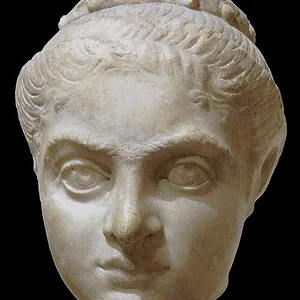

Fausta was a Roman empress, daughter of Emperor Maximian and wife of Constantine I. Mother of three future emperors, she died in 326 under obscure circumstances, shortly after the execution of Prince Crispus.
Fausta(289 — 326)
Fausta
Rome antique
6 min read
Frequently asked questions
Key Facts
- Born around 289-290, daughter of Emperor Maximian, one of the tetrarchs
- Married Constantine I in 307, sealing a political alliance between their families
- Mother of three future emperors: Constantine II, Constantius II, and Constans
- Proclaimed Augusta by Constantine around 324
- Executed in 326 on Constantine's orders (suffocated in an overheated bath according to ancient tradition), shortly after the death of Crispus
Works & Achievements
A union celebrated at Trier that sealed the political alliance between Constantine and Maximian, making Fausta a pillar of the reign's legitimacy.
According to Lactantius, Fausta revealed to Constantine the assassination plot devised by her own father, choosing loyalty to her husband.
Mother of Constantine II, Constantius II, and Constans, Fausta ensured the continuity of the Constantinian dynasty over several decades.
After the victory over Licinius, Fausta received the supreme title of Augusta, shared with her mother-in-law Helena, a consecration of her imperial status.
An official symbol of the Empire's hope and salvation (*Spes/Salus Reipublicae*), her effigy spread the ideal of a fertile and stable dynasty.
Anecdotes
In 310, Fausta's father, the former emperor Maximian, plotted to murder Constantine in his sleep. According to the Christian historian Lactantius, Maximian confided his plan to his daughter Fausta in hopes of her help, but she revealed everything to her husband. Constantine had a eunuch placed in his bed in his stead: the plot failed and Maximian was forced to take his own life.
Fausta appears on imperial coins as a model mother: she is shown holding two children in her arms, with legends such as SPES REIPVBLICAE (“the hope of the State”) or SALVS REIPVBLICAE (“the safety of the State”). These coins served as propaganda to show that Constantine's dynasty was solid and assured of a future.
In 326, shortly after the mysterious execution of Crispus, Constantine's eldest son, Fausta in turn died in obscure circumstances. Several ancient sources claim that she perished, suffocated in an overheated bath (the caldarium), on the orders of Constantine himself.
After her death, Fausta was subjected to damnatio memoriae: her name was chiselled off inscriptions and her memory officially condemned. Yet her three sons all became emperors (Constantine II, Constantius II, and Constans), so the dynasty continued to rest on her descendants.
The scandal of the deaths of Crispus and Fausta left a lasting impression. A century later, the writer Sidonius Apollinaris reports that a mocking epigram had been posted comparing Constantine to Nero, the emperor who had had his own mother and wife killed.
Primary Sources
With no regard for the bonds of blood, Constantine put his son Crispus to death, suspected of a guilty affair with his stepmother Fausta; then, as his mother Helena grieved over this death, he had a bath heated to excess and shut Fausta inside it, from which she was drawn out lifeless.
Maximian revealed his plan to his daughter Fausta, begging her to help him; but she discovered the crime being prepared and reported it to her husband Constantine.
Constantine put his son Crispus to death, then cast his wife Fausta into a scalding bath.
Who then would long for the golden age of Saturn? These times of ours are of gold and precious stones, yet they are the times of Nero.
Key Places
Constantine's imperial capital in Gaul; Fausta married Constantine here in 307 and lived here during the early years of his reign.
Birthplace of her family's power and of her brother Maxentius; the imperial court stayed here in 326 for the celebrations marking twenty years of rule, shortly before Fausta's death.
The town where Crispus, Constantine's son, was executed in 326; his death came only shortly before Fausta's own.
A major imperial residence in the East under Constantine, where the court relocated after his victory over Licinius in 324.
Site of the 312 battle where Constantine defeated Maxentius, Fausta's brother — a turning point in her family's destiny.
Typical Objects

Headband adorned with pearls and precious stones, a mark of the rank of Augusta that Fausta received around 324 alongside the empress Helena.

Cloth dyed reddish-purple, reserved for the imperial family; Fausta wore it as Constantine's wife and then as Augusta.

Coins struck in her name, on which she appears holding two children with the legend SPES or SALVS REIPVBLICAE, symbols of dynastic continuity.

Bathing room heated by a hypocaust; according to several ancient sources, it was in an overheated bath that Fausta met her death in 326.

Earrings, necklaces, and gold fibulae worn by the women of the court; the coin portraits of Fausta show her richly adorned.

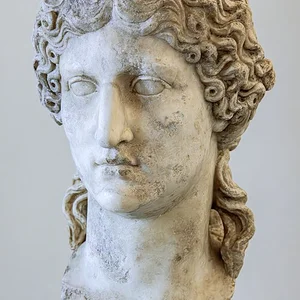
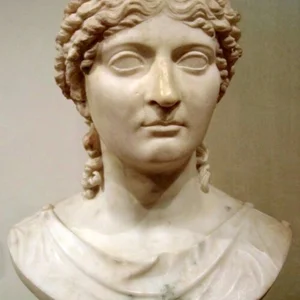
Bust or statue of the empress; many were reworked or destroyed after the damnatio memoriae that struck Fausta.
School Curriculum
Vocabulary & Tags
Key Vocabulary
Daily Life
Morning
An empress's morning began with a lengthy grooming ritual handled by her servants: an elaborate hairstyle held in place with pins, makeup, perfumes, and dressing. She was then presented with the day's business and the requests of the imperial household.
Afternoon
In the afternoon, Fausta oversaw her large household (domus) and the education of her children, who were entrusted to tutors. She received visitors and ladies of the court, and took part in the palace's official ceremonies.
Evening
Evenings were devoted to court banquets, where guests dined reclining on couches to the sound of music. There the empress upheld her rank alongside the emperor, surrounded by the high aristocracy and the dignitaries of the palace.
Food
At the imperial table, refined dishes were served: game and poultry, fish, fruit, wheat bread, and wines flavored with honey or spices. The famous garum, a fermented fish sauce, seasoned many dishes.
Clothing
Fausta wore long tunics and cloaks of silk and fine wool, accented with purple and threads of gold. As Augusta, she displayed the diadem set with pearls and precious stones, along with rich jewelry.
Housing
She lived in the vast imperial palaces of Trier and Rome, or in residences in the East. These dwellings included ceremonial halls decorated with marble and mosaics, gardens, and private baths heated by hypocaust.
Historical Timeline
Period Vocabulary
Liens externes & ressources
Références
Œuvres
Le mariage dynastique avec Constantin
307
La révélation du complot de Maximien
310
La maternité des trois empereurs
316-323
L'élévation au rang d'Augusta
vers 324
L'image monétaire de l'État
324-326