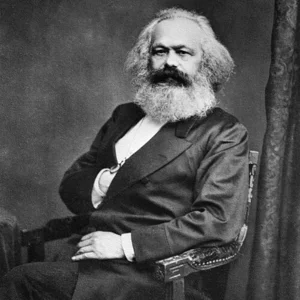

German philosopher, sociologist, and economist (1818–1883), Karl Marx is the founder of historical materialism and the critical analysis of capitalism. He revolutionized political thought by proposing a theory of class struggle and social transformation.
Karl Marx(1818 — 1883)
Karl Marx
royaume de Prusse, apatride
7 min read
Frequently asked questions
Famous Quotes
« The proletarians have nothing to lose but their chains. They have a world to win.»
« It is not the consciousness of men that determines their existence, but their social existence that determines their consciousness.»
Key Facts
- 1848: Publication of The Communist Manifesto with Friedrich Engels, which became a founding text of the labour movement
- 1867: Publication of the first volume of Capital (Das Kapital), his major economic and philosophical work
- 1845–1846: Writing of The German Ideology, formulating the principles of historical materialism
- 1883: Death in London, where he had taken refuge after being exiled for his revolutionary activities
- 1864: Participation in the founding of the First International, an organization bringing together European labour movements
Works & Achievements
Written with Engels for the Communist League, this founding text sets out the theory of class struggle and calls on the proletarians of all countries to unite. It is the most widely read political text in modern history.
Marx's masterwork, a scientific analysis of the capitalist mode of production, labor value, and surplus value. Volumes II and III were published posthumously by Engels.
Early texts unpublished during Marx's lifetime, in which he develops his theory of the alienation of the worker under capitalism. Published in 1932, they had an immense influence in the 20th century.
Written with Engels, this work lays the foundations of historical materialism: the idea that economic structures (base) determine ideas and institutions (superstructure).
A brilliant analysis of the 1851 coup d'état in France, in which Marx refines his conception of the State and social classes. Contains the famous phrase: 'history repeats itself twice, first as tragedy, then as farce'.
A text in which Marx analyzes the Paris Commune as the first experience of a workers' government and draws theoretical lessons from it on the question of the State.
Anecdotes
Karl Marx spent more than 30 years at the British Library in London writing his masterwork 'Das Kapital'. He went there daily, often in a state of great poverty, working on his manuscripts with remarkable determination. This library became the symbolic place where one of the world's most influential thinkers developed his revolutionary theory of capitalism.
Expelled from Germany for his revolutionary ideas, Marx was forced to flee several countries (Belgium, France, Switzerland) before finding refuge in England in 1852. His forced exile shows how his radical political theories alarmed European governments of the time, who saw him as a dangerous agitator of minds.
Marx was known for his extremely difficult living conditions: his clothes were worn out, his health fragile, and his family lived in poverty in London. Ironically, the theorist who analysed the poverty of workers himself experienced material poverty for most of his productive life.
The Communist Manifesto, written with Friedrich Engels in 1848, opened with the famous line: 'A spectre is haunting Europe — the spectre of communism.' This short but powerful text became one of the most widely read and debated political documents in world history.
Marx had a voluminous and impressive beard that became his most recognisable physical feature. In the Victorian era, his revolutionary appearance, combined with his radical ideas, reinforced his image as a nonconformist and rebellious thinker standing against the established order.
Primary Sources
A spectre is haunting Europe — the spectre of communism. All the powers of old Europe have entered into a holy alliance to exorcise this spectre.
The wealth of those societies in which the capitalist mode of production prevails presents itself as an 'immense accumulation of commodities'. Our investigation must therefore begin with the analysis of a commodity.
The worker becomes poorer the more wealth he produces, the more his production increases in power and extent. The worker becomes an ever cheaper commodity the more commodities he produces.
The philosophers have only interpreted the world in various ways; the point, however, is to change it.
From each according to his abilities, to each according to his needs.
Key Places
Marx's birthplace, in the Moselle valley. It is here that he was born in 1818 and received his early education in a region shaped by the ideas of the French Revolution.
Marx lived here from 1843 to 1845 and wrote his Economic and Philosophic Manuscripts of 1844. He moved in socialist circles and met Proudhon, Heine, and above all Engels.
Place of exile from 1845 to 1848, where Marx and Engels wrote The German Ideology and the Communist Manifesto, commissioned by the League of Communists.
A working-class district of London where Marx lived in often extreme poverty with his family for many years, most notably at 28 Dean Street.
Marx's daily workplace for over twenty years, where he combed through thousands of works on political economy to write Capital.
Typical Objects

Marx wrote in a frantic and compulsive manner, covering thousands of pages of manuscripts, notes and correspondence. His quill was the instrument of his relentless thinking.

Marx spent years in the reading room of the British Museum in London, writing the bulk of Capital there. His usual seat is still pointed out to visitors.

A heavy pipe smoker, Marx consumed tobacco in large quantities, which worsened his chronic bronchitis and poor health throughout his life in exile in London.

Marx was a voracious reader of the European economic and political press, poring over British parliamentary reports, industrial statistics and workers' newspapers to fuel his analysis.

Marx maintained a massive correspondence with Engels, activists and intellectuals across Europe. These letters today constitute an irreplaceable historical source.

Marx's desk in his Soho lodgings in London was famous for its extreme disorder: books, newspapers, manuscripts and objects piled up in an apparently chaotic yet fertile jumble.
School Curriculum
Vocabulary & Tags
Key Vocabulary
Tags
Concept
Daily Life
Morning
Marx rose late, often after ten o'clock, having worked through much of the night. He had a frugal breakfast with his family in their cramped Soho apartment, smoking his pipe from early morning and reading through the day's newspapers.
Afternoon
In the afternoon, Marx walked to the British Museum where he spent long hours in the reading room, taking notes in voluminous registers. He consulted parliamentary reports, industrial statistics, and treatises on political economy with methodical rigor.
Evening
In the evenings, Marx sometimes received militant visitors or correspondents passing through, debated politics with Engels during his visits, or returned to his manuscripts by the light of an oil lamp. He also wrote numerous letters to his correspondents across Europe.
Food
The Marx family often lived in near-destitute poverty, subsisting on the regular sums of money sent by Engels. Meals were simple: bread, potatoes, and occasionally cheap meat. Marx was fond of beer and wine when finances allowed.
Clothing
Marx wore the bourgeois dress of his era — black frock coat, waistcoat, cravat — but often worn and threadbare for lack of means. He readily neglected his appearance and sometimes spent entire days in his dressing gown when working.
Housing
The Marx family lived in precarious conditions in London, notably in two small rooms at 28 Dean Street in Soho, an overcrowded working-class neighborhood. The house was dark, damp, and cluttered with books. Several of their children died there in infancy, victims of poverty and disease.
Historical Timeline
Period Vocabulary
Visual Style
Un style réaliste sombre, à la manière des gravures de Daumier, évoquant le Londres victorien industrieux : clairs-obscurs intenses, tonalités brunes et grises, atmosphère studieuse et militante.
Sound Ambience
L'univers sonore de Marx est celui du Londres victorien industriel : le fracas des rues populaires de Soho et le silence studieux de la salle de lecture du British Museum.
Liens externes & ressources
Références
Œuvres
Manifeste du Parti communiste
1848
Le Capital (Das Kapital), Livre I
1867
Manuscrits économico-philosophiques de 1844
1844
L'Idéologie allemande
1845-1846
Le 18 Brumaire de Louis Bonaparte
1852
La Guerre civile en France
1871