 flip
flipRoast capon on the spit, perfumed with truffles
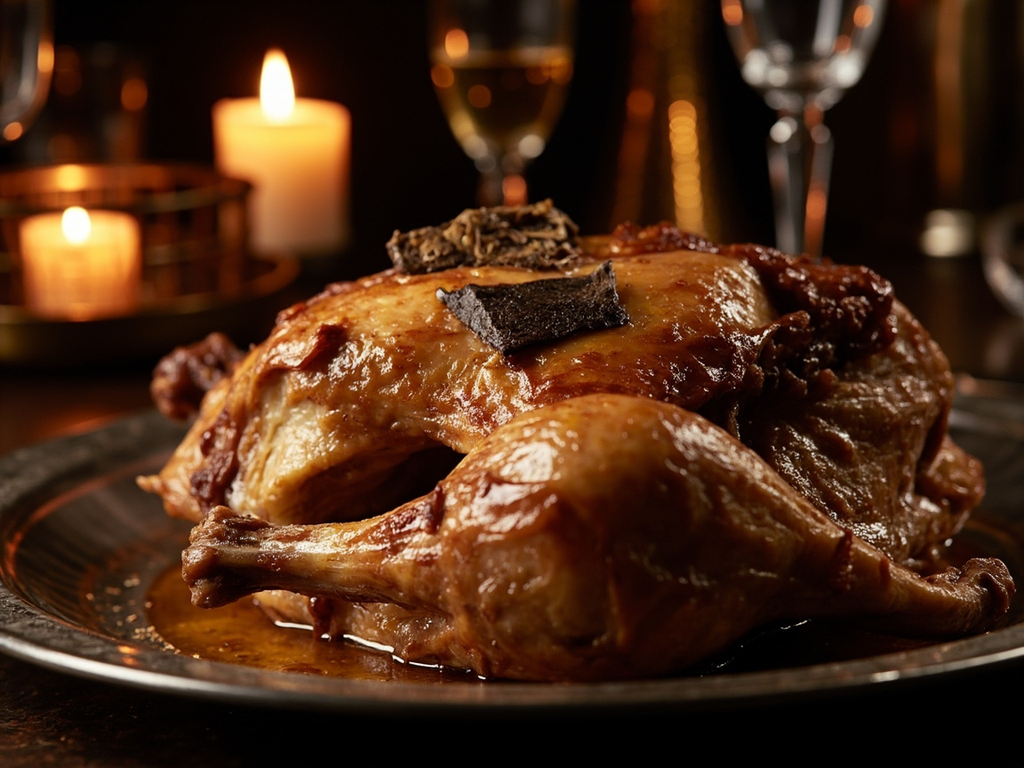
Roast capon on the spit, perfumed with truffles
Why this dish? Perpetual secretary of the Royal Academy of Sciences and sought-after host of the salons of the Marais and Faubourg Saint-Germain, Fontenelle frequented the best tables in Paris. Truffled capon was the centerpiece of these witty suppers where conversation mattered as much as the dish.
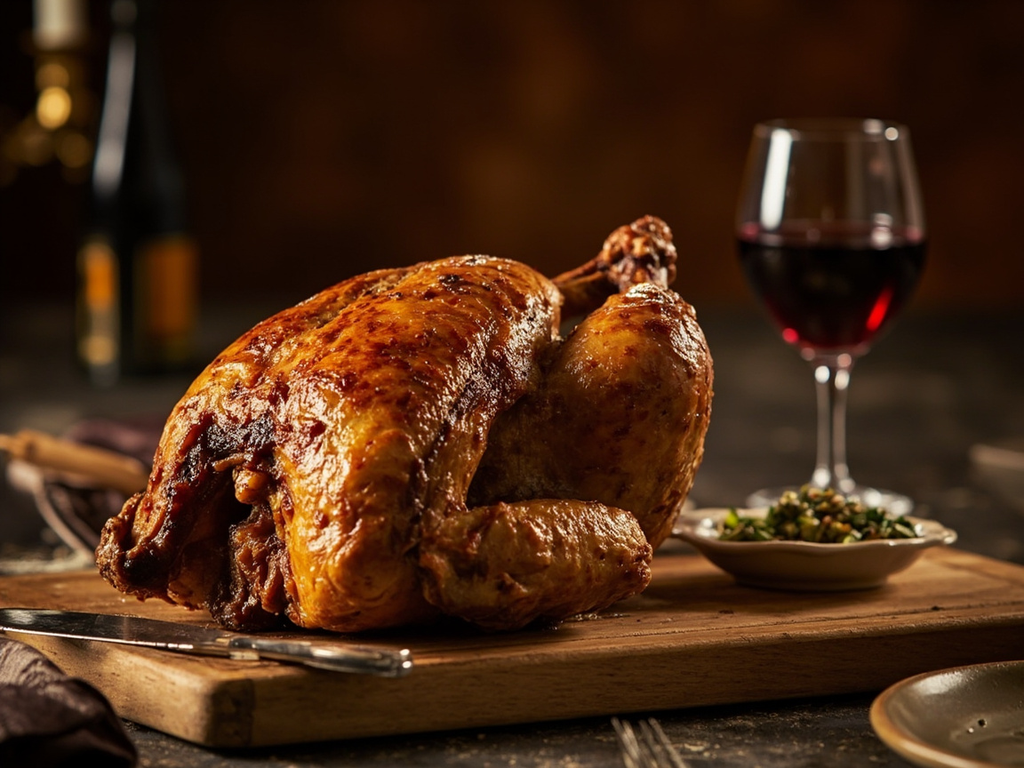
A golden capon roasted on the spit, larded with truffles slipped under the skin, whose perfume fills the whole room: the sober luxury of the great Parisian tables of the Enlightenment.
I was reproached for eating little; I replied that one must save one's appetite for what deserves it. Now nothing deserves it more than a plump capon, under whose skin one has slipped, the day before, a few slices of truffle from Périgord — for the truffle, you see, takes time, like a good thought, to perfume its surroundings. It was turned on the spit before a clear fire, basted with its own fat, and we waited. Serve little to each, but let each remember it: a fine supper is judged by the conversation it inspires.
- •Capon — a fine one (centerpiece)
- •Fresh truffles — a few (noble perfume)
- •Fat bacon — for barding (moisture and basting)
- •Fresh butter — to taste (browning)
- •Salt and pepper — to taste (seasoning)
Roast capon on the spit, perfumed with truffles
A golden capon roasted on the spit, larded with truffles slipped under the skin, whose perfume fills the whole room: the sober luxury of the great Parisian tables of the Enlightenment.
Why this dish? Perpetual secretary of the Royal Academy of Sciences and sought-after host of the salons of the Marais and Faubourg Saint-Germain, Fontenelle frequented the best tables in Paris. Truffled capon was the centerpiece of these witty suppers where conversation mattered as much as the dish.
I was reproached for eating little; I replied that one must save one's appetite for what deserves it. Now nothing deserves it more than a plump capon, under whose skin one has slipped, the day before, a few slices of truffle from Périgord — for the truffle, you see, takes time, like a good thought, to perfume its surroundings. It was turned on the spit before a clear fire, basted with its own fat, and we waited. Serve little to each, but let each remember it: a fine supper is judged by the conversation it inspires.
Ingredients (period version)
- Capon — a fine one (centerpiece)
- Fresh truffles — a few (noble perfume)
- Fat bacon — for barding (moisture and basting)
- Fresh butter — to taste (browning)
- Salt and pepper — to taste (seasoning)
Ingredients
- Capon (or good free-range chicken) — 1 (2.5 to 3 kg) (centerpiece)
- Black truffle (or truffle trimmings + juice) — 30 g (noble perfume)
- Bacon fat slices — 2 thin slices (moisture)
- Butter — 60 g (browning and basting)
- Salt and pepper — to taste (seasoning)
Method
- The day before, slide thin slices of truffle between the skin and flesh of the capon, then wrap and refrigerate to infuse.
- On the day, take the bird out 1 hour before cooking. Season, butter the skin, and bard the breast.
- Roast at 180°C (or on a spit), allowing about 1 hour per kg.
- Baste every 20 minutes with the rendered juices for a golden crispy skin.
- Remove the barding at the end of cooking to let the skin brown.
- Check doneness (clear juices at the thigh), rest 15 minutes under a cloth before carving.
How it was made : Spit-roasting over a wood fire was the queen of festive cooking. Poultry was “contised” with truffles or lard to perfume it deeply. The truffle, already highly prized, signaled a refined table. Massialot, in *Le Cuisinier roïal et bourgeois* (1691), codifies these preparations for quality households.
The contemporary twist : Serve on a wooden board surrounded by a few butter-roasted apples (the fruit, not the tuber!), and grate a final slice of truffle at the table, under the noses of the guests.
Sources : François Massialot, Le Cuisinier roïal et bourgeois, 1691 · François Pierre de La Varenne, Le Cuisinier françois, 1651
Fontenelle · Charactorium