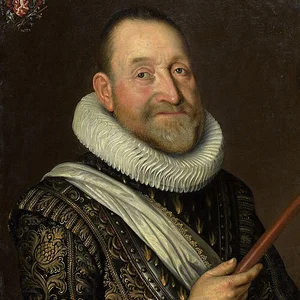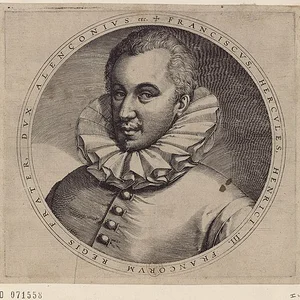

The youngest son of Henry II and Catherine de' Medici, he was an ambitious figure of the Wars of Religion. Leader of the “Malcontents,” a suitor for the hand of Elizabeth I, and briefly sovereign of the rebellious Netherlands, his death in 1584 opened the crisis of succession to the French throne.
Francis of Anjou
Francis of France, Duke of Anjou and Alençon
6 min read
Frequently asked questions
Key Facts
- Born in 1555, the youngest son of Henry II and Catherine de' Medici
- Took the lead of the “Malcontents” party against his brother Henry III in the 1570s
- Courted by Queen Elizabeth I of England as a potential husband (around 1579–1581)
- Became “Lord of the Netherlands” in 1581 but failed after the “French Fury” at Antwerp in 1583
- Died in 1584 without an heir, triggering the succession crisis in favor of Henry of Navarre
Works & Achievements
François rallied moderate Catholics and Protestants discontented with royal power, becoming a major military and political player in the Wars of Religion.
His armed pressure forced the king to grant an edict highly favorable to Protestants, one of the broadest concessions of the entire conflict.
He committed French troops to support the revolt of the United Provinces against the Spain of Philip II.
His negotiations to marry the Queen of England had a strong diplomatic resonance across Europe, though they never came to fruition.
Recognized as Duke of Brabant and lord of the provinces, he attempted to establish French authority there against Spain.
His attempted show of force to seize control of Antwerp turned into a massacre of his own troops and ruined his political reputation.
Anecdotes
François was originally named Hercule at his birth in 1555, but he changed his name after a childhood marked by smallpox that disfigured his face. The disease left him with scars and a deformed nose, which did not stop him from becoming one of the most sought-after marriage prospects in Europe.
Affectionately nicknamed “my little frog” by Queen Elizabeth I of England, François courted the sovereign for years. Despite the great age difference — she was more than twenty years older than him — the queen seemed to feel genuine affection, but the marriage never happened for political and religious reasons.
In 1578, the United Provinces, in revolt against Spain, offered him the title of “Defender of the Liberty of the Netherlands.” But in 1583, frustrated by how little real power he was given, he attempted a coup to seize Antwerp: this was the “French Fury,” a disaster in which his troops were massacred by the inhabitants.
His death in 1584, without an heir, made his brother Henri III the last of the Valois without descendants, placing the Protestant Henri de Navarre in line to inherit the throne. This event triggered the War of the Three Henrys and a new bloody phase of the Wars of Religion.
Leader of the “Malcontents” party, François allied himself at times with moderate Catholics, at times with Protestants, playing a double game against his own brothers. His duplicity and relentless ambition made him an unpredictable and feared figure at the Valois court.
Primary Sources
The Duke of Alençon, the youngest of King Henri's sons, placed himself at the head of the malcontents, hoping to gain advantage from the kingdom's turmoil.
Granted in favor of our very dear and well-beloved brother the Duke of Anjou, by which liberty is restored to those of the so-called Reformed religion.
My dear Sir, my frog, I assure you of my constant affection, even though the affairs of our kingdoms keep us apart.
The States have resolved to call to the sovereignty of these provinces François, Duke of Anjou, brother of the King of France, as prince and lord of these lands.
Key Places
Royal residence where Francis was born in 1555. This Renaissance palace was one of the great centres of the Valois court.
Place where Francis died in 1584, worn down by illness after his failures in the Netherlands. His death there triggered the dynastic crisis.
City in the Netherlands where Francis attempted to seize power by force during the “French Fury” of 1583, which ended in disaster.
Francis travelled there in 1581 to court Queen Elizabeth I. His visit marked the high point of their marriage negotiations.
Centre of royal power where Francis plotted against his brothers Charles IX and Henry III. For a time he was kept under close watch by the court.
Typical Objects

An elegant weapon carried by the great lords of the Renaissance, both a combat tool and a symbol of rank. François wore it as a prince of the blood and military commander.

A fitted, richly decorated jacket worn by the French high nobility. The princes of the Valois court competed in sartorial luxury.

The insignia of the prestigious French royal order of chivalry, the supreme mark of honour. The Valois princes were its eminent members.

A wax matrix used to authenticate the duke's letters and official deeds. He sealed his political and diplomatic correspondence with it.

A symbol of the sovereignty he received over the rebellious Netherlands in 1582. It embodied his ambition to establish a state under his own authority.

A portable firearm used by the infantry of the Wars of Religion. The troops François commanded were equipped with it.
School Curriculum
Vocabulary & Tags
Key Vocabulary
Daily Life
Morning
As a prince of the blood, François began his day surrounded by the gentlemen of his household, who helped him dress according to a codified ceremonial. The morning might be devoted to mass and then to reading his political correspondence.
Afternoon
The afternoon was taken up with audiences, councils with his loyal followers, and court intrigues. During campaigns, he inspected his troops and held war councils with his captains.
Evening
Court evenings blended banquets, balls, and entertainments where the Valois nobility displayed all its splendour. There François forged alliances and plotted, in an atmosphere of constant rivalry.
Food
The princely table offered meat in abundance — game, poultry, venison — accompanied by white bread, costly spices, and wines. Fruit and sugar confections, still rare and expensive, signalled rank.
Clothing
François wore doublets of velvet and silk, starched ruffs, and jewels, in keeping with the sumptuous fashion of the court of the last Valois. Dark colours and gold embroidery asserted his princely dignity.
Housing
He resided in the royal palaces and châteaux — the Louvre, Fontainebleau — and on his own estates as Duke of Anjou and Alençon. These Renaissance residences offered comfort, decorated galleries, and numerous servants.
Historical Timeline
Period Vocabulary
Liens externes & ressources
Références
Œuvres
Direction du parti des Malcontents
1575-1576
Négociation de la Paix de Monsieur (Édit de Beaulieu)
1576
Intervention militaire aux Pays-Bas
1578-1583
Cour matrimoniale auprès d'Élisabeth Ire
1579-1581
Souveraineté sur les Pays-Bas révoltés
1580-1582
La « Furie française » d'Anvers
1583