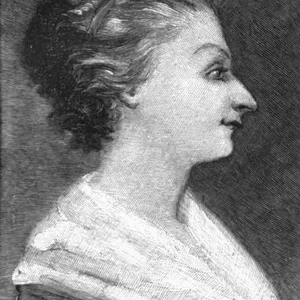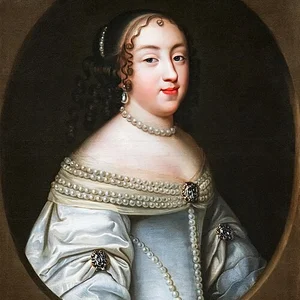

The daughter of the Marquise de Sévigné, she was the main recipient of her mother's famous correspondence. Her departure for Provence after her marriage in 1669 prompted the bulk of these letters, which became a monument of classical French literature.
Françoise-Marguerite de Grignan
Françoise-Marguerite de Sévigné, Countess of Grignan
5 min read
Frequently asked questions
Key Facts
- Born in 1646, daughter of the Marquise de Sévigné and Henri de Sévigné
- In 1669 married François Adhémar de Monteil, Count of Grignan, lieutenant general of Provence
- Her departure for Provence in 1671 sparked her mother's correspondence (~1,120 surviving letters)
- Presented at the court of Louis XIV, renowned for her beauty (nicknamed “the prettiest girl in France”)
- Died in 1705 in Marseille
Works & Achievements
Françoise-Marguerite is the principal recipient of the hundreds of letters from her mother, which form a masterpiece of French classical prose.
As a countess, she oversaw the social life and splendour of the Provençal residence, representing royal power alongside her husband.
As a young girl, she danced in the royal entertainments, where her beauty drew the attention of the king and the entire court.
By keeping her mother's correspondence, she helped, together with her own daughter Pauline, to pass on this literary treasure until its publication.
Anecdotes
Françoise-Marguerite was renowned for her remarkable beauty: at court, she had been nicknamed “the prettiest girl in France”. Her mother, the Marquise de Sévigné, was so proud of her that she lavished compliments about her throughout her letters.
When Françoise-Marguerite left to live in Provence after her marriage in 1671, her mother was so devastated by the separation that she began writing to her tirelessly. It was this grief at being apart that gave rise to one of the most famous correspondences in French literature.
Her husband, the Count of Grignan, was lieutenant general of Provence and represented the king in that region. Françoise-Marguerite therefore had to maintain an almost vice-regal rank at the Château de Grignan, hosting and organizing the social life of a genuine little court.
The Marquise de Sévigné worried greatly about her daughter's repeated and dangerous pregnancies, begging her in her letters to take care of herself. In those days, closely spaced childbirths gravely endangered women's lives, even noble ones.
It was largely thanks to her granddaughter, Pauline de Simiane (Françoise-Marguerite's daughter), that the Marquise de Sévigné's letters were preserved and then published in the 18th century, securing their immortality.
Primary Sources
My grief would be quite slight if I could portray it to you; I shall not attempt it. However hard I look for my dear daughter, I can no longer find her, and every step she takes carries her further from me.
It has been a long time since I told you that I love you, that I think of nothing but you, and that you are the sole occupation of my heart.
Love me always, then; it is the one thing I need to soften the bitterness of our separation.
Key Places
Françoise-Marguerite's birthplace, where she grew up alongside her mother and frequented fashionable salons before her marriage.
The Grignan family's Provençal residence, where Françoise-Marguerite kept an almost vice-regal style of living and where her mother came to join her.
The court of Louis XIV, where the young Françoise-Marguerite appeared as a dancer in the royal ballets and dazzled all with her beauty.
Capital of the parlement of Provence, where her husband carried out his duties as lieutenant general; the centre of the region's official and social life.
The collegiate church in the village of Grignan, where the Marquise de Sévigné rests, having died at the château beside her daughter in 1696.
Typical Objects

Sheets of paper covered in quill writing, folded and sealed, travelling by the royal post between Paris and Provence. The very medium of the bond between mother and daughter.

A small seal of hot wax pressed onto the fold of a letter to close it and guarantee it had not been opened. It often bore the family coat of arms.

A refined accessory for a lady of quality, made of painted silk or feathers mounted on ivory or mother-of-pearl sticks. Indispensable at court for poise and polite conversation.
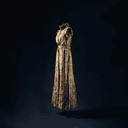
A rich court gown with a boned bodice and a full skirt over panniers, made of embroidered silk. The quintessential garment of noblewomen under Louis XIV.

A pen cut from a goose feather and dipped in an inkwell, the everyday writing instrument of the Grand Siècle. An essential tool for replying to her mother's letters.

A small mirror in a precious frame that ladies consulted while getting ready. The beauty of the Countess of Grignan was the object of every compliment.
School Curriculum
Vocabulary & Tags
Key Vocabulary
Daily Life
Morning
The Comtesse de Grignan began her day with a long toilette, assisted by her chambermaids who arranged her hair and dressed her. She often read the latest letters received from her mother and replied to them by pen.
Afternoon
The afternoon was divided between managing the household, receiving visits from the Provençal nobility, and the ceremonial obligations tied to her husband's rank as lieutenant general of Provence.
Evening
In the evening, the château gathered a select company for conversation, gaming, and sometimes music or theatre. There, people discussed the news from the court and from Paris.
Food
At the table of a great noble house, roasted meats, game, fish, fruits and Provençal preserves were served, accompanied by wines. Meals were occasions of prestige and sociability.
Clothing
She wore rich court gowns with a boned bodice, in embroidered silk, adorned with lace and jewels, with elaborate hairstyles. Her attire reflected her high rank and her famous elegance.
Housing
She lived at the Château de Grignan, a vast Renaissance residence overlooking the Provençal plain, furnished with tapestries, paintings, and precious furnishings worthy of a near-court.
Historical Timeline
Period Vocabulary
Liens externes & ressources
Références
Œuvres
Destinataire de la Correspondance de Madame de Sévigné
1671-1696
Gestion du château et de la cour de Grignan
1671-1705
Participation aux ballets de cour de Louis XIV
vers 1663-1668
Conservation des lettres familiales
fin du XVIIe siècle