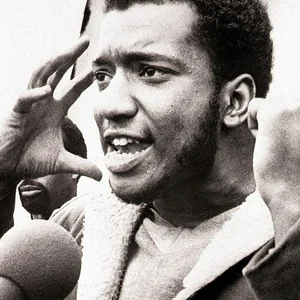

Fred Hampton (1948-1969) was an African American activist and chairman of the Illinois chapter of the Black Panther Party. A charismatic organizer, he founded the “Rainbow Coalition,” uniting several movements. He was killed at the age of 21 during a police raid, becoming a symbol of the repression of the civil rights movement.
Fred Hampton(1948 — 1969)
Fred Hampton
États-Unis
6 min read
Frequently asked questions
Famous Quotes
« You can kill a revolutionary, but you can't kill the revolution.»
Key Facts
- Born on August 30, 1948, in Chicago (Illinois)
- Becomes chairman of the Illinois chapter of the Black Panther Party in 1968
- Founds the “Rainbow Coalition,” a multiethnic alliance of labor and neighborhood movements
- Organizes social programs such as free breakfasts for children
- Killed on December 4, 1969, in Chicago during a police raid carried out with the assistance of the FBI (COINTELPRO)
Works & Achievements
Hampton developed this social program that fed hundreds of poor children every day. It embodied the idea that revolution came through concrete help to the people.
A multiethnic alliance bringing together the Black Panthers, the Puerto Rican Young Lords, and the white Young Patriots. A major political innovation uniting the oppressed across racial lines.
Hampton negotiated a ceasefire between rival gangs to turn their strength into political action. A demonstration of his exceptional talent as an organizer.
The establishment of free medical care and classes to train activists. These programs rooted the party in the daily life of the neighborhoods.
A famous address in which he declares that you can kill a revolutionary but not the revolution. A landmark text of 1960s militant oratory.
Anecdotes
At just 20 years old, Fred Hampton negotiated a historic truce between rival Chicago gangs. His idea was simple but bold: to transform the violence among young Black people into a unified political force against poverty and injustice.
Every morning, the free breakfast program he had set up fed hundreds of poor Chicago children before school. Hampton would repeat that “socialism starts with a full stomach.”
In 1969, Hampton founded the “Rainbow Coalition,” an unprecedented alliance bringing together the Black Panthers, the Puerto Rican Young Lords, and the Young Patriots, poor young white people from Appalachia. He wanted to prove that the struggle united the oppressed across the color of their skin.
The FBI considered him so dangerous that it infiltrated his inner circle with an informant, William O’Neal, who served as his bodyguard. The night of his death, O’Neal had provided the police with a detailed floor plan of his apartment.
Hampton was killed in his sleep on December 4, 1969, at the age of 21, during a police raid. The investigation later revealed that nearly all the shots came from the officers: his death became a global symbol of the repression of the Black movement.
Primary Sources
You can kill a revolutionary, but you can't kill the revolution. You can jail a freedom fighter, but you can't jail freedom.
I am a revolutionary. And you're going to have to keep on saying that until I'm dead.
We want freedom. We want power to determine the destiny of our Black community. We want full employment for our people.
The purpose of the program is to expose, disrupt, discredit, or otherwise neutralize the activities of Black nationalist organizations.
Key Places
Town in the Chicago suburbs where Fred Hampton was born in 1948. His family later settled in Maywood.
Western suburb of Chicago where Hampton grew up. He first became an activist within the NAACP youth council before joining the Panthers.
The party office from which Hampton ran the organization, the political education classes, and the social programs. The nerve center of his activism.
The home where Fred Hampton was killed in his sleep during the police raid of December 4, 1969. The site became a symbol of repression.
Liens externes & ressources
Références
Œuvres
Programme de petits-déjeuners gratuits pour les enfants (Illinois)
1969
Fondation de la Rainbow Coalition
1969
Trêve entre les gangs de Chicago
1969
Clinique médicale gratuite et cours d'éducation politique
1969
Discours « Power Anywhere Where There's People »
1969