
A French general of the Revolution and the Empire, Frédéric Henri Walther commanded the cavalry of the Imperial Guard. He distinguished himself in the major Napoleonic campaigns and was granted the title of Count of the Empire.
Frédéric Henri Walther(1761 — 1813)
Frédéric Henri Walther
France
8 min read
Frequently asked questions
Key Facts
- Born in 1761, he enlisted in the royal army before the Revolution
- He commanded the cavalry of the Imperial Guard under Napoleon I
- Created Count of the Empire by Napoleon Bonaparte
- He took part in the major Napoleonic battles, including Wagram (1809)
- He died in 1813 and did not live to see the fall of the First Empire
Works & Achievements
Walther organized and commanded for nearly a decade the elite cavalry of the Imperial Guard, notably the Chasseurs à cheval responsible for Napoleon's personal protection during all his major European campaigns.
Walther commanded Guard squadrons during Murat's charge at Eylau, one of the greatest cavalry charges in Napoleonic history with nearly ten thousand horsemen, which prevented France's total defeat against Russia.
During the disastrous Russian campaign, Walther and the Guard cavalry ensured Napoleon's protection during the advance on Moscow and throughout the grueling retreat under extreme climatic and logistical conditions.
Napoleon conferred upon Walther the title of Count of the Empire, enshrining his loyalty and services to the Imperial Guard and integrating him into the new military nobility of merit founded by the Emperor to replace the old aristocracy.
Anecdotes
Born in Strasbourg in 1761, Frédéric Henri Walther began his career in the royal cavalry under the Ancien Régime. The French Revolution, far from halting his rise, opened the door to an ascent based on merit alone — an exemplary path walked by many soldiers of modest origins whom the Revolutionary and Napoleonic wars propelled to the highest ranks of the army.
At the Battle of Eylau in February 1807, Walther took part in the legendary charge orchestrated by Murat — an offensive of ten thousand French cavalrymen launched through snow and Russian cannon fire to prevent a rout. This desperate charge, one of the most spectacular in Napoleonic history, allowed Napoleon to restore order on a devastating battlefield where bodies lay piled in the raging blizzard.
Walther commanded the Chasseurs à cheval of the Imperial Guard, the elite unit tasked with escorting Napoleon himself on every campaign. The role demanded the Emperor's absolute trust: the Chasseurs à cheval formed his last line of protection, at his side from dawn to dusk, instantly recognizable by their gold-embroidered green dolman.
Elevated to the rank of Count of the Empire, Walther embodied the principle of "rewarded merit" so dear to Napoleon. Unlike the old hereditary nobility of the Ancien Régime, his title flowed directly from his victories on the battlefield. In this way Napoleon forged a new aristocracy drawn from the people, whose legitimacy rested entirely on service rendered to France and the Empire.
Primary Sources
Walther appears in several march orders and dispatches of the Grande Armée among the commanders of the Guard cavalry, cited for their actions during the Prussian and Polish campaigns of 1806–1807.
The bulletin recounting the Battle of Eylau mentions the cavalry charge, in which the Guard squadrons under his command played a decisive role in restoring the French line of battle.
Archives held at Vincennes containing the service records, commissions, and decorations of Frédéric Henri Walther, from his enlistment in the royal cavalry through his death in December 1813.
Napoleon repeatedly evokes the loyalty and valor of his Imperial Guard generals, and in particular the cavalry commanders who ensured his personal protection during the most critical moments of his campaigns.
Key Places
Birthplace of Frédéric Henri Walther, born in 1761 in this Alsatian city on the Rhine. Strasbourg was home to many officers of Germanic origin who contributed to the military genius of the Grande Armée.
Napoleon's official residence and headquarters of the Imperial Guard. Walther, as commander of its cavalry, was regularly present at the Tuileries to ensure the Emperor's protection and take part in reviews.
Site of the brutal battle of February 1807, in what is now the Kaliningrad exclave. Walther commanded Guard cavalry units during the great charge that saved the French army from certain disaster.
The plain north of Vienna where the great battle against Austria was fought in July 1809. The Guard cavalry under Walther took part in the decisive operations that led to French victory and the Treaty of Schönbrunn.
The Russian capital reached by the Grande Armée in September 1812, then burned by the Russians themselves to deny the invader its resources. Walther and the Imperial Guard took part in this campaign, which marked the fatal turning point of the Empire.
Typical Objects

The primary weapon of the cavalry general, the curved saber delivered slashing blows at full gallop. A Guard general's saber was adorned with a gold guard and engraved with his coat of arms as a Count of the Empire.

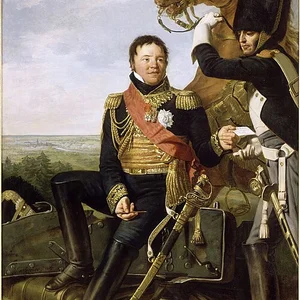
A magnificent uniform consisting of a dark green dolman embroidered in gold, a fur-lined pelisse worn slung over one shoulder, and a shako topped with a large red and green plume. Guard generals wore solid gold epaulettes indicating their rank.

A brass optical instrument that generals used on the battlefield to observe enemy movements at a distance and direct their troops with precision from an elevated vantage point.

Carried in holsters attached to the saddle, these pistols provided the cavalryman with close-range firepower. A Guard general typically owned a pair that was richly decorated and engraved.

An official document signed in Napoleon's own hand granting Walther the title of Count of the Empire — the highest of honors, serving both as a military distinction and as an entry into the new imperial nobility founded on merit.

The decoration created by Napoleon in 1802 to reward civil and military merit. Walther, as a general of the Imperial Guard, held one of its senior grades and wore the insignia on a ribbon slung across his uniform.
School Curriculum
Vocabulary & Tags
Key Vocabulary
Daily Life
Morning
The day of a Guard cavalry general began before dawn, especially on campaign. Walther inspected his squadrons at sunrise, checking the condition of the horses, harnesses, and weapons. Care of the mounts was the top priority: an exhausted or poorly shod horse meant a cavalryman out of action — something the Guard could not afford.
Afternoon
Afternoons on campaign were devoted to tactical movements, terrain reconnaissance, and staff meetings where Napoleon laid out his battle plans. In peacetime in Paris, Walther oversaw the exercises and maneuvers of the Guard cavalry on the plains around the capital, ceaselessly preparing his men for escort duties and combat.
Evening
In the evenings on campaign, Walther and his officers gathered around a bivouac fire for a frugal dinner — army bread, soup, and a ration of brandy to ward off the cold — before writing up reports and orders for the following day. In Paris, Guard generals frequented the salons and official dinners of the imperial regime, taking part in the pageantry of the Napoleonic court.
Food
On campaign, generals often shared in the hardships of their men: army biscuits, boiled meat, and spirits against the cold. After great victories, the Emperor held sumptuous banquets where Champagne wine and game rewarded his generals. The Russian campaign was marked by extreme privation: on some days, officers and soldiers alike ate horses that had frozen to death.
Clothing
Walther wore the magnificent uniform of a Guard cavalry general: a gold-embroidered green dolman, a fur-lined pelisse draped over the left shoulder, an embroidered shabraque on the saddle, solid-gold epaulettes, and a shako topped with a large plume. For routine duties, a grey-green greatcoat allowed greater discretion during reconnaissance. His gilded spurs and aiguillettes marked his rank as general.
Housing
In Paris, Guard generals lodged in private mansions in the neighborhoods near the Tuileries or the Faubourg Saint-Germain, usually equipped with stables for their service horses. On campaign, Walther occupied a staff tent or requisitioned the best house in whatever village they passed through — standard practice under Napoleonic military custom, where billeting with local inhabitants was commonplace.
Historical Timeline
Period Vocabulary
Liens externes & ressources
Références
Œuvres
Commandement de la cavalerie de la Garde impériale
1804-1813
Grande charge de cavalerie à Eylau
Février 1807
Protection de l'état-major impérial lors de la campagne de Russie
1812
Élévation au titre de comte d'Empire
1808