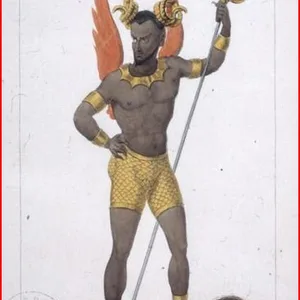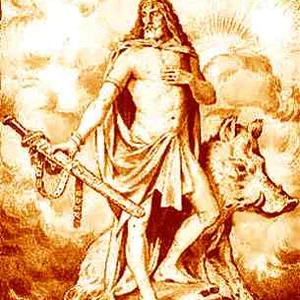

Freyr is one of the major deities of Norse mythology, belonging to the Vanir, gods of fertility and prosperity. Son of Njörðr and twin brother of Freya, he rules over Álfheimr and is invoked to ensure good harvests, peace, and abundance.
Freyr
Freyr
9 min read
Frequently asked questions
Key Facts
- Freyr is one of the Vanir gods, a divine group distinct from the Aesir (Odin, Thor), associated with fertility and prosperity
- He rules over Álfheimr, the realm of the light elves, a gift from the gods at his birth
- He possesses the golden-bristled boar Gullinbursti and the magical ship Skidbladnir, which can be folded up like a cloth
- He sacrificed his enchanted sword — capable of fighting on its own — to win the giantess Gerðr, which will leave him without a weapon at Ragnarök
- He is regarded as the mythical ancestor of the Swedish royal dynasty of the Ynglings, as mentioned in the Ynglingasaga
Works & Achievements
A divine union between Freyr and the giantess Gerðr, symbolizing the fertilization of the earth (the world of giants, cold and mineral) by the god of prosperity. This myth is interpreted as an allegory of the marriage of the sun with the earth.
Freyr received the kingdom of the light elves as his first tooth-gift, a unique honor attesting to his exceptional status among the gods. There he exercises a benevolent sovereignty over beings connected to growth and light.
The seasonal sacrifice rituals dedicated to Freyr structured the Scandinavian agricultural calendar, ensuring through offerings the protection of harvests and livestock upon which all of Norse society depended.
A poem from the Poetic Edda recounting in detail Skírnir's mission to Gerðr: charms, gifts, threats, and curses. It is one of the most fully developed and dramatically compelling love myths in Norse literature.
By giving his sword to Skírnir, Freyr performs an act that is at once heroic and fatally costly. His foretold death at the hands of Surtr is one of the most poignant prophecies of Ragnarök, illustrating the Norse theme of inescapable fate freely accepted.
Anecdotes
One day, Freyr dared to sit on Odin's throne, Hliðskjálf, from which all the worlds can be seen. His gaze fell upon Gerðr, a giantess of breathtaking beauty, daughter of the giant Gymir. He fell instantly in love, but this act of usurpation came at a heavy price: gripped by a deep sorrow, he refused to eat, drink, or sleep, to the point that his father Njörðr had to send his servant Skírnir to negotiate the union.
To win Gerðr, Freyr gave his messenger Skírnir his magical horse capable of riding through fire, and above all his enchanted sword — a weapon that fought on its own and never missed its mark. This sacrifice proved fatal: without his sword, Freyr would be slain at Ragnarök by the fire giant Surtr, forced to fight with nothing but an antler. The Norse gods knew that Freyr's fate was sealed from that very moment.
Freyr possessed a unique treasure: the ship Skiðblaðnir, forged by the Ívaldi dwarves. This extraordinary vessel could carry all the gods in full armor, filled its sails the moment it was unfurled regardless of the wind, and could be folded up like a simple cloth handkerchief to fit in a pocket. Snorri Sturluson mentions this ship in the *Gylfaginning* as one of the greatest masterpieces of dwarven craftsmanship.
In Uppsala, Sweden, the main temple dedicated to the Norse gods housed a particularly striking statue of Freyr: depicted with an erect phallus, he symbolized the fertility of the earth and the fecundity of men and animals. Every nine years, a great festival known as the Uppsala *blót* gathered thousands of worshippers who offered animal — and sometimes human — sacrifices to secure his favor and ensure good harvests.
The boar Gullinbursti (
Golden Bristles
)
Freyr
s mount
had been crafted by the dwarves Brokkr and Sindri during a famous contest of divine craftsmanship. Its bristles shone so intensely that they lit the night as brightly as day
allowing it to gallop faster than any horse. Freyr rode it in great processions and divine weddings
making the animal a symbol of prosperity and light throughout Scandinavia.
Primary Sources
Freyr, son of Njörðr, had one day seated himself on the throne of Hliðskjálf and looked out over all the worlds. He saw in the world of the giants a beautiful young maiden going from her father's dwelling to her own. At this sight, he was struck with great sorrow.
Freyr is the most glorious of the Æsir. He governs rain and sunshine, and with them the growth of plants on the earth. It is good to invoke him for good harvests and for peace. He also governs the prosperity of men.
Loki said to Freyr: "You gave away your sword, you who will have nothing to fight with when the sons of Muspell ride through the forest of Myrkviðr."
Njörðr of Ásgarðr had two children: his son was called Freyr, and his daughter Freyja. They were fair to look upon and full of power. Freyr was one of the most illustrious of the Æsir, and men invoked him for good harvests and peace.
In this temple stand three idols: Thor sits in the center of the throne, with Wodan and Fricco on either side. Fricco is depicted with an enormous phallus. He presides over marriages and bestows peace and pleasure upon men.
Key Places
The mythical realm of the light elves, given to Freyr at birth as a tooth-gift. He rules there as a benevolent sovereign over luminous beings deeply connected to nature and plant growth.
The primary center of worship dedicated to the Thor-Odin-Freyr triad in Scandinavia. The statue of Freyr there was depicted ithyphallic. Grand *blóts* drew thousands of pilgrims every nine years.
The original world of the Vanir, divine homeland of Freyr, Freyja, and Njörðr. After the war between the Æsir and the Vanir, Freyr was sent to the Æsir as a hostage and pledge of peace, bringing his culture of fertility with him.
The citadel of the Norse gods where Freyr settled after the exchange of hostages between the Vanir and the Æsir. It was from the throne Hliðskjálf that he caught sight of Gerðr and fell hopelessly in love, setting in motion one of the greatest Norse myths.
The world of the giants where Gerðr, the giantess Freyr fell in love with, made her home. Skírnir had to travel there at great peril, through flames and curses, to negotiate the union of two beings from opposite worlds.
Typical Objects

Freyr's divine mount, forged by the dwarves Brokkr and Sindri. Its golden bristles glowed in the dark and allowed it to run faster than any horse, making it a symbol of solar light and fertility.

A wondrous vessel crafted by the dwarves of Ívaldi, large enough to carry all the gods in full armor yet able to fold up like a pocket cloth. It represents the complete mastery over the natural elements that was granted to Freyr.

A unique weapon that would fight giants of its own accord the moment it was drawn. Freyr gave it to Skírnir in exchange for his help in wooing Gerðr, thereby tragically sealing his own fate at Ragnarök.

Statues and figurines of Freyr were depicted with a prominent phallic attribute, a direct symbol of the fertility of the land and of human and animal procreation that his worshippers called upon in his temples.

Stripped of his magic sword, Freyr must face Surtr armed with nothing but an antler at the final battle. This incongruous object stands as testament to the price of his divine choices and to the Norse theme of inescapable fate.

During *blót* ceremonies held in his honor, worshippers raised horns filled with beer or mead and solemnly offered vows of fertility, peace, and a good harvest to Freyr.
School Curriculum
Vocabulary & Tags
Key Vocabulary
Tags
Daily Life
Morning
Each morning, Freyr would traverse Álfheimr from his divine dwelling, watching over the sunrise and the dew that fertilized the meadows and forests. The light elves, his subjects, were busy from dawn tending to nature under his benevolent and protective gaze.
Afternoon
In the afternoon, Freyr might ride Gullinbursti, his golden-bristled boar, and journey through the nine worlds to observe the harvests of men and ensure the earth bore its fruits. He also received the prayers and sacrifices dedicated to him in Scandinavian temples.
Evening
In the evening, Freyr would feast with the other Aesir in the halls of Ásgarðr, drinking the gods' mead and joining in discussions about the fate of men and worlds. As the sun sank below the horizon, he would meditate on Gerðr and the price he had paid for her love.
Food
Like the other Norse gods, Freyr took part in divine feasts where roasted meat, fish, barley bread, and fermented mead were consumed. His connection to fertility made him the protector of the rye and oat harvests that concretely sustained the Nordic peoples.
Clothing
Freyr was depicted in texts and statuettes wearing ceremonial garments typical of Nordic nobility: a linen or fine wool tunic, a cloak fastened at the shoulder with a bronze fibula, and an ornate headdress. The Rällinge statuette (11th century) shows him bearded, seated in a fertility pose.
Housing
Freyr resided in Álfheimr, a luminous dwelling at the heart of the world of the elves. In Viking temples, he was represented by a large wooden or metal statue surrounded by offerings of food, animals, and precious objects that his worshippers placed before him in exchange for his protection.
Historical Timeline
Period Vocabulary
Liens externes & ressources
Références
Œuvres
Le mariage avec Gerðr — alliance du dieu et de la géante
Temps mythiques
Le don d'Álfheimr — règne sur les elfes de lumière
Temps mythiques
L'institution des blóts de fertilité (Freyfaxi)
Époque viking, VIIIe-XIe siècle
Skírnismál — le poème de la conquête de Gerðr
IXe-Xe siècle (mise par écrit vers 1270)
Le sacrifice de l'épée — préfiguration du Ragnarök
Temps mythiques