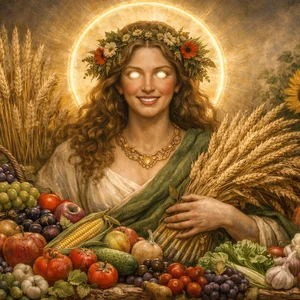

A primordial deity of Greek mythology, Gaia personifies the Earth Mother. Emerging from the primordial Chaos, she gives birth to Uranus (the Sky), the Mountains, and Pontus (the Sea). With Uranus, she bears the Titans, the Cyclopes, and the Hecatoncheires.
Gaia
Gaia
8 min read
Frequently asked questions
Famous Quotes
« “I am the Earth, mother of all gods and of all men.” (words attributed by Greek tradition)»
Key Facts
- Gaia emerges from primordial Chaos according to Hesiod's Theogony (c. 700 BCE)
- She gives birth alone to Uranus (the starry Sky), the Mountains, and Pontus (the Sea)
- United with Uranus, she gives birth to the twelve Titans, three Cyclopes, and three Hecatoncheires
- She conspires with her son Cronus to mutilate Uranus, whose tyranny she could no longer endure
- She is the mother of Typhon (with Tartarus), the last great monster to challenge the Olympian gods
Works & Achievements
Gaia is herself the cosmogonic act: her emergence from Chaos marks the first step in the creation of the world. By giving birth to Ouranos, the mountains, and the sea, she gives the cosmos its fundamental structure.
By uniting with Ouranos, Gaia brings forth the twelve Titans, who would become the ancestors of the Olympian gods. This divine generation is the first act of populating and organizing the Greek mythical world.
By forging this weapon and entrusting it to Cronus, Gaia orchestrates the castration of Ouranos and brings his tyranny to an end. This act frees the imprisoned Titans and opens a new cosmic age.
Gaia is the original owner of the Oracle of Delphi, which she passed successively to Themis and then to Phoebe before Apollo seized it. This oracle became the most important prophetic sanctuary in all of ancient Greece.
By sending the Giants and then Typhon against the Olympians, Gaia attempts to rebalance the cosmic forces. This twofold rebellion is a reminder that the Earth Mother never fully yields to an order imposed by the gods.
Anecdotes
According to Hesiod in the Theogony, Gaia arose spontaneously from the primordial Chaos, alongside Eros and Tartarus. She is one of the very first cosmic entities to exist, long before the gods of Olympus. Her appearance marks the passage from formless nothingness to a structured and habitable universe.
Gaia gave birth alone to Ouranos (the starry Sky), the mountains, and Pontus (the sea), then united with Ouranos to bring forth the twelve Titans, the Cyclopes, and the fearsome Hecatoncheires with their hundred arms. Fearing these powerful creatures, Ouranos imprisoned them at birth deep within Gaia's own body, causing her unbearable pain.
To take revenge on Ouranos, Gaia forged a sickle of adamant, an indestructible metal, and entrusted it to her son Cronus. He castrated his father, whose blood fell upon the earth and the sea: from those drops were born the avenging Erinyes, the Giants, and the Ash Tree nymphs — showing that even the most violent act can give rise to new forms of life.
Before Apollo wrested it from her, the oracle of Delphi belonged to Gaia. The Earth Mother delivered her prophecies there through vapors rising from the ground, guarded by the serpent Python. The Greeks regarded her as the first and most ancient of all prophetic powers, for the Earth herself knows every buried secret.
After helping Zeus defeat the Titans, Gaia turned against him, outraged that he had imprisoned them in Tartarus. She first sent the Giants, then the monster Typhon to overthrow the master of Olympus. This rebellion illustrates that even Zeus had to reckon with the primordial will of the Earth, which never fully bows to any imposed order.
Primary Sources
Verily, at first Chaos came to be; then wide-bosomed Earth, ever-sure seat of all the Immortals [...] And Gaia first bore, equal to herself, starry Heaven, to cover her on every side and to be an ever-sure abiding-place for the blessed gods.
Great Gaia, groaning, fashioned the grey metal of steel, made a great sickle, and showed it to her dear sons [...] Kronos, the most daring, took the jagged sickle and severed his father Ouranos's members.
I will sing of Earth, universal mother of deep foundations, the most venerable of all, who nourishes upon her soil everything that exists [...] It is you who give life to mortals, and it is you who take it back.
In the beginning Chaos alone existed; then arose Gaia, Tartarus, and Eros. Gaia first bore Ouranos her equal, to cover her entirely and to be an ever-sure abiding-place for the blessed gods.
My mother Themis, who is also Gaia — for she bears many names — had foretold me the outcome of these events, teaching me that it is not force nor violence, but cunning alone that must prevail.
Key Places
Before being consecrated to Apollo, the oracle of Delphi was the sanctuary of Gaia, where the Earth spoke through underground vapors. The Greeks considered this place the navel of the world, a meeting point between gods and men.
The mythical place from which Gaia emerged according to Hesiod, Chaos is described as a gaping void preceding all existence. It has no real geographical location, but represents the zero point of Greek cosmogony.
An underground abyss lying beneath the very bowels of Gaia herself, Tartarus is both her creation and her extension. It is where Ouranos imprisoned his children, and where Zeus would later confine the defeated Titans.
A sanctuary dedicated to Gaia stood in Athens near the Ilissos river. The Athenians venerated her as a protective goddess of the fertility of the fields, and the most solemn oaths were sworn by touching her earth.
A mountain created by Gaia herself as the dwelling of the gods, Olympus illustrates the fundamental relationship between Earth and Sky in Greek mythology — neither able to exist without the other.
Typical Objects

Forged by Gaia from the indestructible metal known as adamant, this sickle was the secret weapon she entrusted to Cronus to castrate Uranus. It symbolizes the Earth Mother's power to reclaim what she has given, even at the cost of a violent act.

As the nurturing Earth Mother, Gaia is associated with grain and harvests. Wheat grows from her body and represents her fundamental generosity toward the mortals who till her soil.

Serpents, which live in the earth and return to it, are Gaia's sacred animals. The Python of Delphi, guardian of her oracle, is the most famous example in Greek mythology.

This sacred conical stone discovered at Delphi was considered the "navel of the world" — the point of contact between Gaia and the earth's surface, where she delivered her prophecies through underground vapors.

A symbol of the earth's inexhaustible fertility, the cornucopia is Gaia's attribute as a nurturing deity who lavishes her riches — plants, fruits, minerals — upon mortals and gods alike.

Gaia is said to know the properties of every plant that grows upon her body. She notably gave Heracles a protective herb that granted him invulnerability during the Gigantomachy.
School Curriculum
Vocabulary & Tags
Key Vocabulary
Daily Life
Morning
In mythological tradition, Gaia 'awakens' with the dawn: it is the moment when dew moistens the earth and seeds begin to germinate. Greek shepherds and farmers offered their first prayers to the Earth-Mother before beginning their work, pouring libations of honey and milk directly onto the ground.
Afternoon
Gaia is present in every agricultural act of the day: plowing, planting, harvesting. Greek peasants asked her permission before turning the earth and consecrated their seeds in her name. The oracles at her sanctuaries interpreted the signs she sent — earthquakes, underground vapors, mysterious murmurings.
Evening
At dusk, Greeks gave thanks to Gaia for the day's harvest. Funerary rites were addressed to her, for the dead return to her womb. The most sacred oaths were sworn by touching the ground, calling Gaia as witness and thus guaranteeing their inviolable nature.
Food
As a primordial deity, Gaia does not eat like mortals — she is herself the source of all nourishment. Offerings intended for her consisted of firstfruits (the first fruits and first grain of the season), honey, and flour cakes mixed with oil, deposited in pits dug in the ground.
Clothing
In Greek iconography, Gaia is depicted as a majestic woman half-emerging from the earth, dressed in a green or brown chiton symbolizing vegetation. Her hair is often adorned with wheat ears, leaves, or serpents; some representations crown her with wheat or vine tendrils.
Housing
Gaia has no dwelling apart from herself — she is the universal home of all beings. Her depths — Tartarus — serve as a place of confinement for the Titans and monsters. Her earthly sanctuaries, such as that of Delphi or the megara (sacred pits) scattered throughout Greece, are the points where her presence is most perceptible to mortals.
Historical Timeline
Period Vocabulary
Liens externes & ressources
Références
Œuvres
La création du cosmos
Temps primordial (mythique)
La naissance des Titans et des dieux
Temps primordial (mythique)
La faucille d'adamant et la libération des Titans
Temps mythique — 1ère ère
La fondation de l'oracle de Delphes
Temps mythique (antérieur au VIIIe s. av. J.-C.)
La résistance à Zeus — la Gigantomachie et Typhon
Temps mythique — 3ème ère