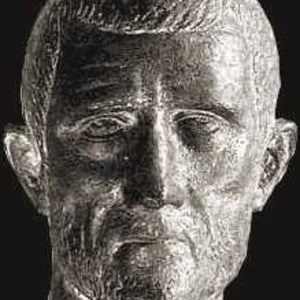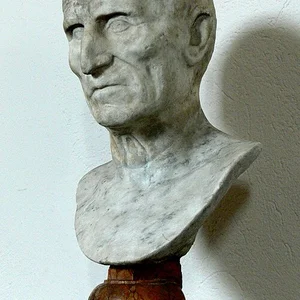

Galba was the sixth Roman emperor, in power from 68 to 69. An elderly former governor from the high aristocracy, he came to the throne after the fall of Nero but was assassinated after only seven months of rule, opening the Year of the Four Emperors.
Galba(2 av. J.-C. — 69)
Galba
Rome antique
6 min read
Frequently asked questions
Key Facts
- Proclaimed emperor in 68 after the revolt against Nero, succeeding the Julio-Claudian dynasty
- First of the emperors of the Year of the Four Emperors (68-69)
- Unpopular for his severity and his refusal to pay the donativum promised to the Praetorians
- Assassinated in January 69 at the instigation of Otho, his former ally embittered at not being named heir
- His reign and downfall are analyzed by Plutarch and Tacitus as an illustration of the instability of power
Works & Achievements
Accession to the supreme magistracy under Tiberius, marking his entry into the highest ranks of the senatorial career (cursus honorum).
Firm administration of a key province of the Empire; there he restored discipline and earned a reputation for strictness.
A long provincial command in Spain, a power base that allowed him to enter the race for the throne.
The overthrow of Nero and accession to the throne with the support of the Senate; he became the sixth Roman emperor.
An austerity policy aimed at restoring the finances ruined by Nero, which earned him the hostility of the soldiers and the people.
The public designation of an heir to secure the succession, a gesture that triggered Otho's revolt.
Anecdotes
Galba was nearly 71 when he became emperor, making him one of the oldest men ever to reach the throne. He was said to be so thrifty that he refused to pay the soldiers who had actually brought him to power, declaring the words that became famous: “I am accustomed to levy my soldiers, not to buy them.”
To seize power, Galba had to deal with the legate Vindex in Gaul and then win recognition from the legions of Spain. But his reputation for extreme severity was his undoing: he had several notables executed without trial and decimated a legion of marines, which quickly made him unpopular.
Galba's reign lasted only seven months. When he adopted the young Piso as his heir in January 69, he deeply offended Otho, who had hoped to be chosen. Otho then turned the Praetorian Guard against him.
Galba was assassinated in the middle of the Roman Forum on 15 January 69. According to Suetonius, soldiers caught up with him near the Lacus Curtius and cut his throat; his head was paraded on the tip of a pike before being bought back and returned to his servants.
Tacitus summed up Galba's fate in a judgement that became proverbial: he would have been deemed “capable of ruling had he never ruled” (omnium consensu capax imperii nisi imperasset) — that is, everyone would have believed him worthy of the throne if he had never tried to occupy it.
Primary Sources
By general agreement, he would have been deemed capable of ruling, had he never ruled.
“It is my custom to levy my soldiers, not to buy them”: such was his reply, which alienated the troops.
Galba showed himself virtuous on the whole, but his old age and his excessive trust in his freedmen ruined his authority.
Galba was struck down near the Lacus Curtius and finished off by the soldiers, his head carried away as a trophy.
Key Places
Region of Latium from which the Sulpicii Galba branch came. Galba was born into this ancient Italian aristocracy.
Capital of the province of Hispania Tarraconensis, which Galba governed under Nero. It was there that he was acclaimed emperor by his legions in 68.
The political heart of Rome where Galba was assassinated on 15 January 69, near the Lacus Curtius. A symbolic site of power and of his downfall.
Capital of the Empire where Galba settled after the fall of Nero to exercise power. He reigned there for only seven months.
Center of the province of Africa, which Galba administered around 45, reinforcing his reputation as a strict and disciplined governor.
Typical Objects

An ornate ceremonial garment, embroidered and dyed purple, worn during triumphs and by the emperor. It symbolized the supreme dignity of imperial power.

A gold coin struck in Galba's name, spreading his portrait and slogans throughout the Empire. Coinage served to legitimize the new ruler and to pay the troops.

The short sword of the Roman legionaries, the main weapon of the imperial army. It was with this blade that the Praetorians finally cut Galba down.

A military standard (signum) around which the emperor's personal guard rallied. The oath of the Praetorians made and unmade emperors.

A wreath woven from laurel leaves, worn by victorious generals and by emperors. It marked victory and the favor of the gods.

A kind of bed carried on men's shoulders, used by elderly Roman notables to move about the city. Galba, old and frail, used one to travel through Rome.
School Curriculum
Vocabulary & Tags
Key Vocabulary
Daily Life
Morning
An elderly emperor, Galba began his day with the salutatio, where clients and senators came to greet him. He then received his freedmen and advisers to handle affairs of state and read correspondence from the provinces.
Afternoon
The afternoon was devoted to audiences, judicial decisions, and meetings with military commanders. Known for being meticulous, Galba scrutinized the accounts and settled cases, often with a severity that worried those around him.
Evening
In the evening, the Roman aristocracy gathered for the banquet (cena), reclining on couches around low tables. The frugal Galba led a more austere life there than Nero had, which contrasted with the splendor expected of an emperor.
Food
The diet of the Roman elite combined bread, olives, cheeses, fruits, fish, and meats seasoned with garum (a fish sauce). Galba had a reputation for sobriety and was thought to dislike the luxuries of the table.
Clothing
He wore the toga, the garment of the Roman citizen, and, as emperor, the insignia of power: a purple toga and a laurel crown during ceremonies. For everyday wear, a woolen tunic served as the basic garment.
Housing
As emperor, Galba resided in the imperial palace on the Palatine Hill in Rome. These vast residences, richly decorated with marble, mosaics, and frescoes, overlooked the Forum and the city.
Historical Timeline
Period Vocabulary
Liens externes & ressources
Références
Œuvres
Consulat à Rome
33
Gouvernorat de la province d'Afrique
vers 45
Gouvernorat de l'Hispanie Tarraconaise
60-68
Prise du pouvoir impérial
68
Réformes financières et monétaires
68-69
Adoption de Pison Licinianus
10 janvier 69