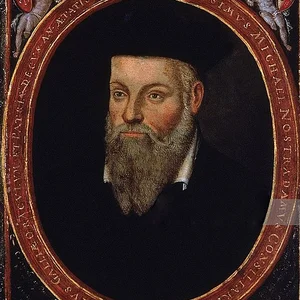

A French physician and apothecary of the Renaissance, Nostradamus is famous for his Centuries, a collection of prophetic quatrains first published in 1555. He was also a respected practitioner during plague epidemics.
Nostradamus(1503 — 1566)
Nostradamus
royaume de France
7 min read
Frequently asked questions
Famous Quotes
« Under the oak of Guyenne struck by lightning, far from there the hidden treasure is found.»
Key Facts
- 1503: Born in Saint-Rémy-de-Provence
- 1525: Receives his medical degree from the University of Montpellier
- 1546–1547: Fights the plague in Aix-en-Provence and Lyon, earning a great reputation
- 1555: Publication of the first astrological Centuries (prophecies in quatrain form)
- 1564: Appointed royal physician to King Charles IX
- 1566: Dies in Salon-de-Provence
Works & Achievements
A collection of 942 quatrains written in archaic French, organized into ten centuries of one hundred quatrains each. This is Nostradamus's major work, continuously reprinted to this day and translated throughout the world.
A practical guide to cosmetics and medicinal cooking, containing recipes for preserves, jams, and beauty preparations. It reflects the side of Nostradamus the physician and apothecary, attentive to everyday well-being.
A series of annual publications containing month-by-month astrological predictions, along with medical and agricultural advice. Widely circulated throughout France, these almanacs preceded the fame of the Centuries and provided Nostradamus with a steady income.
A translation and commentary on a text by the Greek physician Galen concerning hygiene. This publication confirms Nostradamus's grounding in the humanist medical tradition of the Renaissance.
Two prose texts framing the Centuries, in which Nostradamus outlines his prophetic method and astrological principles. These letters are essential documents for understanding his worldview.
Anecdotes
During the great plague epidemic that ravaged Aix-en-Provence in 1546, Nostradamus refused to flee and treated the sick with innovative remedies based on herbs and strict hygiene. His method, which rejected the traditional practice of bloodletting, earned him an extraordinary reputation and the gratitude of the city.
In 1555, Queen Catherine de' Medici, fascinated by his Centuries, invited Nostradamus to the court of Henry II. He was tasked with casting the horoscopes of the royal princes, which secured him the protection of the royal family and an official pension.
Nostradamus wrote his prophecies in deliberately obscure quatrains, mixing French, Latin, Greek, and Hebrew. He himself claimed to intentionally obscure his verses to prevent religious authorities from accusing him of witchcraft or heresy.
In 1564, King Charles IX, while traveling through France, made a special detour to visit Nostradamus in Salon-de-Provence. The king appointed him Physician and Ordinary Counselor to the King, a rare honorary title for a provincial practitioner.
Nostradamus reportedly predicted his own death to his secretary Jean de Chavigny: on the eve of his passing in July 1566, he allegedly told him, 'By sunrise, I shall no longer be here.' He was indeed found dead the following morning, on July 2, 1566.
Primary Sources
The young lion will overcome the old one, on the field of battle in single combat, he will pierce his eyes in a cage of gold, two wounds in one, then he dies a cruel death.
To make a robe of crimson velvet dyed in grain… take well-ground rock alum, boil it with clean rainwater.
Considering that the coming of common folk is cause enough for me to withdraw my pen to the quiet of the night, I have composed books of prophecies, each containing one hundred astronomical quatrains of prophecy.
To the most invincible, most powerful and most Christian Henry, King of France the Second: Michel Nostradamus, his most humble and most obedient servant and subject… These present prophecies shall in part be fulfilled.
The month of January will be cold and rainy with fierce winds… diseases will be widespread and universal across many regions of Christendom.
Key Places
Nostradamus's birthplace in Provence, where he was born in 1503 into a converted Judeo-Provençal family. The house where he was born is today a museum dedicated to his memory.
The renowned medical faculty where Nostradamus studied from 1522. There he acquired the foundations of humanist medicine and medical botany before setting out to treat plague victims.
The town where Nostradamus settled permanently after his second marriage in 1547, and where he wrote his Centuries. He died there in 1566; his tomb is still visible in the Collegiate Church of Saint-Laurent.
The city he helped save during the great plague of 1546, earning the gratitude of its inhabitants and consuls. This episode durably established his reputation as an exceptional physician.
Nostradamus was received at court in 1555 at the invitation of Catherine de' Medici, who had him draw up horoscopes for the princes. This visit cemented his fame throughout the kingdom.
Typical Objects

An astronomical measuring instrument used by Nostradamus to calculate the positions of celestial bodies. He based part of his prophecies on astrology, a discipline considered at the time to be a legitimate science in its own right.

Tables of planetary positions published each year. Nostradamus consulted them diligently to draw up horoscopes and almanacs, his main source of income before the fame brought by his Centuries.

Distillation apparatus and tools for preparing remedies from plants, minerals, and spices. Nostradamus was renowned for his anti-plague pills and his innovative cosmetic preparations.

The writing tools with which he composed his quatrains at night, as he himself described in the preface to the Centuries. He worked in his study in Salon-de-Provence by candlelight.

An antique-inspired three-legged stand mentioned in his own writings as a support for his visions. The reference to the tripod of the Pythia at Delphi connects him to the Greek prophetic tradition he claimed as his own.

A yearly prophetic publication that Nostradamus produced from 1550 onward, offering predictions for the coming year. These almanacs were hugely popular and provided him with steady income and recognition before the publication of the Centuries.
School Curriculum
Vocabulary & Tags
Key Vocabulary
Tags
Daily Life
Morning
Nostradamus rose early, often after a night of work in his study. Each morning he examined patients in a dedicated room of his house in Salon-de-Provence, prescribed his herbal remedies, and received visitors seeking horoscopes or medical consultations.
Afternoon
In the afternoons, he devoted himself to writing his almanacs or quatrains, preparing remedies in his apothecary workshop, and corresponding with his patrons. He sometimes received local dignitaries or messengers from the royal court.
Evening
Night was his time for prophetic work: seated before his bronze tripod, he composed his verses by candlelight, consulting his ephemerides and astrology texts. He slept little, convinced that visions came in the silence of the night.
Food
As a humanist physician, Nostradamus applied Galenic principles of balanced eating according to the four humors. He consumed plenty of vegetables, Provençal aromatic herbs, bread, fish, and moderate amounts of meat, accompanied by wine diluted with water. He recommended that his patients eat jams and honey-based preparations to ward off illness.
Clothing
Nostradamus wore the long black robe of Renaissance physicians and scholars, often fur-lined or padded depending on the season, along with a black square cap with four points. For audiences at the royal court, he dressed in finer woolen garments befitting his rank as royal counselor.
Housing
His house in Salon-de-Provence was a comfortable two-story bourgeois home that included a medical consultation room, an apothecary workshop stocked with dried herbs and alembics, and a study on the top floor — his famous 'secret study' mentioned in his own writings. The house also sheltered his large family: his wife Anne and their six children.
Historical Timeline
Period Vocabulary
Visual Style
Portrait de savant humaniste renaissance, en clair-obscur flamand, mêlant instruments scientifiques, livres ouverts et symboles astrologiques dans une palette chaude et sombre aux tons bourgogne et or.
Sound Ambience
L'atmosphère sonore du cabinet nocturne de Nostradamus à Salon-de-Provence : silence studieux ponctué du crissement de la plume, du crépitement du feu et des cloches de la ville endormie.
Liens externes & ressources
Références
Œuvres
Les Prophéties (Centuries)
1555-1558
Traité des fardements et des confitures
1555
Almanachs annuels
1550-1566
Paraphrase de C. Galen
1557
Lettre-préface à César et Épître à Henri II
1555-1558