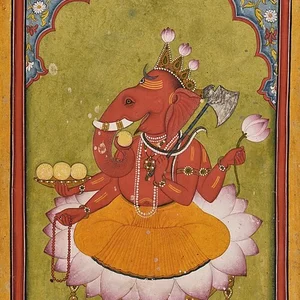

Ganesh is one of the most revered deities in Hinduism, instantly recognizable by his elephant head. Son of Shiva and Parvati, he is the god of wisdom, intellect, and success, and the “Lord of Obstacles,” invoked at the beginning of any new endeavor.
Ganesh
Ganesh
9 min read
Frequently asked questions
Key Facts
- Ganesh is mentioned in the Puranas composed between the 4th and 12th centuries CE
- He is depicted with an elephant head, a symbol of wisdom and memory in Indian tradition
- According to myth, his human head was replaced by an elephant's head on Shiva's orders
- He is invoked first in every Hindu ceremony, before any other deity
- Ganesh is also known as Vinayaka (the leader) or Ganapati (lord of the celestial hosts)
Works & Achievements
According to Hindu tradition, Ganesh served as the scribe for the sage Vyasa during the composition of one of humanity's greatest epics (more than 100,000 couplets). His participation symbolizes the union of divine wisdom and human intelligence in the service of transmitting knowledge.
One of the eighteen Upapuranas devoted entirely to Ganesh, recounting his four avatars, his mythological deeds, and the rituals of his worship. It stands as the foundational canonical text of the Ganapatya tradition.
A sacred text describing the eight cosmic forms of Ganesh (Ashtavinayaka), each associated with the defeat of a demon representing an inner obstacle of the human soul. It is the reference work for Ganeshian theology.
The oldest text associated with the figure of Ganapati, lord of the celestial hosts. Although the connection to the Ganesh of the Puranas is indirect, this hymn constitutes the Vedic root upon which all later theology was built.
A short Upanishadic text that identifies Ganesh with the absolute Brahman and the primordial sound AUM. Recited daily by millions of devotees, it synthesizes Ganeshian metaphysics by affirming that Ganesh is the ultimate reality of the universe.
Anecdotes
According to the Shiva Purana, Ganesh was beheaded by his own father Shiva, who did not recognize him upon returning from a long meditation and found him guarding the entrance to Parvati's chambers. Devastated, Parvati demanded that her son be brought back to life. Shiva sent his servants to find the head of the first sleeping creature with its head facing north: they found an elephant. Shiva placed this head on the boy and breathed life into him, making him a more powerful deity than before.
Tradition holds that the sage Vyasa asked Ganesh to write down the Mahabharata as he dictated it, without ever stopping. Ganesh agreed, but imposed a condition in return: Vyasa would have to dictate without pausing. When the reed he was using as a pen broke, Ganesh snapped off one of his own tusks to continue transcribing without interrupting the story. That is why he is almost always depicted with a broken tusk, a symbol of his devotion to knowledge.
One day, the gods offered a divine fruit to whichever of his two sons could circle the world first. Kartikeya, Ganesh's brother, mounted his peacock and flew off at full speed. Ganesh, perched on his humble rat, thought for a moment, then quietly circumambulated his parents Shiva and Parvati. He declared: “My parents are my entire universe; to walk around them is to circle the world.” He received the fruit, celebrating wisdom over speed.
According to the Brahma Vaivarta Purana, after a feast during which he had consumed a prodigious quantity of modak, Ganesh was riding his rat through the night when the serpent Vasuki crossed the path. The rat stumbled, Ganesh fell, and his overly full belly split open. He gathered up his sweets, sewed his abdomen back together using the serpent as a belt, and got back up. The moon, witness to the scene, burst out laughing. Furious, Ganesh hurled his broken tusk at it and cursed anyone who looked at the moon on the evening of Ganesh Chaturthi.
The Puranic texts grant him the dual title of Vighnesha and Vighnaharta — at once “the One Who Creates Obstacles” and “the One Who Removes Them.” This ambivalence is fundamental: invoked before any start of studies, a marriage, a journey, or a business venture, Ganesh can open the path to the virtuous or block it to those who act with recklessness or ill intent. This dual function makes him a figure of moral order as much as of divine benevolence.
Primary Sources
Parvati molded a human form from the sandalwood paste of her body and breathed life into it, asking him to stand guard. Shiva, not recognizing the child, confronted him and cut off his head. At Shiva's command, the ganas brought back the head of an elephant, and Shiva placed it on the child's body, granting him new life and primacy among the gods.
Brahma said to Vyasa: 'To write this poem, invoke Ganesha.' Vyasa meditated on Ganesha, who appeared at once. Vyasa said: 'Be my scribe to transcribe this poem, if you are willing.' Ganesha replied: 'I will do so, on condition that your dictation never stops.'
We invoke before all others Brahmanaspati, the great lord of sacred prayers, the one who, among the gods, shines brightest in wisdom. May he protect us, he who leads the celestial hosts.
Ganesha is the supreme master, the primordial Being, without beginning or end. He is Brahman itself, he is the sound AUM, he is the cause of all things. Those who worship him with devotion pass through all the obstacles of existence without hindrance.
There are eight forms of Ganesha corresponding to the eight obstacles of human existence: Vakratunda conquers pride, Ekadanta illusion, Mahodara attachment, Gajavaktra greed, Lambodara anger, Vikata lust, Vighnaraja crime, and Dhumravarna ego.
Key Places
A cosmic mountain in the Himalayas regarded as the divine abode of Shiva and Parvati, and thus the mythological birthplace of Ganesh. A supreme site of meditation, it stands at the center of Hindu, Buddhist, and Jain cosmology.
The first and foremost temple of the Ashtavinayak circuit (the eight sacred Ganesh shrines of Maharashtra), considered the paramount earthly residence of Ganesh. Millions of pilgrims visit it every year.
Rock-cut temples carved into red sandstone in the 6th–7th centuries by the Chalukya dynasty, housing some of the oldest and finest known sculptures of Ganesh, bearing witness to the spread of his worship across the Deccan.
A UNESCO World Heritage Site comprising 34 rock-cut temples (Hindu, Buddhist, and Jain) excavated between the 6th and 11th centuries; the Shaivite temples contain numerous monumental representations of Ganesh.
A temple founded in the 17th century, housing the tutelary deity of the city of Pune. It was from this city that Bal Gangadhar Tilak launched, in 1893, the transformation of Ganesh Chaturthi into a national public festival, making Pune the world center of modern Ganesha worship.
Typical Objects

A sweet rice dumpling filled with coconut and jaggery, the quintessential ritual offering and Ganesh's favorite food. He is typically depicted holding one in his hand or in a bowl, symbolizing the spiritual reward granted to devoted worshippers.

One of Ganesh's two tusks is always shown broken, recalling the sacrifice he made by pulling it out to use as a quill when transcribing the Mahabharata. It symbolizes self-sacrifice in the service of knowledge.

A guiding tool used by mahouts to direct elephants, held in one of his hands. It represents his power to steer the minds of devotees and lead them back onto the right path.

A rope or lasso that Ganesh holds in another hand, used to capture the obstacles, demons, and passions that hinder humanity's spiritual progress.

Ganesh's sacred vehicle (*vahana*), able to slip into every corner and into the hearts of men. It represents the human mind — quick, agile, and difficult to master — which only Ganesh's wisdom can tame.

The sacred flower symbolizing spiritual purity and the awakening of consciousness. Ganesh is often depicted seated on a lotus or holding one in his hands, underscoring his divine nature and his connection to the principle of creation.

A martial attribute present in certain depictions of Ganesh, symbolizing his power to sever the bonds of ignorance and cut through the karmic obstacles accumulated across past lives.
School Curriculum
Vocabulary & Tags
Key Vocabulary
Daily Life
Morning
In Hindu cosmology, Ganesh's day begins before dawn, when the first devotees light oil lamps and incense sticks in his temples. He presides in his serene aspect of Mangalamurti, 'auspicious image', receiving the prayers of those embarking on a new venture, a journey, or studies. His devotees offer him red flowers and freshly prepared modak.
Afternoon
In his role as Ganapati, 'lord of the ganas', Ganesh presides at midday over the assemblies of Shiva's divine servants, settling their disputes and maintaining cosmic order. It is also the time when he decides, according to each individual's merits, which obstacles to remove or place in the path of the mortals and devas who seek his intervention.
Evening
At nightfall, Ganesh rides his rat Mushika through the three worlds, observing human behavior and silently adjusting the course of destinies. On the evening of Ganesh Chaturthi (the fourth day of the month of Bhadra), candlelit processions carry his clay effigies to rivers and the sea, where they are immersed, symbolizing the god's return to the cosmos.
Food
Ganesh is famous for his prodigious appetite and his immoderate love of sweets. His canonical offering is the modak, a steamed rice dumpling filled with grated coconut and unrefined cane sugar. He also enjoys laddoo (chickpea flour and sugar balls) and fresh fruits, particularly banana and mango. His rounded belly — a symbol of prosperity and abundance — reflects this sacred fondness for sweets.
Clothing
Ganesh is most often depicted wearing a dhoti of bright yellow or saffron red silk, colors associated with auspiciousness and vital energy. His massive body, painted vermilion red or golden ochre depending on regional traditions, is adorned with heavy gold necklaces, bracelets, and diadems set with rubies and emeralds. An ornamental crown (mukuta) tops his elephant head, and a yajnopavita (sacred thread) crosses his chest.
Housing
Ganesh's mythological home is Mount Kailash, the cosmic mountain of the Himalayas where his parents Shiva and Parvati reside. But he is also present in every temple, every household niche, every entrance door that bears his effigy — for he is the guardian of thresholds. His dwelling is therefore both the summit of the celestial world and the threshold of every door crossed with devotion.
Historical Timeline
Period Vocabulary
Liens externes & ressources
Références
Œuvres
Le Mahabharata (transcription)
c. IVe siècle av. J.-C. — IVe siècle de notre ère
Ganesha Purana
c. IXe-XIe siècle de notre ère
Mudgala Purana
c. XIe-XIIe siècle de notre ère
Hymne védique à Ganapati (Rigveda II.23.1)
c. 1500-1200 av. J.-C.
Ganapati Atharvashirsa Upanishad
c. XIVe-XVIe siècle de notre ère