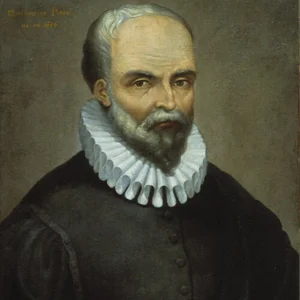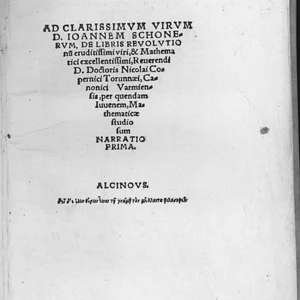

Austrian mathematician and astronomer of the Renaissance. Copernicus's only disciple, he published the Narratio prima in 1540, the first printed account of the heliocentric system, and persuaded his master to publish De revolutionibus.
Georg Joachim Rheticus(1514 — 1574)
Georg Joachim Rheticus
Saint-Empire romain germanique
6 min read
Frequently asked questions
Key Facts
- Born in 1514 in Feldkirch (Austria), died in 1574 in Kassa
- Became a professor of mathematics at the University of Wittenberg in 1536
- Joined Copernicus in Frombork in 1539 and became his only student
- Published the Narratio prima in 1540, the first printed presentation of the heliocentric system
- Considerable work in trigonometry: tables of the six trigonometric functions (Opus Palatinum, posthumous)
Works & Achievements
First printed account of Copernicus's heliocentric system, written in the form of a letter. It made the new astronomy known even before the publication of his master's great book.
Rheticus convinced Copernicus to publish and organized the printing in Nuremberg of the founding work of modern astronomy.
Treatise on trigonometry drawn from Copernicus's work, one of the first to present these tables separately from astronomy.
Tables of the six trigonometric functions, a pioneering work for the calculations of mathematicians and astronomers.
Monumental trigonometric tables calculated with unprecedented precision, completed and published after his death by his student Valentin Otho.
Tables of the positions of celestial bodies calculated according to the Copernican system, among the first to put heliocentrism into concrete practice.
Anecdotes
In 1539, the young Rheticus, a professor of mathematics at Wittenberg, left his Protestant post to go study with Nicolaus Copernicus, a Catholic canon in Frombork, Prussia. For a Lutheran, this journey to a Church astronomer was a bold move: he stayed there for nearly two years and became the only true disciple of the aging scholar.
In 1540, Rheticus published the *Narratio prima*, an open letter that presented to the public, for the first time in print, the system in which the Earth revolves around the Sun. Copernicus still did not dare publish his great book; it was the enthusiasm of his young student that finally convinced him to allow the *De revolutionibus* to be printed.
Rheticus never used his real family name: his father, a physician, had been convicted and executed for fraud, and the family lost the right to bear his name. The young Georg Joachim then took the name “Rheticus,” after Rhaetia, the Alpine region he came from.
Rheticus devoted much of his life to calculating immense trigonometric tables, with values of sine and cosine for every ten seconds of arc. This colossal work, the *Opus palatinum*, was so vast that it was not completed and published until 1596, more than twenty years after his death, by his student Valentin Otho.
Toward the end of his life, Rheticus settled in Hungary and then in Poland, and also took an interest in medicine, chemistry, and even astrology. Curious about everything, he remained above all faithful to the memory of Copernicus, whose work he had carried to the scholarly world of Europe.
Primary Sources
My teacher has written a work in six books in which, in imitation of Ptolemy, he has encompassed the whole of astronomy, demonstrating each point through mathematics and the geometric method.
I can easily imagine, Most Holy Father, that as soon as it becomes known that I attribute motion to the Earth, certain people will cry out that I ought to be condemned.
Tables of sines, tangents, and secants calculated for every interval of ten seconds of the quadrant.
Key Places
Rheticus's birthplace, in Vorarlberg, at the foot of the Alps. It was from neighbouring Rhaetia that he took his nickname.
The university that was the cradle of the Reformation, where Rheticus studied and then taught mathematics and astronomy.
The cathedral town where Copernicus lived; Rheticus stayed there for nearly two years as his only disciple.
The printing town where Rheticus arranged the publication of Copernicus's *De revolutionibus*.
The city where Rheticus settled for many years, practising medicine and pursuing his scientific work.
A town in Royal Hungary where Rheticus died in 1574.
Typical Objects

Circular brass instrument used to measure the altitude of celestial bodies and to determine the time or latitude. An essential tool for Renaissance astronomers.

A graduated quarter-circle instrument fitted with a plumb line, used to measure the angle of a celestial body above the horizon. Rheticus used one for his observations.

Long lists, first handwritten then printed, of values for sines, tangents and secants. Rheticus devoted years to them in order to make astronomical calculations easier.

A movable-type machine that allowed the *Narratio prima* and *De revolutionibus* to spread across Europe. Rheticus personally oversaw the printing of Copernicus's book in Nuremberg.

A model of the heavens made of metal rings representing the celestial circles. It was used to teach and to visualize the motion of the stars.

The scholar's writing tools, indispensable for composing letters, proofs and calculation tables by hand.
School Curriculum
Vocabulary & Tags
Key Vocabulary
Daily Life
Morning
At daybreak, Rheticus devoted his mornings to studying and teaching mathematics. In Wittenberg, he gave lessons to students; at Copernicus's home, he took notes and discussed astronomical calculations.
Afternoon
The afternoon was often spent bent over tables of figures, copying out and checking endless columns of sines and cosines. He also corresponded with other scholars across Europe through long letters in Latin.
Evening
When night fell, on clear evenings, he observed the sky with his instruments, noting the positions of the planets and stars. Winter evenings were also devoted to writing his books by candlelight.
Food
Like the scholars and townspeople of the Central European Renaissance, he ate rye bread, soups, vegetables, fish, and meat depending on the day. Wine and beer accompanied meals, since water was often unsafe to drink.
Clothing
Rheticus wore the long, dark robe of university scholars, along with a cap, a mark of his status as a professor. Beneath the robe, one wore a linen shirt, a doublet, and hose, following the fashion of the 16th century.
Housing
He lodged in university houses or with his hosts, such as Copernicus's canonical residence in Frombork. These stone or brick dwellings were heated by a stove and furnished with a work table, chests, and shelves of books.
Historical Timeline
Period Vocabulary
Liens externes & ressources
Références
Œuvres
Narratio prima
1540
Supervision de l'impression du De revolutionibus orbium coelestium
1543
De lateribus et angulis triangulorum
1542
Canon doctrinae triangulorum
1551
Opus palatinum de triangulis
1596
Ephemerides (éphémérides astronomiques)
1550