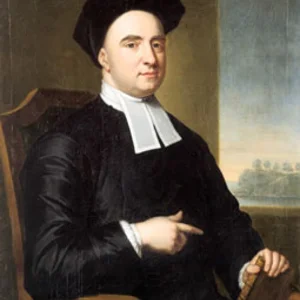

Irish Anglican philosopher and bishop, a major figure of British empiricism. He defended immaterialism, the doctrine that sensible things exist only insofar as they are perceived.
George Berkeley(1685 — 1753)
George Berkeley
royaume d'Irlande
6 min read
Frequently asked questions
Famous Quotes
« Esse est percipi (To be is to be perceived)»
Key Facts
- Born in 1685 near Kilkenny, Ireland
- Published in 1710 A Treatise Concerning the Principles of Human Knowledge, the statement of his immaterialism
- Brought out in 1713 the Three Dialogues between Hylas and Philonous
- Appointed Bishop of Cloyne in 1734
- Died in 1753 in Oxford; the city of Berkeley, California is named in his honor
Works & Achievements
Analyzes how the eye perceives distance, magnitude, and position. His first major work, it paves the way for the immaterialist thesis.
The central statement of immaterialism: only minds and their ideas exist, with no independent matter. This is where “esse est percipi” appears.
A restatement of immaterialism in the form of a lively, accessible dialogue, meant to answer objections and persuade a wide audience.
An essay criticizing Newton's notions of absolute space and force, anticipating certain ideas of modern physics.
A series of dialogues defending the Christian religion against free-thinkers, written during Berkeley's stay in America.
An attack on the logical foundations of Newton's and Leibniz's infinitesimal calculus, which spurred mathematicians toward greater rigor.
A singular work praising tar-water as a remedy, which gradually rises toward metaphysics and theology.
Anecdotes
To defend his immaterialism, Berkeley coined a phrase that has remained famous: “esse est percipi” (to be is to be perceived). According to him, a thing exists only insofar as a mind perceives it, which immediately raised the question: does a tree fall in a deserted forest? Berkeley answered that God, an infinite mind, perceives everything at all times.
It is said that the writer Samuel Johnson, irritated by Berkeley's thesis denying matter, gave a stone a great kick while exclaiming “I refute it thus!”. The anecdote, reported by the biographer James Boswell, has remained the textbook example of a bad objection: kicking the stone does not prove that it exists outside of all perception.
In 1728, Berkeley crossed the Atlantic with the dream of founding a college in Bermuda to train missionaries and educate the peoples of the New World. He settled for three years in Newport (Rhode Island) while waiting for the subsidies promised by the British Parliament, which never came: the project failed for lack of money.
Toward the end of his life, Berkeley became a fervent promoter of “tar-water,” a remedy made from pine tar that he believed capable of curing almost every illness. In 1744 he devoted to it an astonishing book, the *Siris*, which blends medical recipes with lofty philosophical speculation.
The city of Berkeley in California, and the university that makes it famous, owe their name to the philosopher. The name was chosen in 1866 in memory of a line by Berkeley on the westward march of civilization: “Westward the course of empire takes its way.”
Primary Sources
Their being (esse) consists in being perceived or known (percipi); so that it is impossible they should have any existence whatsoever outside the minds or thinking things that perceive them.
I do not deny the existence of sensible things, that is, of those I perceive by my senses; what I deny is the existence of a material substance distinct from perception.
Distance, of itself and immediately, cannot be seen. For distance being a line directed end-wise to the eye, it projects only one single point onto the bottom of the eye.
Tar-water, taken in a suitable quantity, is one of the safest and most effective remedies that can be applied to a great number of ailments.
Key Places
Region of County Kilkenny where Berkeley was born and spent his childhood. The Irish landscape left its mark on the future philosopher and bishop.
University where Berkeley studied and later taught, and where he developed his first major works on vision and knowledge.
Colonial town where Berkeley stayed from 1729 to 1731 while awaiting the funds promised for his college in Bermuda, which never came.
Small town of which Berkeley was the Anglican bishop from 1734 to 1752, dividing his time between pastoral duties and philosophical work.
University town where Berkeley retired in 1752 to live near his son, and where he died the following year.
Typical Objects

A staff curved like a shepherd's crook, the emblem of the spiritual authority of the bishop who guides his “flock” of faithful. Berkeley carried one as Bishop of Cloyne.

A writing instrument cut from a goose feather, dipped in ink to compose treatises and correspondence. All of Berkeley's works were written this way.

A vessel holding tar-water, a mixture of water and pine tar that Berkeley promoted as a universal remedy late in his life.

The holy book at the heart of the life of Berkeley the clergyman and bishop, whose philosophical thought remains inseparable from his Christian faith.

A sphere depicting the Earth, common in eighteenth-century studies, evoking Berkeley's missionary ambition toward the New World.

A long white wig, a sign of the respectability of the gentleman and clergyman in the eighteenth century. Berkeley wears one in his portraits.
School Curriculum
Vocabulary & Tags
Key Vocabulary
Daily Life
Morning
As a clergyman and later a bishop, Berkeley began his day with prayer and the reading of Scripture. Mornings were often devoted to study, to the writing of his treatises, and to correspondence with the scholars of Europe.
Afternoon
Afternoons combined pastoral duties — visiting parishioners, managing the diocese of Cloyne — with intellectual work. Berkeley also received learned men and discussed the new ideas of his century.
Evening
Evenings were spent reading, in scholarly conversation, or in family life, as Berkeley was married and a father. By candlelight, the talk turned to philosophy, theology, and the sciences.
Food
The diet of an eighteenth-century Irish gentleman was based on bread, meat, fish, vegetables from the garden, and beer. Toward the end of his life, Berkeley above all praised the virtues of his tar water.
Clothing
Berkeley wore the plain black dress of the Anglican clergy, completed by a white collar band and the customary powdered wig. As a bishop, he donned the liturgical ornaments for ceremonies and carried the crosier.
Housing
At Cloyne, he lived in the episcopal residence, a vast country house surrounded by gardens. During his stay in America, he lived on a farm near Newport, which he named Whitehall.
Historical Timeline
Period Vocabulary
Liens externes & ressources
Références
Œuvres
Un essai pour une nouvelle théorie de la vision
1709
Traité sur les principes de la connaissance humaine
1710
Trois dialogues entre Hylas et Philonous
1713
De Motu (Du mouvement)
1721
Alciphron, ou le petit philosophe
1732
L'Analyste
1734